

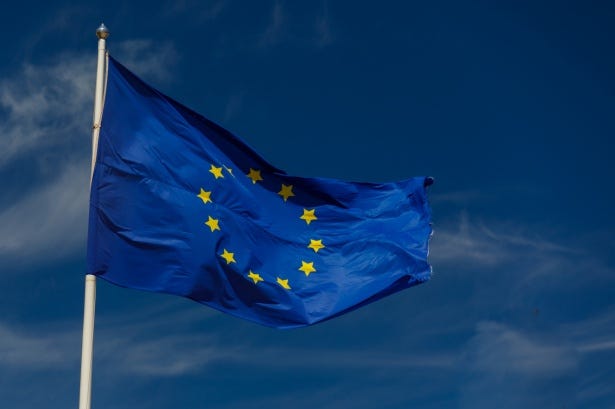
The European Union, this suis generis organization, has long prided itself on being a normative power, a champion of diplomacy, trade, and multilateralism. As a political experiment, the EU has experienced both progress and setbacks, having relied heavily on the U.S. for its defense since the end of WW II. This dependency has long positioned the EU as the junior partner in the transatlantic relationship. Yet in a world increasingly defined by hard power and strategic competition, a pressing question emerges: does the EU still matter and can it catch up?
A Trade Deal That Exposed the Limits
The latest EU-US Trade Agreement was presented as a transatlantic reset. In practice, however, the European leaders avoided a trade war with Washington by effectively bending the knee. Behind the diplomatic smiles, the body language of Ursula von der Leyen beside President Trump visibly reflected the underlying power imbalance. This agreement is seen as a victory for the U.S. and for President Trump, but it has also drawn significant criticism within the European Union. Many officials argue that the agreement is fundamentally uneven, disproportionately favoring U.S. interests at the expense of Europe’s strategic and economic autonomy.
More specifically, the agreement imposes high tariff-rate quotas (TRQs) on EU steel and aluminum exports, while offering only limited reciprocal access to U.S. markets. European producers fear long-term damage to their competitiveness, and Washington’s ability to secure such favorable terms has sparked frustration in Brussels. Also, it fueled debate over the EU’s inability to defend its industrial and strategic interests.
But perhaps this is more than a bad deal: it’s a reflection of the Union’s deeper structural weakness. We should not forget that the EU remains a union of sovereign states, marked by a fragmented decision-making process, slow response mechanisms, and a foreign policy constrained by the need of unanimity. In an era defined by speed, leverage and hard power, these limitations are becoming increasingly difficult to ignore.
A Model in Decline?
From Brexit and the rise of nationalist movements to energy dependency and demographic decline, Europe has been under internal strain for years. The Trade Deal serves as a mirror: it reflects a continent that has struggled to adapt to the pace and realism of 21st-century geopolitics. While the U.S. and China increasingly use trade as a tool of strategic influence, the EU remains anchored to rules-based ideals without the tools to enforce them. In this regard, a difficult question is emerging: Has the European model reached its peak?
The EU remains hostile against Russia over Ukraine. A visit of Ursula von der Leyen in Beijing, prior the meeting with the American President was disastrous for the Union, further narrowing its geopolitical room for maneuver. Consequently, in a fast-changing world, the EU found itself without alternatives and thus forced into agreeing with the U.S. on this trade deal. Officially the EU is acting as the junior partner in the transatlantic relationship without the power or the strategic autonomy to protect its own strategic interests. This is a reality that is widely seen by other global powers, who act accordingly. The humiliating reception of Ursula von der Leyen in Beijing stands a characteristic example. Symbolic of how the EU is now perceived on the global stage: divided, soft and unsignificant.
The Case for Reform
This deal should be treated as a wake-up call. The EU must reform, not just to survive, but to make it happen in a fast-changing world. Otherwise, the century of European humiliation is near.
Key priorities might include:
Establishing a truly common foreign and trade policy. This will allow the EU to negotiate as a truly unified and thus powerful entity that represents the interests of all its members.
Reducing dependency on external powers in critical sectors like energy, raw materials, and defense technology. It is time to strengthen European industries and prioritize intra-EU partnerships, even if it means excluding non-EU actors from strategic deals. Let’s not forget is the money of European taxpayers.
Creating faster decision-making frameworks capable of responding to crises and external pressures. However, the EU must abandon double standards and act as a responsible, and consistent global actor who is protecting the interests of its member states with credibility.
Reform is a herculean task. The EU has dozens of member-states with different strategic interests and priorities. National governments guard their sovereignty, and public trust in European institutions is fragile. Yet, despite those challenges, the cost of inaction is far greater for the EU and its member-states. Without reform, the EU risks becoming a regulatory empire with no political weight in global affairs.
A European Awakening?
Europe is not doomed but the whole European experiment is at a crossroads. The EU’s model of shared sovereignty and consensus-based governance must evolve, or it will be outpaced by more centralized and agile powers. The EU–US trade deal should be remembered not just as a poor agreement, but as a wake-up call. The future of the EU, in the era of Great Powers competition, rests on its own hands.
Insightful analysis! I'm afraid that the EU won't see fundamental reform, even though the costs of non-reform are higher than the costs of reform. Also because treaty changes require unanimity.