

Today, women in power are still the exception in world politics. Even in liberal democracies, the majority of parliaments, ministries and cabinets are dominated by men while the number of women leading countries is even smaller: 26 out of 193 countries have a female head of state or government. 9 out of 193 countries have at least 50% women in the national cabinet and 6 out of 193 countries have at least 50% in the national legislation according to the CFR’s Women Power Index. Even though the momentum in getting more women into leadership is positive and there’s been significant progress, still more need to be done. So, where do we stand today? And more importantly, is equal power between men and women achievable in the foreseeable future[1]?
Tracking Progress: CFR’s Women’s Power Index and UN Blueprint
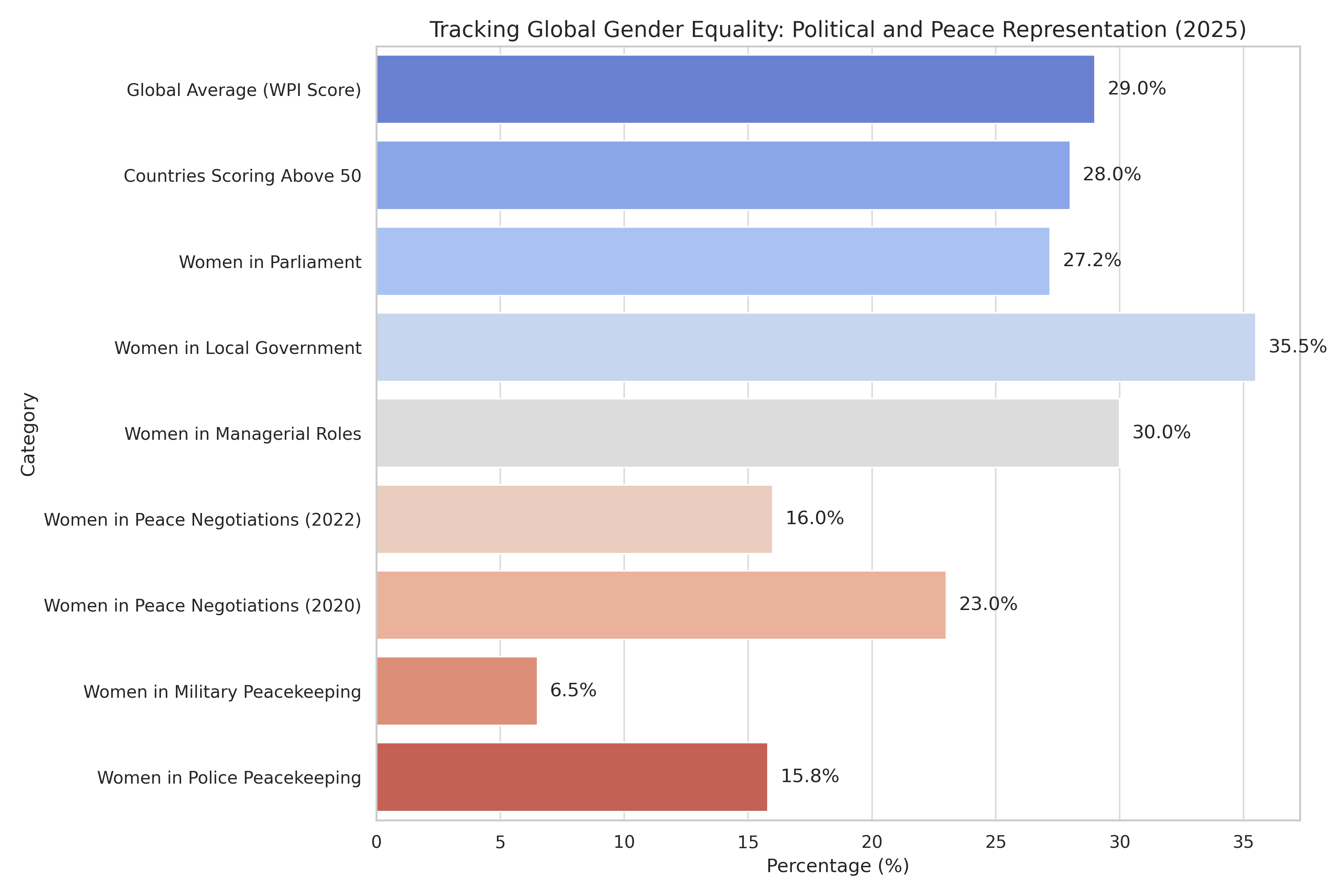
According to the Women’s Power Index, which was created by CFR’s Women and Foreign Policy Program, ranks 193 UN member states based on female representation in political office, including heads of state or government, cabinets, legislatures, and local councils. As of April 2025, the global average score was just 29 out of 100[1]. This translates in no improvement from 2024 as only 28 states managed to score above 50 while all the rest is behind.
Some states are leading the way. More specifically, Iceland tops the list scoring 86, while Mexico (75) and Andorra (73) are close. Additionally, there is slow but steady increase in elected women as head of states or governments in the last 25 years as 82 states have elected women as heads of state or government. However, global progress towards political equality has lost momentum over the last year.
Moreover, the United Nations codified gender equality through Sustainable Development Goal 5 Achieve gender equality and empower all women and girls, with Target 5.5 demanding equal participation in leadership and decision‑making in political, economic, and public life[2].
According to the UN’s 2025 SDG Progress Report:
Women occupy 27.2% of national parliament seats and 35.5% of local government seats.
Their share in managerial positions is rising slowly, just 30% as of 2023, climbing only 2.4 percentage points since 2015.
At the current trajectory, managerial parity won’t be achieved until around 2199, nearly 176 years from now[3].
The data reveals the truth: progress has been made but at current rates, SDG 5 ambition will remain unmet for decades, let alone by its 2030 deadline.
Power in Peace and Economics
Political Representation in elected office is only one part of the story. In UN‑led peace talks in 2022, women made up just 16% of negotiators, down from 23% in 2020[4]. In peacekeeping missions, women comprised only 6.5% of military personnel and 15.8% of police[5]. Economic inclusion also remains uneven. CFR ranking of 189 countries shows legal equality, access to jobs, credit, land, remains unrealized. Even the highest-ranked nations, like Australia (scoring 94.9), fall short in areas like protection from violence and equal pay[6].
Why is progress so slow? Despite decades of advocacy and international commitments, progress towards gender equality is slow. Several key barriers are responsible for that.
Outdated Laws: In 61 out of 131 monitored states, women still face legal restrictions that limit their access to equal employment opportunities. Shockingly, only 63 states have rape laws based on the principle of consent, and just 38 guarantee a minimum marriage age of 18 without exceptions[7].
Structural inertia and weak enforcement: Even where gender parity policies exist, they are usually not backed up by law. As a result, without legal force tends to fade. Quotas and enforcement mechanisms are either absent or symbolic. Consequently, political representation has stagnated in many parts of the world, with slow progress[8].
Backlash: To make matters worse, many states are going even backwards. In 2024, almost 25% of UN members states reported deteriorating in women’s rights. UN Secretary-General Antonio Guterres has warned of a growing poison of patriarchy which threatens reproductive rights, public safety and equal access to leadership[9].
Insufficient UN system reform: Even within the UN, efforts are failing short. The UN’s Gender Equality Acceleration Plan exists but its implementation is weak. The main agency, UN Women, remains underfunded while it is lacking the mandate to fully integrate gender equality across the UN System. Without structural reforms and proper resources, global leadership remains more rhetorical than a transformational reality.
Is 2030 Doomed or is there hope?
The next five years are crucial, but the current trend shows that no country is on track to truly achieve gender parity by 2030[10] as they are mentioned in UNSDG’s. However, there is still hope. Where progress is been made, it’s been driven by legal reforms, government accountability, inclusive public services, and enforced quotas. Those successes indicate that real change is possible but only when there is a willingness to action.
The Commission on the Status of Women’s 2025 declaration calls all the UN member-states for:
Develop and implement national plans to end violence against women.
Close persistent gender gaps in digital access and unpaid care work.
Engage men and boys as active allies in the fight for gender equality.
Proactively nominate women for top leadership roles, including the position of the UN Secretary-General.
Strategies that work
Achieving gender equality is a matter of political will and persistent effort. The strategies that have proven effective share one thing in common: the combination of bold policy with enforceable action. To accelerate global progress, the following steps are essential:
Mandate equality through the law. Eliminate discriminatory legislation and embed equal rights in areas like property ownership, employment, and legal protection. Equality must be a legal standard not just aspiration.
Enforce quotas with real consequences. Require gender parity in public office, corporate boards and UN Leadership. Back this with penalties for noncompliance and independent oversight to ensure progress is not just symbolic.
Address the economic imbalance of care. Unpaid caregiving continues to fall disproportionately on women. Solutions might include universal childcare, paid parental leave, and meaningful support for men’s equal participation at home.
Strengthen the UN’s ability to lead. Expand UN Women’s mandate and funding. Equip the whole UN system with clear gender-equality targets and the tools to track and enforce them.
Engage the private and civil sectors. — Incentivize companies to meet gender parity benchmarks. Support grassroots efforts and bring men and boys into the conversation.
With sustained political will and accountability, gender parity by mid-century is not just possible but within reach. Without it, inequality will continue to limit human potential and drag down economies for generations to come.
Conclusion
In conclusion, gender equality is yet to be achieved in the realm of world politics. The CFR’s Women’s Power Index gave the bigger picture: the political representation of women, in global scale, had slowed down significantly. To make matters worse, UN data projects that gender equality in world politics will be achieved in 2199 while women’s representation in peace and security positions will probably take longer. This is more than disappointing. 2199 obviously is far too distant to achieve something so fundamental as gender equality. Women are needed in leadership roles not just to balance the statistics, but gender diversity leadership leads to better decision making and thus better societies.
As mentioned in this paper, the part to gender equality is challenging as it requires political willingness and persistent enforcement. We are already heading in the second quarter of the 21st century and gender equality should be more reality than just rhetoric. We need to act because if we fail, we might reach 2100 with half of world’s population still excluded from leadership. Such a choice is simply unacceptable.
References
Council on Foreign Relations, Women’s Power Index, updated April 1, 2025.
Linda Robinson and Noël James, Women’s Power Index Shows Stalled Progress for Women’s Political Participation, CFR blog, April 3, 2025.
UN Department of Economic and Social Affairs (DESA), Sustainable Development Goal 5: Achieve gender equality and empower all women and girls.
UN Secretary-General, The Sustainable Development Goals Report 2025, July 14, 2025.
Council on Foreign Relations, Women’s Participation in Peace Processes, 2022 data.
Council on Foreign Relations, Top and Bottom Countries in Women’s Workplace Equality.
Associated Press, Confronting backlash against women’s rights, March 10, 2025.
Council on Foreign Relations, Renewing the Global Architecture for Gender Equality, 2022.
[1] https://www.cfr.org/tracker/womens-power-index?utm_source=chatgpt.com
[2] https://sdgs.un.org/goals/goal5?utm_source=chatgpt.com
[3] https://sdgs.un.org/goals/goal5?utm_source=chatgpt.com
[4] https://unric.org/en/sdg-5/?utm_source=chatgpt.com
[5] https://www.cfr.org/womens-participation-in-peace-processes/?utm_source=chatgpt.com
[6] https://www.cfr.org/legal-barriers/country-rankings/
[7] https://sdgs.un.org/goals/goal5?utm_source=chatgpt.com
[8]https://www.cfr.org/blog/womens-power-index-shows-stalled-progress-womens-political-participation?utm_source=chatgpt.com
[9]https://apnews.com/article/un-women-gender-equality-backlash-beijing-platform-2e4c0c31cb1e032b7dbd56c943d8bd0b
[10] https://sdgs.un.org/goals/goal5?utm_source=chatgpt.com
[1] Women’s Power Index of CFR and the UN’s Sustainable Development Goal 5
Few geopolitical analyses go beyond the headline numbers — yours does. That drop in women peace negotiators from 23% to 16% stopped me mid-read.
It suggests the real barrier isn’t in the laws anymore. It’s in how we unconsciously picture a leader — decisive, dominant, commanding. Women who fit that image get called aggressive. Women who don’t get called weak. There’s no winning position, and no amount of good intentions changes that without structural pressure.
Which is why your argument for enforced quotas lands. Not as a workaround — as the only thing that actually breaks the pattern.
Do crises make this worse — do even progressive systems quietly revert to type when security is at stake?