

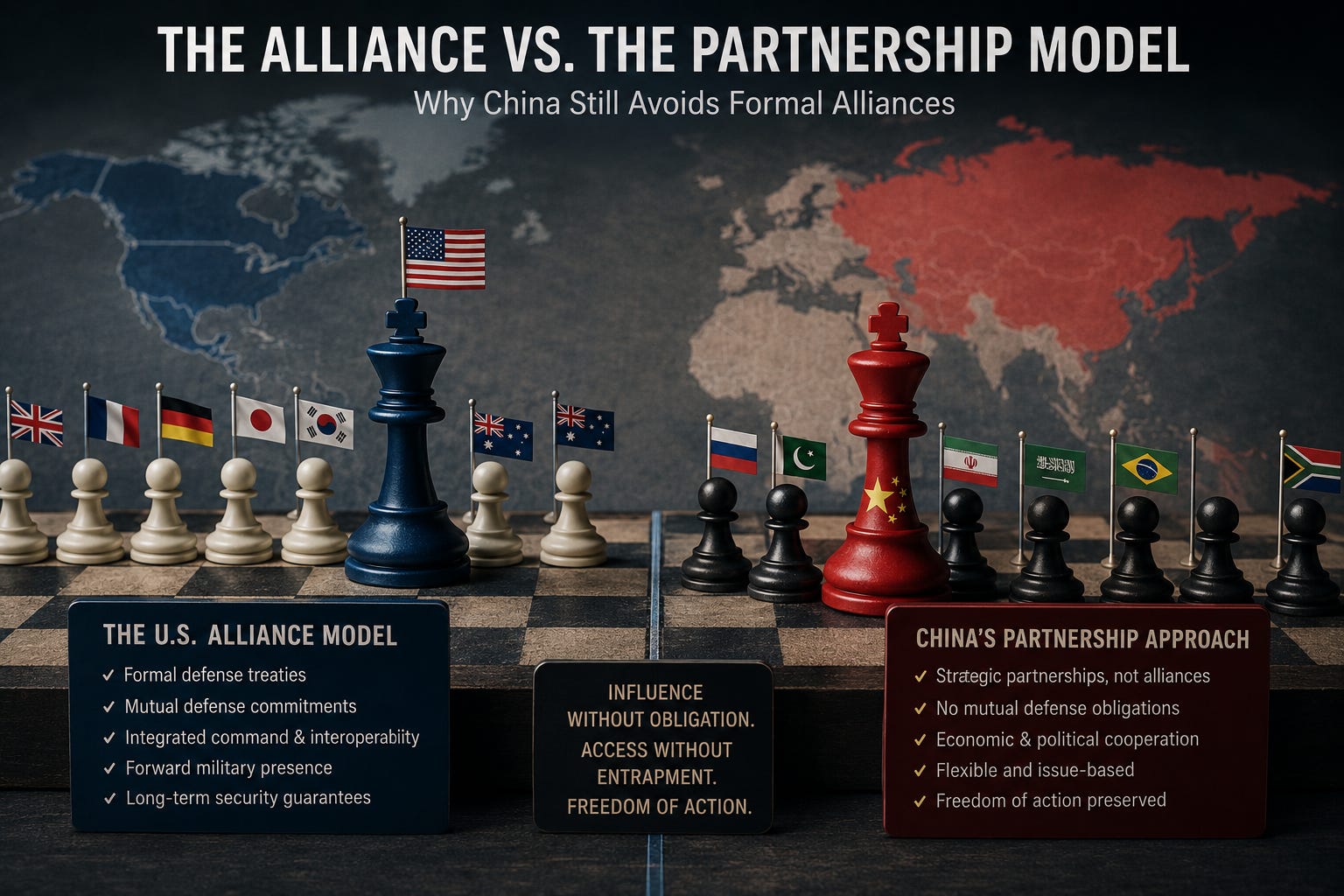
At first glance, China’s foreign policy presents a paradox. Beijing is the only power with the economic scale, industrial capacity, military modernization, and diplomatic reach to challenge the United States as a systemic rival. Yet unlike Washington, it has not built a global network of binding military alliances.
Washington has been operating via formal defense treaties, forward military bases, alliance commands, interoperability, and long-term security guarantees. Beijing, however, has chosen a different approach to expand its influence. The mix includes strategic partnerships, infrastructure projects, political coordination, economic and trade dependence, military exercises, multilateral forums, but not legal commitments which would require China to defend another state in case of war. In other words, China has been avoiding alliances like NATO and especially clauses like NATO’s chapter 5.
This is a deliberate strategic choice. Beijing does not want to reproduce the American alliance system because it does not see that system only as a source of strength, but also as a structure of obligation, exposure, and potential entrapment. China wants partners, not allies in the strict legal sense, leverage without automatic commitments, influence without shared command, access without dependency. Above all, it wants freedom of action.
Thus, the main question is not why China has failed to create a NATO of its own but why Beijing would want one at all.
The U.S. Alliance Model and China’s Different Logic
One of the pillars of American global dominance is the country’s alliance architecture. NATO, arguably the most successful military alliance in history and one of the core Washington’s alliances, is still a part of a larger system. That said, Washington maintains treaty alliances with Australia, Japan, South Korea, Thailand, the Philippines, alongside other security partnerships in Europe, the Indo-Pacific and the Middle East. This system offers Washington access, intelligence networks, legitimacy, military interoperability, political and economic influence and forward deployment.
Washington perceives alliances as multipliers of its power, overcoming the limits of geography. Through its alliances, the U.S. forces have consecutive presence in Europe, the Pacific, the Middle East and East Asia, far beyond the continental United States. This extended system of alliances and partnerships has allowed the U.S. to shape regional balance according to their national interests and prevent crises before becoming direct threats. However, this system has also created political expectations since the American allies depend heavily on the U.S. protection which the U.S. depends on their cooperation and alignment. The recent war in the Middle East has shown the limits of dependence for both the U.S. and its allies.
China on the other hand perceives the alliance system differently. For the Chinese policy makers, the American alliances are not neutral security arrangements but they are instruments of containment, specifically in East Asia. In this regard, the U.S. forces in South Korea and Japan, the U.S.-Philippines alliance, the AUKUS, the QUAD, the 5 Eyes, are perceived as part of a broader system built to contain the Chinese expansion especially in the Beijing maritime perimeter. Thus, the Chinese rhetoric of “bloc confrontation” is not mere propaganda but a reflection of a real strategic concern: Chinese rise is happening within a region where the U.S. has already established an extended alliance network. Nonetheless, China is not trying to copy the U.S. but it has chosen a different, more flexible approach by forming strategic partnerships without including any defense commitments.
GeoSec Insights is a reader-supported publication. To receive new posts and support my work, consider becoming a free or paid subscriber.
China Has Partners, Not a Real Alliance System
The absence of formal alliances does not mean that China does not have close relations with other powers. First and foremost, Beijing has a close partnership with Moscow. Additionally, China has a relationship with Pakistan, deep economic ties across the Global South, growing influence in parts of Africa and the Middle East, and institutional roles in forums such as the Shanghai Cooperation Organization and BRICS. Finally, China has only one formal defense treaty, inherited from the Cold War, with North Korea.
All the aforementioned partnerships are not by any means equivalent to NATO or the U.S.-Japan alliance:
They do not create a unified command system,
They do not bind China to defend multiple partners automatically,
They do not require Beijing to station large permanent forces across allied territory,
They do not place Chinese security policy inside a shared alliance structure.
However, China’s partnerships are useful because they are politically broad and legally limited:
They allow China to cooperate with Russia without inheriting all of Russia’s risks.
They allow China to support Pakistan without being trapped in every India-Pakistan crisis.
They allow China to engage Iran, Saudi Arabia, Israel, the Palestinians, and Gulf states without formally choosing one side in all regional conflicts.
They allow China to present itself as a mediator when convenient and as a great-power counterweight when necessary.
This is the core of the Chinese model: maximum diplomatic space with minimum formal obligation.
The Historical Lesson: The Sino-Soviet Split
One of the reasons behind the Chinese approach is historical. More specifically, China’s alliance with the Soviet Union, in the early stages of the Cold War, started as the ideological partnerships between the two communist powers. Soon it turned into a lesson about dependance, mistrust and hierarchy. The later split indicated to the Chinese leaders that ideological alignment is not enough to keep an alliance especially since one part is treated as a lesser partner (in this case the Soviet Union treated China as not an equal partner). Consequently, the Sino-Soviet relationship deteriorated into hostility with military clashes along the borders.
This experience had a deep impact on Chinese strategic thinking by enforcing the suspicion that formal alliances can limit freedom of action and thus reduce sovereignty. The powerful ally can become a patron, constraint and eventually a threat. This is why China’s post-Mao foreign policy placed such strong emphasis on independence: Beijing’s official language regarding an independent foreign policy of peace is not just rhetorical but it reflects the conclusion that China should avoid being subordinated to another power’s strategy. China does not want to be the junior partner in anyone else’s alliance and or become responsible for the survival of weaker states.
Strategic Flexibility as a Source of Power
China’s preference for non-alliance diplomacy gives it room to maneuver. Usually, a formal alliance requires a specific and thus predictable behavior. Formal alliances create credibility tests for the most powerful member of this alliance: If an ally is attacked, the patron must respond or risk damaging its reputation. This can strengthen deterrence, but it can also pull a great power into crises it did not choose.
China wants to avoid this problem: It does not want to be forced into a war because of another country’s decision. Moreover, it does not want to risk its economic development, military modernization, or domestic stability for the automatic defense of a partner. The Chinese leaders understand that the country’s power still depends heavily on economic performance, export capacity, technological upgrading, energy security, and internal control. A rigid alliance system would reduce Beijing’s ability to calibrate its responses.
The latter is of crucial importance in the contemporary geopolitical environment. China faces pressure from the U.S., tensions over Taiwan, maritime disputes in the South China Sea and East China Sea, technological restrictions, supply-chain realignment, demographic challenges, and a slowing growth model. In this context, Beijing does not need more automatic risks but instead flexible options which are provided by partnerships not formal alliances.
Sovereignty and Control
Another important aspect of the Chinese non-alliance strategy is related to the Chinese Communist Party (CCP) obsession with control. Thus, the CCP’s reading of modern Chinese history is shaped by the “Century of Humiliation,” which was the result of foreign intervention, unequal treaties, territorial fragmentation, and external pressure. Whether one accepts this narrative fully or not, it remains central to the way Beijing explains its security behavior.
Formal alliances usually require coordination, intelligence sharing, interoperability, joint planning, and foreign military access. For the U.S., this is normal alliance management but for China, it creates discomfort. Beijing neither wants foreign militaries embedded in its security architecture nor outside partners influencing its decision-making. Of course it does not want its own military to depend on allied consensus.
This is one reason China criticizes the U.S. alliance system so strongly. Beijing argues that American bases and security guarantees undermine the sovereignty of host nations and divide regions into hostile blocs. Of course, this criticism serves Chinese interests, but also it reflects China’s own preference: Beijing wants influence over others without accepting equivalent influence over itself.
Russia: Partnership Without Alliance
Today’s Sino-Russian relationship is the clearest example of Beijing’s alliance model. The two powers share opposition to U.S. dominance, criticize Western sanctions, conduct military exercises, cooperate diplomatically, and promote a more multipolar international order. Their relationship has become much closer since the war in Ukraine and the deterioration of Russia’s relations with the West.
Nonetheless, China has still avoided a formal military alliance with Russia. China benefits from Russia as a strategic partner because Moscow distracts the West, challenges NATO, supplies energy, and supports China’s broader argument against the U.S.-led order. At the same time, China does not want to inherit Russia’s war in Ukraine. It does not want to be legally tied to Moscow’s military decisions. It does not want to sacrifice its economic relations with Europe, the Global South, or parts of the international financial system for Russia’s objectives.
The relationship is therefore close but bounded. China wants Russia strong enough to weaken Western pressure, but not so powerful or reckless that it drags China into a wider confrontation. This is partnership as strategic utility, not alliance as shared destiny.
North Korea: The Exception That Proves the Rule
China’s treaty relationship with North Korea is the major exception, but even this exception reveals the limits of Chinese alliance behavior. Beijing does not want North Korea to collapse because collapse could bring instability, refugees, loose weapons risks, and potentially a U.S.-aligned Korea closer to China’s border. In this regard, North Korea serves as a buffer zone between China and the American forces stationed in South Korea. However, Beijing is uncomfortable with North Korea’s provocations, nuclear program, and unpredictability.
China wants stability on the Korean Peninsula, not an uncontrolled crisis that could force Beijing into a direct confrontation with the U.S. and its allies. In this sense, North Korea is not a model for China’s future alliance system but rather a historical burden China manages because geography leaves Beijing few easy alternatives.
The SCO, BRICS, and the Alternative to Alliances
The Chinese model is not isolation but not NATO-style alliance building. For instance, the Shanghai Cooperation Organization offers to Beijing the stage for security dialogue, deep cooperation on critical issues like counterterrorism and political coordination in Eurasia. BRICS offers Beijing a broader stage, focused on the global south, for diplomacy, economic cooperation and criticism regarding Western dominance. The Belt and Road Initiative (BRI) is the tool used by China to spread its influence across Asia, Africa, Europe, and the Middle East via infrastructure.
These mechanisms let China shape the international environment without building a collective defense system, and they allow Beijing to work with states that are even openly hostile to one another. India and Pakistan both sit within the SCO. Iran, Saudi Arabia, Russia, and China participate in overlapping forums without becoming formal allies, which is an arrangement a military alliance could not accommodate.
The Chinese approach is therefore more political than legal, more transactional than ideological, and more flexible than institutional. Beijing is trying to build influence in a world where many states want alternatives to Western dominance but do not want to become Chinese satellites.
The Current Geopolitical Situation
The current geopolitical environment makes China’s strategy both more consequential and more difficult to execute. The U.S. is moving beyond its reliance on traditional alliances, forming overlapping coalitions serving primarily Washington’s national interests. In this regard, the Quad is not NATO, nonetheless is becoming more operational. Moreover, AUKUS is not a universal Indo-Pacific alliance, but it strengthens military-technological coordination among the U.S., the U.K., and Australia. Japan has been increasing its defense spending significantly while the Philippines has expanded defense access for U.S. forces. India remains formally non-aligned, but it is also deepening cooperation with Washington and other partners when it serves Indian interests.
This is the real challenge for Beijing. Washington has been using formal alliances and flexible coalitions to contain China. In this regard, the American strategic advantage is not only the established formal alliances like NATO or bilateral treaties but the ability to form networks around specific challenges: semiconductors, rare earths, shipping routes, undersea cables, military basing, cyber defense, and maritime surveillance.
China’s partnership model gives Beijing freedom, but it does not always produce reliable support in a crisis. Thus, many states want Beijing as their trade partner or want Chinese investment but fewer want to be locked into a confrontation with the U.S.. This is the structural weakness of China’s approach: it can create influence and alignment but not always loyalty and commitment.
Could China Change Course?
China could move towards a more formal alliance model if the pressure from the U.S. and its allies rise. A crisis in Taiwan or a military incident with the U.S. forces could push Beijing toward a more formal security cooperation with its current partners.
However, this would be a major shift of the Chinese strategic thinking, not just a continuation of current policy. Additionally, it would carry costs: A formal Sino-Russian alliance would alarm the EU, India, Japan and many states in SE Asia. A tighter China-Iran cooperation would expose Beijing to the unstable Middle East while a creation of a military bloc with Pakistan would deepen tensions with India and damage the image of China of a peaceful and responsible world power.
At the moment, China seems to prefer ambiguity. It wants the political benefits of anti-U.S. alignment without the legal burdens of alliance commitments. It wants Russia, Iran, Pakistan, and other partners to complicate American strategy, but it does not want to become responsible for all of their risks. In other words, the Chinese support is real but not unconditional while it serves the interests of Beijing.
Strategic Assessment
The Chinese approach to alliances is an indicator of how Beijing understands power. In this regard, China is expanding its influence via economic weight, technology and infrastructure, strategic partnerships and selective coercion. This approach offers flexibility since it allows China to engage rival states simultaneously while it reduces the risk of entrapment. Consequently, China can present itself as the responsible power which rejects the Cold War era monolithic blocs, keeps total control over its strategic movements and exploits the anti-Western alignment.
However, this approach has its own limits. During a crisis, China might discover that partners are not equals as allies. That said, Russia will support China rhetorically, but its own military, technological, political, and economic constraints will eventually limit what it can actually offer. On the other hand, Pakistan is an important partner but at a regional level since it counters India. Additionally, Iran - a regional power still surviving the U.S.-Israeli attacks by causing severe damage to the U.S. military installations and the energy infrastructure in the region, cannot be seen as a crucial partner to China. Finally, numerous global south states welcome Chinese investments and diplomatic support but they are actually navigating between China and the U.S. since they do not choose to go against Washington directly.
This is the central tension in China’s strategy. The current Chinese approach has served the Chinese interests especially today in the era of strategic competition where both the U.S. and China are trying to rewrite the global rules to better serve their national interests. However, if the competition escalates to a direct military conflict, this approach might not serve the Chinese interests.
Conclusion
China does not avoid formal alliances because it is weak, but because it perceives rigid alliances as liabilities. The Sino-Soviet split taught Beijing that even ideological partners can turn into constraints. Watching Washington taught it that alliances extend power but also create obligations, credibility tests, and entanglement.
Beijing’s model is deliberate: no NATO-style bloc, no automatic defense commitments, no foreign say over Chinese security decisions. Instead, a wide network of flexible partnerships that supports its rise, complicates U.S. strategy, and preserves its freedom of action.
China’s alliance problem is ultimately not about doctrine but about what kind of great power Beijing wants to be. The U.S. built an order around allies while China is building influence around autonomy. Whether that model survives a major crisis is one of the defining questions of the decade.
I would be interested to hear your thoughts on this issue.
Thank you for reading GeoSec Insights. I research geopolitics, international security, war, and shifts in global power to understand the deeper forces shaping events beyond the daily headlines. If this analysis helped you see the issue more clearly, please consider sharing it with someone who may also find it useful.
References
Australian Government, Department of the Prime Minister and Cabinet. “Joint Leaders Statement on AUKUS.” March 14, 2023.
Liff, Adam P. “China and the US Alliance System.” The China Quarterly 233 (March 2018): 137–165. doi:10.1017/S0305741017000601.
Lüthi, Lorenz M. The Sino-Soviet Split: Cold War in the Communist World. Princeton, NJ: Princeton University Press, 2008.
Ministry of Defense of Japan. “Press Conference by Defense Minister Koizumi on Tuesday, December 2, 2025, at 2:29 PM.” December 2, 2025.
Ministry of Foreign Affairs of Japan. “Japan-Australia-India-U.S. (Quad) Leaders’ Meeting.” September 21, 2024.
Ministry of Foreign Affairs of Japan. “Treaty of Mutual Cooperation and Security between Japan and the United States of America.” Washington, DC, January 19, 1960.
Ministry of Foreign Affairs of Pakistan. “Joint Statement between the People’s Republic of China and the Islamic Republic of Pakistan.” May 26, 2026.
Ministry of Foreign Affairs of the People’s Republic of China. “Chinese and Russian Heads of State Exchange Messages of New Year Greetings; Chinese Premier and Russian Prime Minister Exchange Messages of New Year Greetings.” January 2, 2025.
Ministry of Foreign Affairs of the People’s Republic of China. “Position Paper of the People’s Republic of China for the Summit of the Future and the 79th Session of the United Nations General Assembly.” September 20, 2024.
Ministry of Foreign Affairs of the People’s Republic of China. “Xi Jinping Exchanges Messages of Congratulations with General Secretary of the WPK and President of the State Affairs of the DPRK Kim Jong Un on the 65th Anniversary of the Signing of the China-DPRK Treaty of Friendship, Cooperation and Mutual Assistance.” July 11, 2026.
North Atlantic Treaty Organization. “The North Atlantic Treaty.” Washington, DC, April 4, 1949.
Shanghai Cooperation Organisation. “Charter of the Shanghai Cooperation Organization.” Saint Petersburg, June 7, 2002.
Shanghai Cooperation Organisation. “Dushanbe Declaration on the 20th Anniversary of the SCO.” September 17, 2021.
State Council Information Office of the People’s Republic of China. The Belt and Road Initiative: A Key Pillar of the Global Community of Shared Future. Beijing, October 2023.
United States Department of Defense. “Philippines, U.S. Announce Four New EDCA Sites.” February 1, 2023.
Union of Soviet Socialist Republics and People’s Republic of China. “Treaty of Friendship, Alliance and Mutual Assistance.” Moscow, February 14, 1950. United Nations Treaty Series 226. The treaty and its UNTS location are also identified in the U.S. Department of State’s official historical record.
Zhang, Ketian. “Alliances with Chinese Characteristics? The Contents and Rationale of China’s Strategic Partnerships.” International Politics 63 (2026): 386–421. doi:10.1057/s41311-025-00701-0.
Zhang, Feng. “China’s New Thinking on Alliances.” Survival 54, no. 5 (2012): 129–148. doi:10.1080/00396338.2012.728350.