

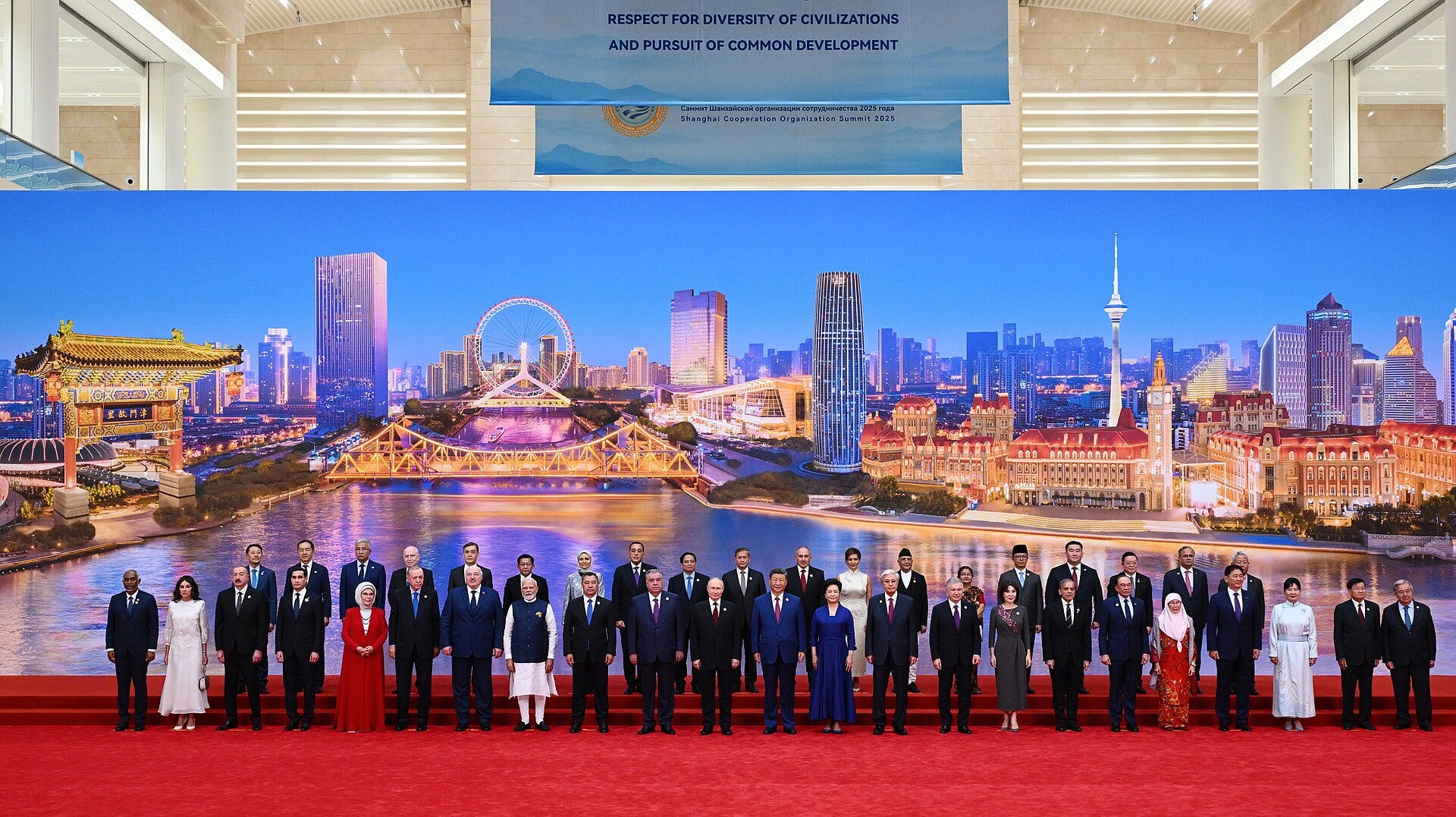
At the end of August, China brought world leaders to Tianjin for the biggest SCO summit in history, followed days later by a grand military parade in Beijing. The timing was not an accident. Beijing’s aim is to be perceived by the international community as a responsible leader of a new multipolar order. Yet the real test is whether spectacle can translate into substance.
On August 31st and September 1st more than 20 world leaders gathered at the northern port city of Tianjin for the Shanghai Cooperation Organization (SCO) summit, hosted by the Chinese President Xi Jinping. This was the largest meeting in the history of SCO, which was founded in 2001. Some days later, Beijing staged its grand military parade marking the 80th anniversary of the end of World War II.
Together, these two events are more than ceremonial. They are carefully orchestrated signals of how China wants to be seen: not only as a regional power, but as a global shaper of order at a time when the international system is unstable.
The SCO in Tianjin: A Platform for Multipolarity
The SCO has evolved far beyond its origins as a Eurasian security club. Today, it consists of a total of 26 countries, 10 of which are full members, observers, and dialogue partners stretching from East Asia to Africa. That said, the SCO members represent 23% of global GDP and approximately 43% of world’s population (3,5 billion people). This year’s summit drew more than 20 heads of state and 10 international organizations, including Russia’s Vladimir Putin, India’s Narendra Modi, UN Secretary-General António Guterres, and ASEAN’s Kao Kim Hourn.
For China, hosting such a lineup was a diplomatic win. The Chinese message was clear: stability. Even in a turbulent geopolitical environment, Beijing retains the ability to convene, attract, and command attention, presenting itself as the responsible global power ready and capable of leading the new multipolar world order.
However, the Summit was not only about optics. Chinese officials have hinted at a series of new initiatives, ranging from economic cooperation and digital governance to proposals for strengthening security coordination. The idea was to present the SCO as a counterpoint to Western-led institutions, a forum where sovereignty, non-interference, and development first principles take precedence over the liberal values promoted in Brussels or Washington.
This is where China’s intention lies. By embedding its vision of international order into the SCO’s agenda, Beijing aims in shaping the narrative of multipolarity and aligning it with Chinese national interests.
Xi Jinping’s Moment -Key Takeaways from the Summit
President Xi delivered keynote speeches and unveiled measures to constructively safeguard the post-war international order, a telling phase. In this regard, China strategic objective is to reshape from within the American system build after 1945, carving out greater legitimacy for alternative centers of power.
Deeper regional integration for a multipolar world. President Xi urged member states of the SCO, including Russia, Iran, and India, to seek integration, not decoupling, and become a cornerstone in building an orderly multipolar world, rejecting power politics. Additionally, he introduces a new Global Governance Initiative (The Washington Post).
Dismission to aggressive state behaviors and Cold War rhetoric. Furthermore, President Xi criticized unnamed countries, obviously implying the United States, for exhibiting bullying behavior and strongly called on SCO nations to resist Cold War–style bloc politics and embrace multilateralism (thetimes.co.uk).
Creation of an SCO development bank and loan offers. Also, President Xi proposed the establishment of an SCO development bank while he pledged approximately US $1.4 billion in loans over the next three years to SCO members (The Washington Post).
Cooperation in AI, energy and financial infrastructure. President Xi unveiled an AI cooperation center for SCO nations while he revealed his plans for an international energy cooperation platform, positioning technology and infrastructure as central to the bloc’s governance and development agenda (Reuters).
SCO’s responsibility for regional peace and development. President Xi also emphasized that the SCO should bear greater responsibility for maintaining regional peace, fostering consensus, and enhancing cooperation for the entire region’s development (Reuters).
Obviously, each of these initiatives promotes Beijing’s agenda. It is clearer than ever that China is stepping in as the leader of the Global South while consolidating its influence in Eurasia, the very heartland that classical strategists from Mackinder to Brzezinski saw as decisive for global dominance.
The Modi Variable
Among all the guests, Indian Prime Minister Narendra Modi was probably the most politically significant. Relations between Beijing and New Delhi soured dramatically after the deadly border clash in 2020. Yet Modi’s presence, the first in China in seven years, signals a recalibration between the two Asian giants.
But why now? Partially because the American policy against India. More specifically, President Trump’s aggressive tariffs and protectionist rhetoric have strained India’s access to U.S. markets. That makes China a more attractive economic partner, even if strategic distrust remains due to border disputes which have been settled with negotiations.
For Beijing, this is a strategic opportunity as it is luring India back into a more balanced position between the U.S.-led West and the Sino-Russian axis. On the other hand, for India, it is a delicate gamble, as it tries to balance in the great power rivalry era. How this balance plays out in Tianjin will be closely watched in East and West.
A Parade with a Message
Immediately after the summit, China rolled out tanks, supersonic missiles, and fighter jets on the streets of Beijing for the Victory Day parade. At first glance, the two events seemed different, one diplomatic, the other military, but their sequencing was intentional.
The Summit gave Beijing a stage to demonstrate consent as dozens of leaders endorsing China’s convening power. The military parade then projected capability: the hard power muscle behind the soft power choreography. Together, they reinforced the image of a global power which is not only integrated into the global system but also capable of defending its vision of order.
This mix of consent and capability is the classic language of Great Powers. Beijing wants to be seen not as a restless challenger on the sidelines, but as a shaper of the system itself, with allies to call on, institutions to lead, and armies to project its military strength.
The Risks Behind the Spectacle
Despite the impressive SCO Summit Beijing is facing real challenges to its ambitions.
Unity Is Fragile. The SCO is a diverse institution, with competing interests. While U.S. tariffs brought closer India and China, New Delhi resists joint defense initiatives that blur into anti-Western positioning. Additionally, Central Asian states worry about overdependence on China. Even Russia, Beijing’s closest partner, has its own agenda on Eurasian leadership while its focused-on Ukraine (AP News).
Global Perceptions. China can convene dozens of leaders, but many attend out of necessity rather than conviction. Economic gravity draws them to Beijing, yet few are willing to formally align themselves against the West. The more China frames the SCO as anti-hegemonic, the more some members may hesitate (AP News). Once again, anti-Americanism, or antiwesternism in general, is insufficient to shape a pole capable in transforming the world order towards multipolarity.
Domestic Challenges. China is facing real challenges at home. Slowing growth, demographic decline and aging population, and growing public frustration force the CCCP to seek external victories which can boost the prestige of the government and enhance its legitimacy among the Chinese people. In this case, diplomacy might become a tool of domestic policy pursing impressions instead of realistic solutions (Financial Times).
Overreach. Beijing has chosen to pair the SCO Summit with its military parade as it seeks to demonstrate its military capabilities to its close partners. However, this move is risky as it confirms the western perception of China as an aggressive and revisionist power. The latter could be used mainly by the U.S. to reinforce its containment strategies against China (The Guardian).
Chinese Playbook
China’s week of diplomacy is best understood as a strategic rehearsal: testing how far it can push the SCO as a vehicle for multipolar governance, how much credibility it can project as leader of the Global South, and how effectively it can use symbolism to offset structural weaknesses. The SCO summit in Tianjin will not alter the global balance overnight. But it matters in three ways:
It shows that Beijing still has convening power even as tensions with the U.S. deepen.
It reveals China’s ability to intertwine soft power (multilateral summits) with hard power (military strength though the parade) into a single narrative.
It highlights the real shift of many significant powers, like India, towards China which is now the protector of global trade and development.
Conclusion
To conclude, China’s has revealed its intentions in the global stage. Beijing’s aim is to cement the SCO as a stage where China actually sets the rules, projects leadership, and contrasts its inclusive multipolar order against what it calls Western hegemonism.
There is a clear opportunity for China to persuade many world leaders, who perceive themselves as the Global South, to follow its leadership. Nonetheless, there are some real risks. SCO’s unity is fragile because the member states have different agendas and interests while China might be perceived as a militaristic and aggressive power.
In the end, this “Chinese week” may not be remembered for what is agreed in Tianjin or what is rolled out in Beijing. It will be remembered for how clearly it revealed China’s vision of power in the 21st century: a capable protector of the world order built by the U.S.
A last note, but an important one. The Chinese military parade was impressive, and many have drawn comparisons with the American display just months ago. But let’s be clear: Wars are not won by military parades no matter how impressive they appear. What truly matters is battle readiness and here lies the difference, in my opinion. The U.S. commands an armed force which is tested, prepared and unmatched. China on the other hand has not face a real enemy on the battlefield for decades. So let’s not jump into conclusions.
Super thanks for pulling this together. All important one stop read of the event.