

The rearmament of Japan and Germany
Key Takeaways
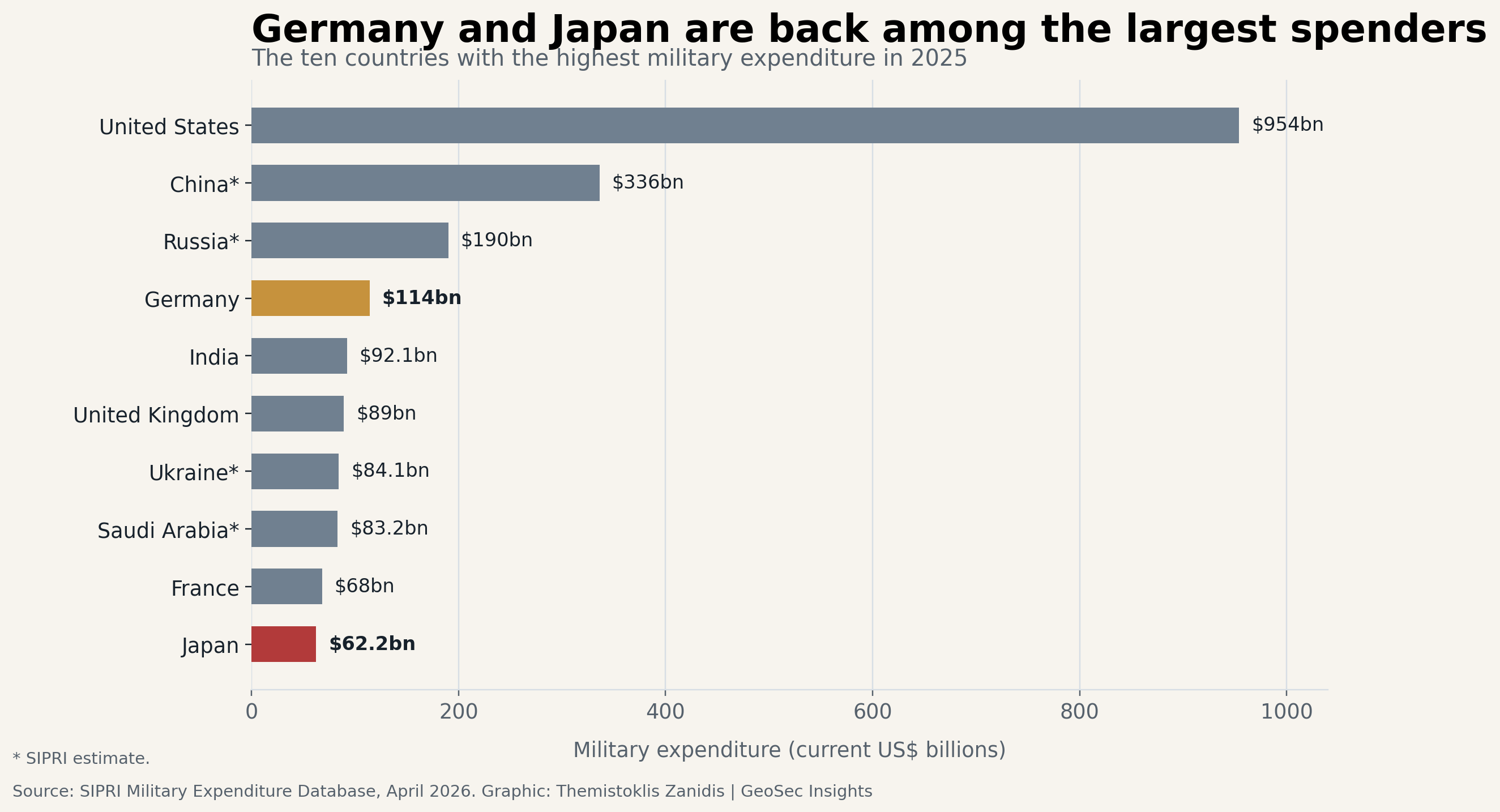
Japan and Germany, the two major defeated powers of World War II, are no longer insignificant military actors. According to the latest SIPRI’s publication (2025 data), Berlin is the world’s fourth-largest military spender while Tokyo is the tenth largest. This fact suggests how far the post-1945 security order has shifted (Liang et al. 2026).
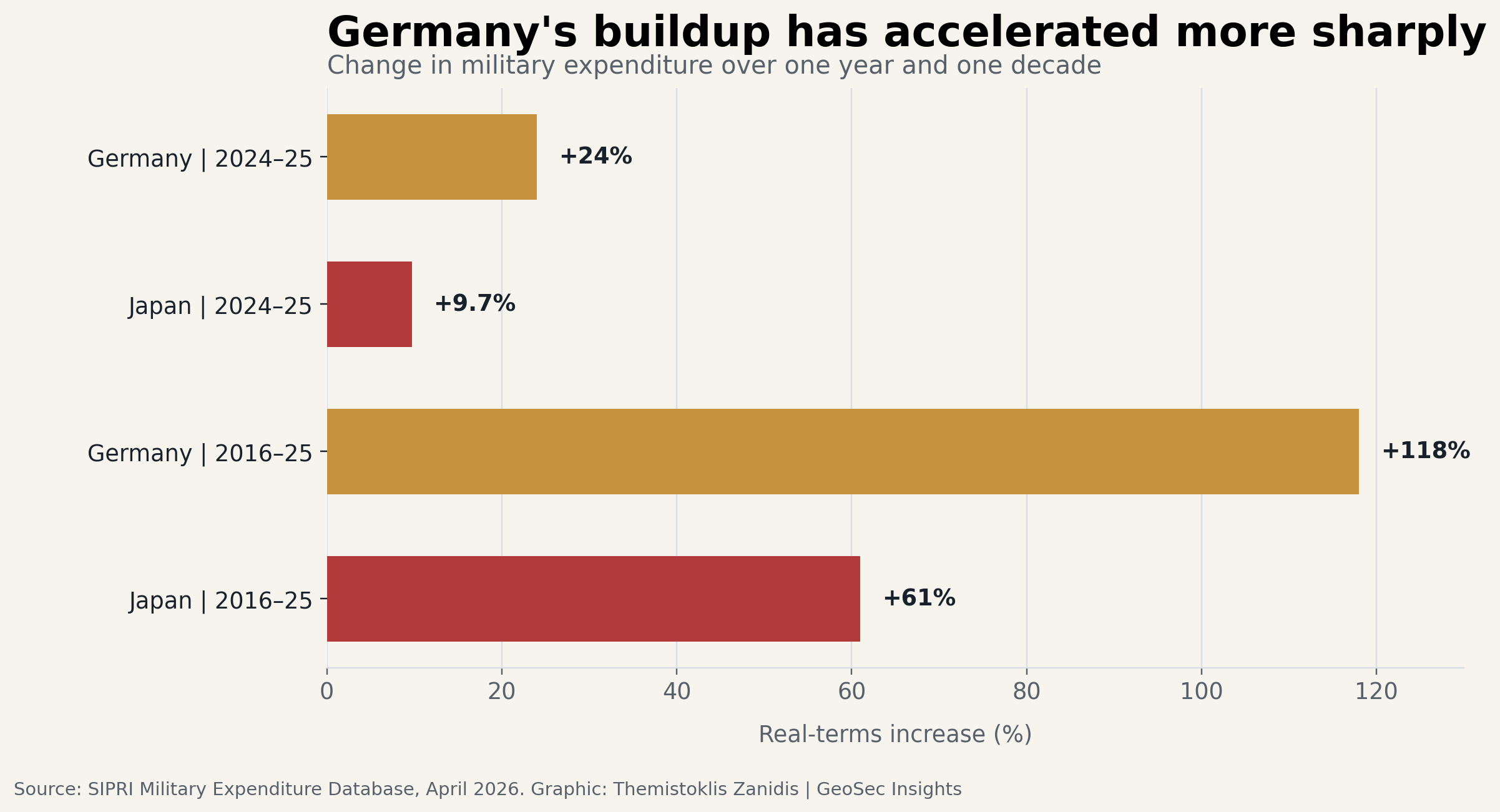
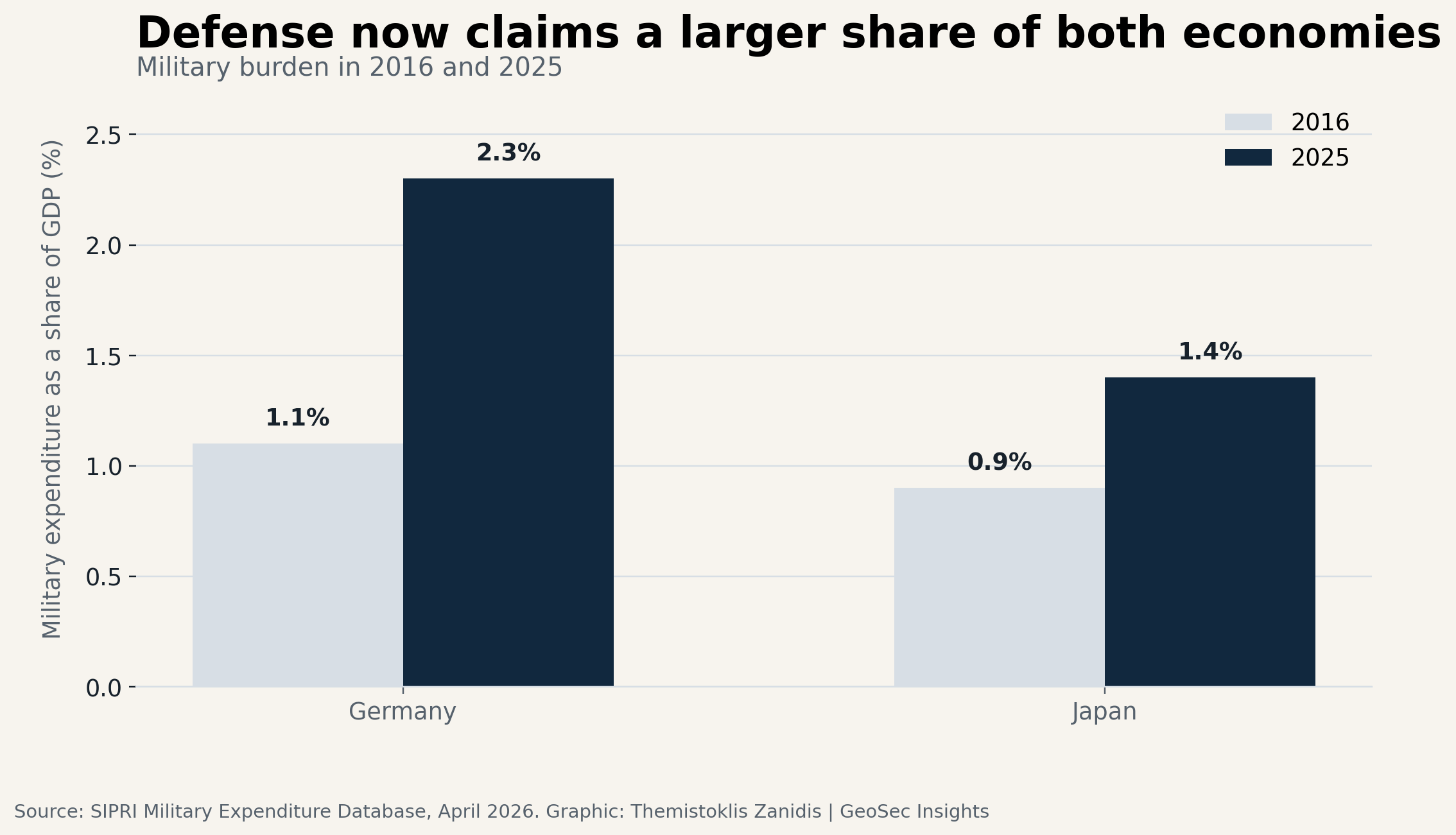
Germany’s military spending had reached $114 billion in 2025, which is a 24% real-terms increase from the previous year. Thus, Germany’s military spending had reached 2.3% of GDP, exceeding 2% for the first time since 1990 (Liang et al. 2026).
Japan’s military spending on the other hand had reached $62.2 billion in 2025, which is a 9.7 % increase from 2024 and a sharp 61% from 2016. The country’s military burden had reached 1.4% of the GDP which is the highest level for Japan since 1958 (Liang et al. 2026).
These numbers do not suggest a return to the 1930’s militarism but they do indicate a structural response to a more dangerous security environment, weaker confidence in U.S. guarantees, Russia’s war against Ukraine, China’s military rise, North Korea’s missile and nuclear programs, and NATO’s higher spending expectations.
The policy challenge is not whether Japan and Germany should spend more because they already are and they are planning to spend even more in the near future. The real question is whether their rearmament will strengthen deterrence and alliance cohesion, or create new fiscal, political, and strategic risks.
Issue Overview
The publication of SIPRI’s latest military expenditure data confirms a major shift in global security politics. World military expenditure reached $2.887 trillion in 2025, rising 2.9% in real terms, marking the eleventh consecutive year of growth. Global military spending also reached 2.5% of world GDP, the highest level since 2009 (Liang et al. 2026). The most important fact is not only about the overall numbers but it’s about who is spending. In East Asia, Japan, whose postwar identity was built around restraint, economic power, alliance dependence, and strict limits on the use of force, is moving into a new phase being now the 10th largest military spender globally. Moreover, in Europe, Germany has increased its military spending and now is the fourth-largest military spender in the world, behind only the U.S., China, and Russia. The symbolism is hard to miss because the two powers which were most closely associated with the military catastrophe of the first half of the twentieth century are again central to the military balance in Europe and Asia. The latter does not suggest that the postwar order has disappeared overnight because Germany remains anchored in NATO and the European Union, while Japan remains bound by its pacifist constitutional culture and its alliance with Washington. However, the old pattern, where both countries could remain strategically restrained while relying heavily on U.S. protection, is rapidly breaking down.
The postwar settlement assumed that Germany and Japan would be economically powerful but militarily limited but this division is no longer sustainable under the current strategic environment. Russia’s ongoing war against Ukraine has forced Europe to confront the possibility of long-term conventional war on the continent. China’s military modernization, pressure around Taiwan and generally its ambition in the entire Chinese Sea, and North Korea’s missile development have forced Japan to rethink the adequacy of a purely defensive posture. The result is not independent militarization but rather an allied rearmament, a distinction that matters even though this is a historic shift.
Germany: From restraint to Europe’s central military spender
Germany’s military shift is clear according to SIPRIS’s 2025 figures. More specifically, its military expenditure reached $114 billion, rising 2 % in just one year. SIPRI notes that 2025 was Germany’s third consecutive year of double-digit percentage growth in military spending. At 2.3% of GDP, Germany crossed the 2% level for the first time since reunification in 1990 (Liang et al. 2026). The spending increase reflects a broader change in German security policy: Germany’s 2023 National Security Strategy describes the country as the most populous state and largest economy in the heart of Europe, carrying “special responsibility” for peace, security, prosperity, and stability. Moreover, it frames Germany’s security environment as one shaped by a “watershed era,” or Zeitenwende (Federal Government of Germany 2023).
This language is important as it presents how Germany understands the current strategic context. That said, Berlin is no longer presenting defense spending as an exceptional response to a temporary crisis but its security policy as a core function of state responsibility. That is a major departure from the long post-Cold War assumption that Germany could remain a civilian power while outsourcing much of hard security to the United States and NATO’s eastern members.
Additionally, SIPRI highlights the fiscal transformation behind Germany’s military rise. In 2025, military spending above 1% of GDP was excluded from Germany’s debt break, allowing Berlin to finance additional military expenditure through borrowing (Liang et al. 2026). That matters because Germany’s rearmament is not only a defense issue but also a constitutional, fiscal, and political issue mainly because Berlin is changing the way it funds security. The postwar German state was built around economic discipline, export strength, and caution in military affairs, but the new model accepts that defense may require permanent fiscal flexibility.
Germany’s military spending obviously has consequences on NATO itself. In this regard, the European Military spending reached a record of $864 billion in 2025, which is a sharp 14% rise from the year before. Over the decade from 2016 to 2025, European military spending doubled, rising 102% (Liang et al. 2026) and Germany is central to that shift because of its size, geography, industrial capacity, and political weight. If Germany sustains higher defense spending, Europe’s defense posture changes but if it fails, NATO’s European pillar remains underpowered.
Japan: From shield to counterstrike
In the East, Tokyo’s shift is not as sharp as Berlin, but it is equally important. According to the SIPRI publication, Tokyo’s military spending reached $62.2 billion in 2025, rising 9.7% from last year and a staggering 61% from 2016. Additionally, Japan’s 2025 procurement was focused primarily on long-strike and counterstrike capabilities which include cruise missiles and intelligence, surveillance, and various reconnaissance systems (Liang et al. 2026).
This constitutes a significant shift in Japan’s postwar defense posture. Japan’s Defense Buildup Program defines counterstrike capabilities as Self-Defense Forces capabilities that leverage stand-off defense and other assets. It states that, in cases where an armed attack against Japan has occurred and missiles or other means have been used, Japan may mount effective counterstrikes against an opponent’s territory as a minimum necessary measure for self-defense (Japan Ministry of Defense 2022). The policy remains formally defensive while it is not framed as a doctrine of preventive war or unilateral offensive action, but it still changes the strategic meaning of Japan’s Self-Defense Forces. Japan is moving from a posture centered mainly on interception and territorial defense toward one that includes the ability to hold enemy launch sites and military assets at risk.
Japan’s Defense Buildup Program also sets expenditure for defense capability buildup at approximately ¥43 trillion over FY2023–FY2027, with annual defense budgets for the period totaling approximately ¥40.5 trillion (Japan Ministry of Defense 2022). The drivers are clear, Japan faces China’s expanding military power, North Korea’s missile and nuclear programs, and increasing uncertainty about the long-term reliability of U.S. security guarantees. SIPRI states that spending increases by U.S. allies in Asia and Oceania, including Japan, reflect not only regional tensions but also growing uncertainty over the American military support (Liang et al. 2026).
Japan’s case shows how the postwar order is changing in Asia. For decades, Japan’s security identity depended on three pillars: constitutional restraint, U.S. extended deterrence, and economic strength. Today, those pillars remain, but they are being adjusted. Japan is still closely allied with Washington, but it is assuming a larger share of deterrence. It is still constitutionally constrained, but it is interpreting self-defense more actively. Finally, it is still an economic power, but defense is taking a larger share of political attention and public resources.
GeoSec Insights is a reader-supported publication. To receive new posts and support my work, consider becoming a free or paid subscriber.
What This Means for the Postwar Order
We need to be clear: the rise of German and Japanese military spending does not mean the world is returning to 1939. This comparison is historically inaccurate and analytically weak because today’s strategic environment is different from 1939. Additionally, today, Germany and Japan are advanced democracies, embedded in alliances. This means that their defense policies are shaped by parliaments, legal constraints, public debate, and alliance coordination. The better conclusion is that the postwar division between “normal” military powers and “restrained” defeated powers is weakening.
For nearly eighty years, the U.S. has been the main security provider for both Europe and East Asia. Germany and Japan became pillars of the U.S.-led order precisely because they were economically strong but militarily restrained. This balance helped the American policymakers to stabilize two crucial regions after the end of WW II with significant presence of the American military.
Today, this burden-sharing model is changing. Washington still matters, but its allies are preparing for a world in which U.S. support may be less predictable, more conditional, or more focused on China. In this regard, Washington has pressured its allies, particularly the European states and Canada, to increase their defense spending, a shift that, according to SIPRI data, is already reflected in their national budgets.
The deeper significance is that defense spending is becoming a test of political seriousness. Germany is being judged by whether it can rebuild military capability after decades of underinvestment. Japan is being judged by whether it can develop credible deterrence without destabilizing its domestic consensus or alarming neighbors unnecessarily. Both cases draw the same conclusion: the postwar order is not being replaced by a clean new system, but it is being revised under pressure.
Strategic Implications
The return of Germany and Japan as major military spenders does not simply add two more states to the global defense ranking but it changes the structure of the U.S.-led security order itself. For decades, Washington carried the largest share of hard military responsibility in both Europe and East Asia, while Germany and Japan remained economically powerful but strategically restrained. In today’s geopolitical environment, this arrangement is under pressure. Germany’s rise as Europe’s central military spender and Japan’s move toward counterstrike capabilities suggest that allied defense is becoming more distributed, more expensive, and more politically demanding.
This shift also creates a new strategic dilemma. Stronger German and Japanese capabilities can improve deterrence, support burden-sharing, and reduce overdependence on the United States. However, they can also create fiscal strain, procurement problems, domestic resistance, and regional anxiety if they are not managed carefully. The key issue, therefore, is not whether Germany and Japan should become more capable. They already are moving in that direction. The real question is whether they can build credible military power while preserving the restraint, transparency, and alliance discipline that have made them stable pillars of the postwar order.
What to Watch
The first thing to watch is whether Germany and Japan can turn higher defense spending into real military capability. The numbers already show the direction of travel: Germany has become the world’s fourth-largest military spender, while Japan has reached tenth place. That is historically important, but spending alone is not strategy. Germany’s real test will be readiness, ammunition stocks, air defense, logistics, deployable forces, and whether the Bundeswehr can absorb money fast enough after decades of underinvestment. Japan’s test will be different but equally important: whether its counterstrike capabilities, cruise missiles, ISR systems, and defense-industrial planning can strengthen deterrence without breaking the country’s domestic consensus around self-defense.
The second thing to watch is political sustainability. Rearmament in both countries will face fiscal pressure, demographic strain, public debate, and alliance expectations. In Germany, the question is whether the Zeitenwende becomes a permanent strategic adjustment or remains dependent on crisis politics. In Japan, the question is whether Tokyo can expand its military role while keeping its doctrine clear, defensive, and closely coordinated with the United States. Thus, the deeper issue is not whether Germany and Japan are “returning” as dangerous powers. The real issue is whether two postwar restrained powers can become more capable military actors without losing the restraint, legitimacy, and alliance discipline that made them stable pillars of the post-1945 order in the first place.
I would be interested to hear your thoughts on this issue.
Final Thoughts
SIPRI’s 2025 military expenditure data shows that the postwar order is changing in measurable ways. The most revealing evidence is not only that global military spending is rising. It is that Germany and Japan are again becoming central military actors. This is historically significant because both countries built their post-1945 identities around military restraint. Germany became Europe’s economic engine. Japan became Asia’s high-technology civilian power. Both relied heavily on U.S. security guarantees. Both avoided the image of hard military power. That era is ending or at least being revised. Germany’s fourth-place global ranking and Japan’s tenth-place ranking are not isolated budgetary facts. They are indicators of a wider shift from a U.S.-dominated postwar security system toward a more distributed allied defense model.
The danger is not that Germany and Japan are becoming aggressive powers. The greater risk is that they are being forced to adapt quickly in a world where the old security assumptions are no longer valid. Their success will depend on whether they can turn money into capability, capability into deterrence, and deterrence into stability. The defeated powers of 1945 are not returning as revisionist states. They are returning as armed pillars of a strained order. That alone tells us how much the world has changed.
Thank you for reading GeoSec Insights. I research geopolitics, international security, war, and shifts in global power to understand the deeper forces shaping events beyond the daily headlines. If this analysis helped you see the issue more clearly, please consider sharing it with someone who may also find it useful.
References
Federal Government of Germany. 2023. National Security Strategy: Robust. Resilient. Sustainable. Integrated Security for Germany. Berlin: Federal Government of Germany.
Japan Ministry of Defense. 2022. Defense Buildup Program. Tokyo: Ministry of Defense.
Liang, Xiao, Nan Tian, Diego Lopes da Silva, Lorenzo Scarazzato, Zubaida Karim, and Jade Guiberteau Ricard. 2026. Trends in World Military Expenditure, 2025. SIPRI Fact Sheet. Stockholm: Stockholm International Peace Research Institute.