

The world is spending more on weapons than at any time in history but fielding fewer soldiers than ever before. From the streets of Gaza to the skies over Ukraine, from missile fields in western China to NATO stockpiles in Poland, the 21st-century arms race is accelerating. The Cold War’s crude arithmetic of tank counts and nuclear megatons has given way to a new competition: one defined by precision, speed, and the industrial capacity to fight long wars.
Introduction
We are living in the era of renewed power politics, where the U.S. and China compete for global dominance. At the same time other powers have risen contributing to the emergence of a multipolar world order. Within this shifting strategic environment, militarization is back at the center of international affairs. In 2024, global military expenditure reached an unprecedented $2.7 trillion after a decade of steady growth. Yet, as history does not repeat itself, this is not a simple revival of the Cold War arms race. On the contrary, states today maintain significantly smaller armed forces while are channeling resources into high-tech weapons with high precision, advanced networked capabilities, and nuclear expansion/modernization. The result is a new kind of global arms race focusing on quality rather than quantity.
This paper uses two cornerstone references namely the Institute for Economics & Peace (IEP) and the SIPRI Yearbook 2025, to map who is spending, why they are spending, and who is selling, with comparisons to the late Cold War and the immediate post–Cold War era.
I. From Cold War Mass to 21st-Century Precision
During the Cold War’s peak, world military burdens hovered well above five percent of global GDP. Today the global military burden is roughly one-half of that level, even as absolute spending is at a record high. IEP shows the armed forces rate fell from about 700 per 100,000 people in the early 1970s to around 350 per 100,000 by 2020, a structural shift away from mass armies and toward technologically dense forces, which can easily be more lethal. At the same time, SIPRI records ten consecutive years of spending growth culminating in 2024’s historic high. These two trends, shrinking personnel and rising budgets, define the modern militarization paradox.
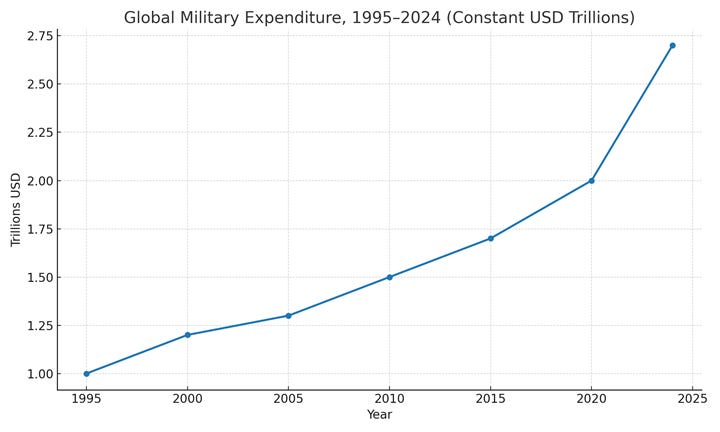
Figure 1. Global military expenditure in constant USD (approximate trend).
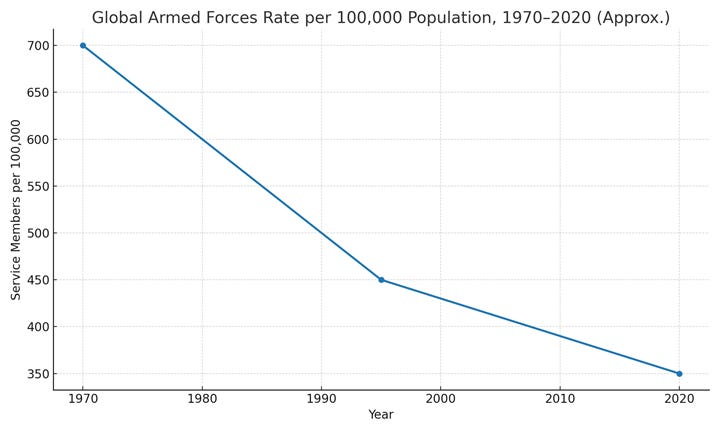
Figure 2. Armed forces rate per 100,000 population has halved since the 1970s.
II. Where the Money Goes. Regional Patterns and Big Players
Military spending is concentrated in North America, Europe, and Asia–Oceania, but every region is rearming even in slower pace. Europe has seen the steepest post-2015 increase; Asia–Oceania accounts for persistent, multi-decade growth; and the Middle East remains a high-intensity procurement market fluctuating with conflict cycles.
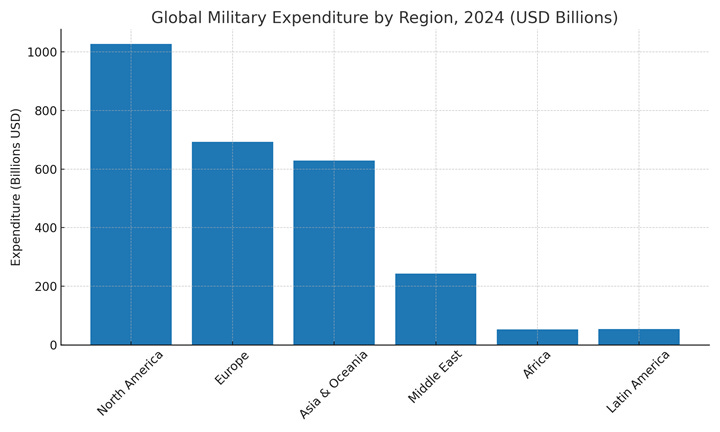
Figure 3. Regional distribution of military spending, 2024.
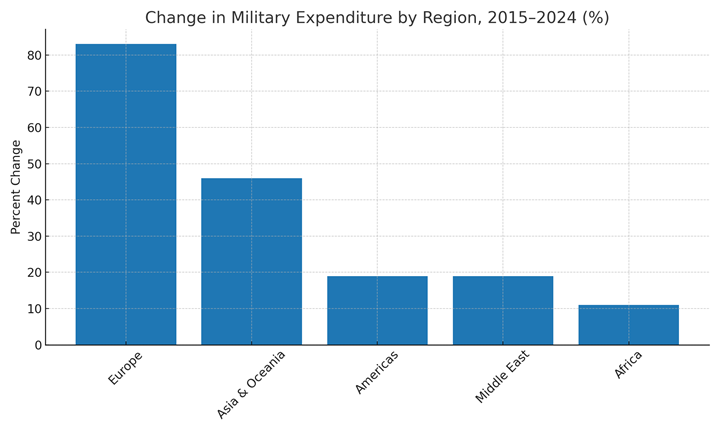
Figure 4. Change in military spending by region, 2015–2024.
North America is anchored obviously by the United States, which spent roughly $1 trillion in 2024 which is more than the next three countries combined. In NATO Europe, 17 of 30 members reached or exceeded the alliance’s 2% of GDP benchmark in 2024. The most dramatic annual increases included Romania (+43%), the Netherlands (+35%), Sweden (+34%), Poland (+31%), and Germany (+28%). These figures reflect a strategic pivot to deterrence-by-denial along NATO’s eastern flank, accelerated by the Ukraine war and a renewed emphasis on stockpiles, air defense, and long-range strike.
Asia–Oceania has experienced uninterrupted growth for 35 years. China accounts for about half of the region’s total, an estimated $314 billion in 2024 (+7% year-on-year). Beijing’s multi-domain modernization includes anti-access/area denial, ballistic and cruise missiles, a rapidly modernizing navy, and a growing nuclear force. Japan posted a 21% increase in 2024 which is its largest since 1952, accelerating missile defense, standoff munitions, and hardening of bases in the southwest islands. India continues steady growth focused on contested borders with China and Pakistan and on maritime presence in the Indian Ocean. Australia’s procurement of long-range strike and undersea capabilities complements these trends.
In the Middle East military expenditure increased significantly in 2024, because of the Gaza War and other regional clashes. In this regard, Israel increased its defense budget by 65% while Saudi Arabia remained among the world’s top spenders. Other regional actors like Türkiye posted a 12% increase which highlights the growth of its domestic defense industry. Across the region, procurement priorities converged on air and missile defense, precision-strike systems, and loitering munitions, capabilities reflecting both immediate conflict pressures and longer-term strategic competition.
Africa’s military spending remains comparatively small (~$52 billion in 2024), however, modern warfare, including UAVs and missiles, is reshaping conflict dynamics in regions like the Sahel, Sudan and Somalia. Finally, Central and South America have showed mixed trends as South America’s spending is roughly flat, while Central America and the Caribbean saw a notable increase driven by internal security challenges and fleet and air-asset recapitalization.
III. The Arms Industry. Concentrated Supply, Expanding Demand
The SIPRI Top 100 recorded $632 billion in arms revenues in 2023, with 73 firms increasing sales and 39 posting double-digit growth. The top five firms, Lockheed Martin, RTX, Northrop Grumman, Boeing, and General Dynamics are all American and together represent roughly one-third of the Top 100 total. Chinese manufacturers remain ascendant, with nine companies in the ranking and three in the top ten. On the other hand, Russia’s data are unclear. The available data show two major firms with a combined $25.5 billion in 2023 revenues (+40% year-on-year), underscoring war-driven demand despite sanctions and capacity constraints. Western defense companies are doubling down on mergers and acquisitions, especially in areas like AI-driven command systems, electronic warfare, missile defense, and drones.
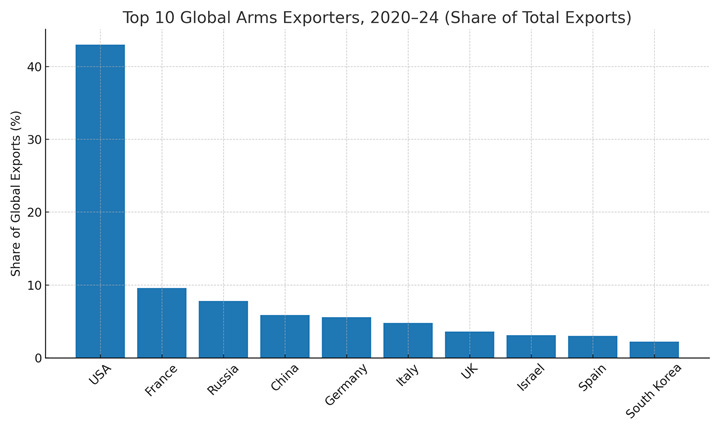
Figure 5. Top arms exporters, 2020–24.
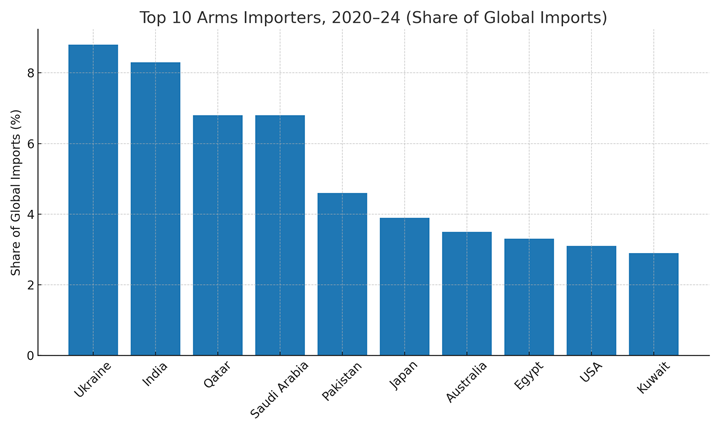
Figure 6. Top arms importers, 2020–24.
Arms transfers have been stable in aggregate over the last fifteen years, but regional flows have shifted markedly. Transfers to Europe jumped 155% in 2020–24 relative to 2015–19, driven by Ukraine and NATO rearmament. The top recipients were Ukraine, India, Qatar, Saudi Arabia, and Pakistan. On the supply side, the United States expanded its global share to 43% (+21% from the prior period). France became the second-largest exporter (9.6%). Russia’s exports halved compared to 2015–19, falling to their lowest level in any five-year window since 1950 for Moscow or the Soviet Union. China and Germany rounded out the top five.
IV. Missiles, UAVs, and the Return of Long-Range Strike
Modern conflict is defined by volume fire, long-range strike, and air & missile defense saturation. In 2024 Russia used thousands of ballistic and cruise missiles and one-way attack UAVs against Ukraine, while Ukraine expanded deeper strikes into Russian territory with Western-plausible systems. Europe faces what SIPRI calls a missile renaissance: the U.S. will station ground-launched missiles in Germany from 2026, and European states launched a cooperative Long-range Strike Approach to co-produce medium-range systems. In the Middle East, Iran’s direct missile salvos against Israel, Hezbollah’s persistent rocket and UAV campaigns, and the Houthis’ strikes on shipping underscore a multifront contest of long-range fires. Across sub-Saharan Africa, at least six conflicts saw use of armed UAVs since 2021, with nearly a thousand civilians killed by strikes, an indicator of rapid proliferation and doctrinal diffusion.
V. Nuclear Forces: A New Qualitative Arms Race
As of 2025, nine countries possess about 12,241 nuclear warheads, with roughly 3,912 deployed and around 2,100 kept at high operational alert. The United States and Russia still hold almost 90% of the total while they are modernizing their nuclear triad: the delivery systems, warheads, and production infrastructure. China’s stockpile rose from ~500 to as many as 600 warheads in one year, coupled with silo field construction and MIRV-capable missile development, aiming to possess more than 1,000 at the end of the decade. India and Pakistan continue to expand and diversify triad elements. North Korea advances toward multiple-warhead capabilities and sea-based options. In Europe, doctrinal debate has intensified as extended deterrence is revalidated; the U.S. has upgraded NATO-stationed gravity bombs. Meanwhile, Russia’s 2024 update to its nuclear doctrine appears to broaden conditions for use.
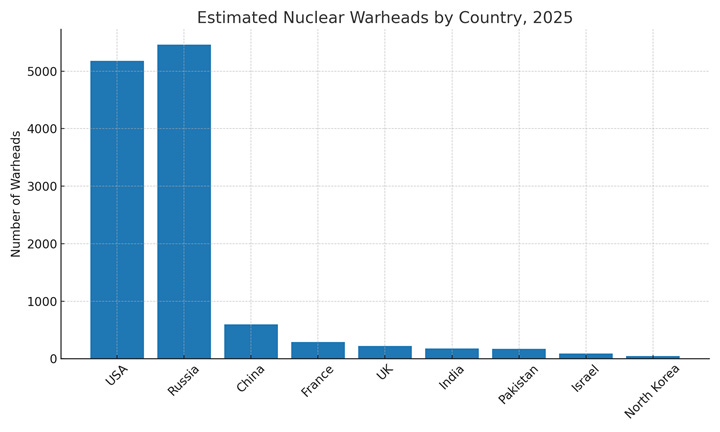
Figure 7. Estimated nuclear warheads, January 2025.
VI. The Economic Burden and PPP Reality
IEP’s lens clarifies the domestic burden of defense outlays. As a share of total government spending, military budgets fell from over 10% in 2000 to under 7.5% by 2022, while health rose from about 5.1% to 7.3%, a partial rebalancing of state priorities. Yet in purchasing-power terms, the burden in emerging economies is far heavier than headline dollar figures imply.
India’s military spending in 2022, measured in PPP, reached roughly $247 billion, more than three times the constant-USD figure, indicating the real resource trade-offs borne domestically. Moreover, Russia’s PPP-to-USD ratio likewise exceeds two and a half, while China’s is 1.53. These differences shape industrial capacity, manpower costs, and the pace of procurement.
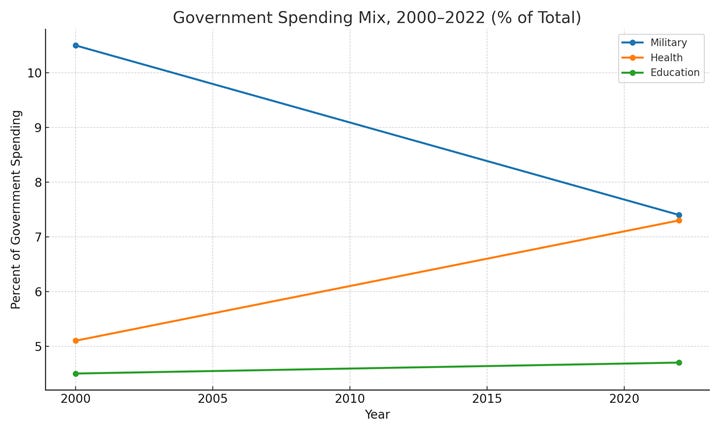
Figure 8. Government spending mix, 2000–2022 (illustrative).
VII. Why States Spend: Threats, Prestige, Industry, Alliances
States spent on defense for two main reasons. First, as they feel insecure, they know that self-help and hard power will provide them security and expand their influence in the global arena. Specifically, for the U.S., the challenge is about keeping the world’s dominance and containing the Chinese rise. On its behalf, China’s rise has made Asia a constant pressure point, while the U.S. still is involved in Europe and Middle East. This whole situation results in a defense budget that needs to cover multiple theaters at the same time. China is not facing this overextension its leaders perceive the Western Pacific as the frontline, where deterring U.S. intervention and safeguarding sea lanes is not optional but essential to both security and prosperity. The other Asian giant, India, is facing a complicated strategic environment as New Delhi is trying to balance between the West and especially the U.S., after the tariffs, its standing rivalry with Pakistan, and the careful approach with China. The complex strategic situation in the Indo-Pacific region has driven India to invest heavily on is military capabilities. In Europe, defense spending has drastically increased as the majority of the European NATO members are meeting finally the 2% GDP benchmark of defense spending set by the U.S. This increase indicates the common goal of detaining Moscow. In the Middle East, security threats are even more direct. Competition via proxy wars and direct military confrontation has fueled a constant demand for arms. In this regard, Israel, Saudi Arabia, UAE, and the other Gulf States are continuing to invest heavily in missile defenses and develop their long strike capabilities. Also, for states like Türkiye, Saudi Arabia, and the UAE, defense industry is a way of national pride.
The common characteristic of the aforementioned regions is the existence of new military technologies. Precision strike weapons, advanced air defenses, and integrated command systems have set a new global baseline for credible deterrence. Even mid-sized powers can no longer rely on sheer manpower or legacy equipment—they are compelled to buy into this higher tier of capability. In today’s world, defense spending is not just about survival; it is about relevance.
Conclusion
The strategic map of militarization is being redrawn. Power is diffusing away from a small group of great powers even as the defense industrial base remains concentrated. Absolute spending is rising, personnel are shrinking, and lethal precision is proliferating. Europe is building magazines and air defenses at a pace unseen since the 1980s. Asia–Oceania is entrenched in a sustained maritime and aerospace competition. The Middle East is a laboratory for missiles and UAVs, with spillovers across the Red Sea and beyond. Nuclear arsenals are modernizing, and the guardrails of arms control have frayed. The new arms race is not merely about counting missiles or tanks; it is about the speed of adaptation—industrial, doctrinal, and technological. That is the decisive metric of power in the 2020s.
References
Stockholm International Peace Research Institute (SIPRI). SIPRI Yearbook 2025: Summary. Solna, 2025. Key sections cited: Military Expenditure; Arms Production; International Arms Transfers; World Nuclear Forces; Missiles and UAVs.
Institute for Economics & Peace (IEP). Contemporary Trends in Militarisation 2024. Sydney: IEP, 2024. Key sections cited: personnel trends, PPP comparisons, government spending composition.
Appendix: Regional Deep Dives & Historical Comparisons
Europe vs. the Late Cold War: SIPRI notes that the 2020–24 volume of international arms transfers to Europe rose by 155 percent relative to 2015–19 and reached levels far higher than in any of the previous six five-year periods. However, compared to the Cold War peak (1980–84), today’s global volume is still about 35 percent lower. The difference lies in the qualitative shift: more precision munitions, integrated air and missile defense, and industrial base expansion to sustain high-tempo operations, rather than mass platforms alone.
Ukraine and the Ecosystem of Suppliers: At least thirty-five states delivered major arms to Ukraine between 2020 and 2024, mostly as aid packages. This created a trans-Atlantic supply chain spanning artillery, air defense, armor, and ISR, and accelerated NATO standardization of munitions and C4ISR. The political effect is durable: NATO members not only increased spending but reoriented defense plans around stockpile depth, surge capacity, and resilience.
Asia & Oceania Trajectories: China’s estimated $314 billion defense budget in 2024 accounted for about half of all regional expenditure. Japan’s 21 percent jump, the largest since 1952, hastened procurement of standoff missiles and layered air defenses. India, with rising PPP-adjusted defense outlays, is expanding naval aviation and surface combatants while investing in missile defense and dual-capable systems. Australia remains a top global importer (3.5 percent of 2020–24 imports), channeling funds to undersea warfare and long-range fires.
Middle East Dynamics: Israel’s 65 percent rise in spending reflects multi-front operations, air & missile defense saturation, and extended strike campaigns. Saudi Arabia and Qatar, both top global importers in 2020–24, continue deep procurement across air power, air defense, and precision strike. Türkiye’s 12 percent increase complements indigenous production and export ambitions, including UAVs and guided munitions.
Sub-Saharan Africa & UAV Diffusion: Confirmed use of armed UAVs in at least six conflicts, Burkina Faso, Ethiopia, Mali, Nigeria, Somalia, and Sudan, contributed to more than 940 civilian deaths between November 2021 and November 2024. Non-state actors show increasing UAV activity across West Africa’s border zones and the Lake Chad Basin. Regulatory frameworks lag technology, with no dedicated multilateral process to govern armed UAVs.
Missile Renaissance in Europe: After the demise of the INF Treaty, Europe moved to rebuild long-range strike. In July 2024, Germany and the United States agreed to station U.S. ground-launched missiles in Germany from 2026, while France, Germany, Italy, and Poland signed a letter of intent (later joined by Sweden and the U.K.) to co-produce medium-range missiles. The shift parallels renewed investment in integrated air and missile defense across NATO states.
Russia–Ukraine Missile Duel: Between January and September 2024, Ukraine reported nearly 5,500 Russian ballistic and cruise missile and one-way UAV launches—over twenty per day on average. In November 2024, Russia tested the dual-capable Oreshnik intermediate-range missile with multiple independently targetable reentry vehicles against Dnipro. Later that month, the United States authorized Ukraine to use certain U.S.-supplied systems to strike deeper into Russian territory, putting key logistics and bases at risk.
Nuclear Guardrails Under Strain: At the start of 2025, nine nuclear-armed states held an estimated 12,241 warheads, about 3,912 of which were deployed, and roughly 2,100 at high alert. Russia updated its nuclear doctrine in November 2024, apparently widening scenarios for use. The U.S. confirmed it replaced NATO-stationed nuclear gravity bombs with upgraded versions. Russia and Belarus claimed Russian deployment on Belarusian territory, though conclusive evidence was lacking.