The Nature of War in the Age of Strategic Competition
Power, Perception and Politics | Policy Analysis 2026/03 | Part 2

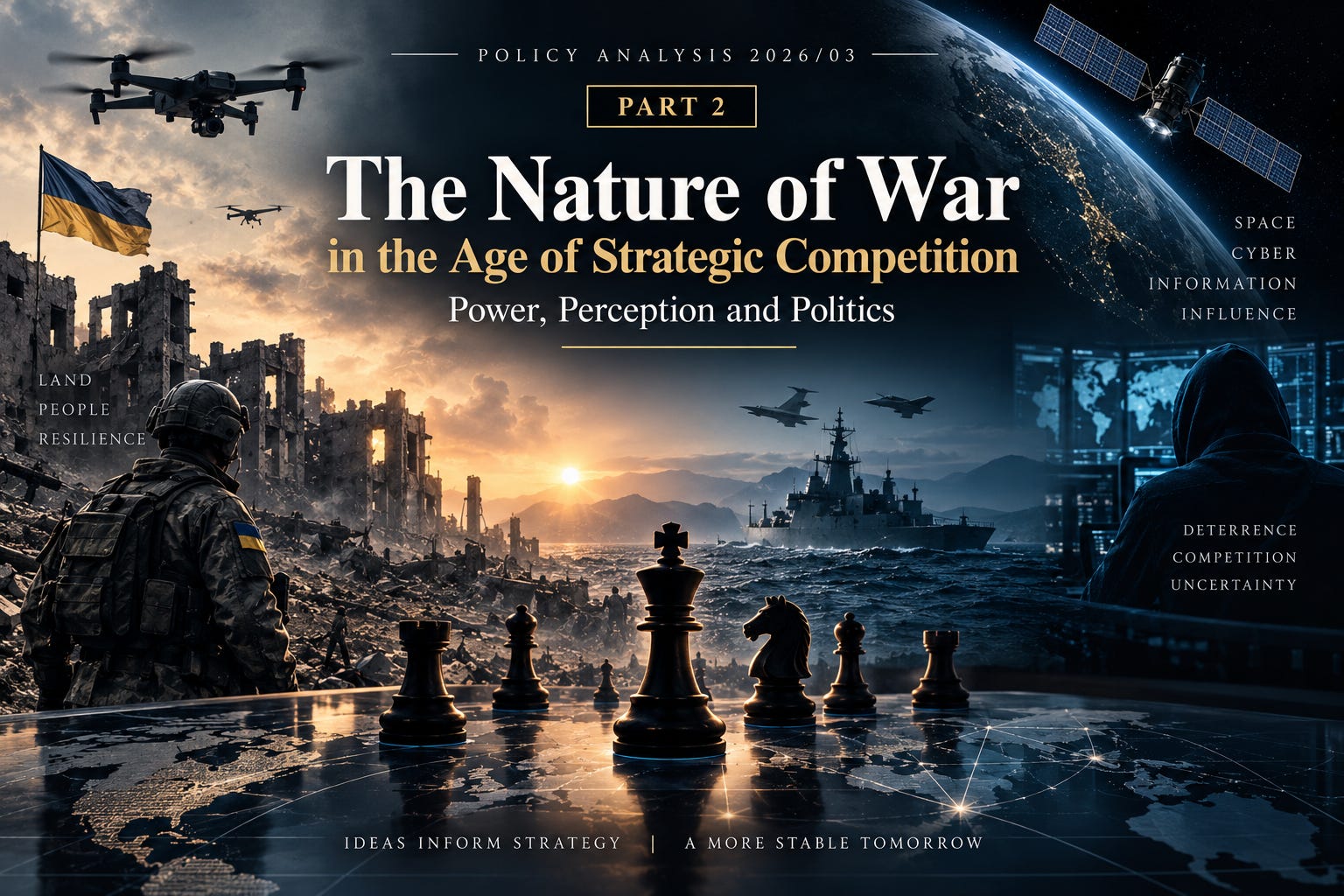
“Every age has its own kind of war, its own limiting conditions, and its own peculiar preconceptions.”
— Carl von Clausewitz
Executive Summary
War remains one of the most enduring and destructive features of human history, yet it is also one of the most difficult to define with precision. It changes form across time, geography, and technology, but it never fully disappears. In today’s strategic environment, marked by great-power rivalry, hybrid threats, cyber conflict, disinformation, autonomous systems, and renewed geopolitical competition, the question of what war is has returned with urgency. This is not a purely academic debate. How policymakers, analysts, and strategists define war shapes how they prepare for it, justify it, and respond to it.
This paper argues that no single theory fully captures the nature of war. Realism explains war’s structural roots in an anarchic international system. Liberalism highlights the conditions under which conflict can be moderated through institutions, interdependence, and diplomacy. Constructivism reminds us that war is also shaped by perception, identity, and narrative. Marxist approaches expose the economic interests and material hierarchies often concealed beneath strategic language. Clausewitz remains essential because he anchors war in politics, while Sun Tzu broadens the picture by showing that strategy, deception, and psychological pressure can be as decisive as brute force. Feminist and postmodern critiques add another necessary layer by demonstrating that war is also shaped by discourse, exclusion, and symbolic power.
The central judgment is straightforward: war is neither material nor only ideational. It is a political act shaped by power, fear, interests, identity, perception, and historical context. Technology changes the character of war, but not its basic logic. The battlefield now includes cyberspace, the information environment, and outer space, while recent conflicts, especially in Ukraine, have shown how drones, digital resilience, and networked adaptation are reshaping the conduct of war without eliminating its enduring political nature.
For serious readers of geopolitics, the point is not to search for one perfect definition. It is to understand that each theory captures a different dimension of the phenomenon. Better analysis begins when we stop treating war as a single thing and start treating it as a complex interaction between power, ideas, institutions, interests, and human choice.
Keep reading with a 7-day free trial
Subscribe to GeoSec Insights to keep reading this post and get 7 days of free access to the full post archives.