

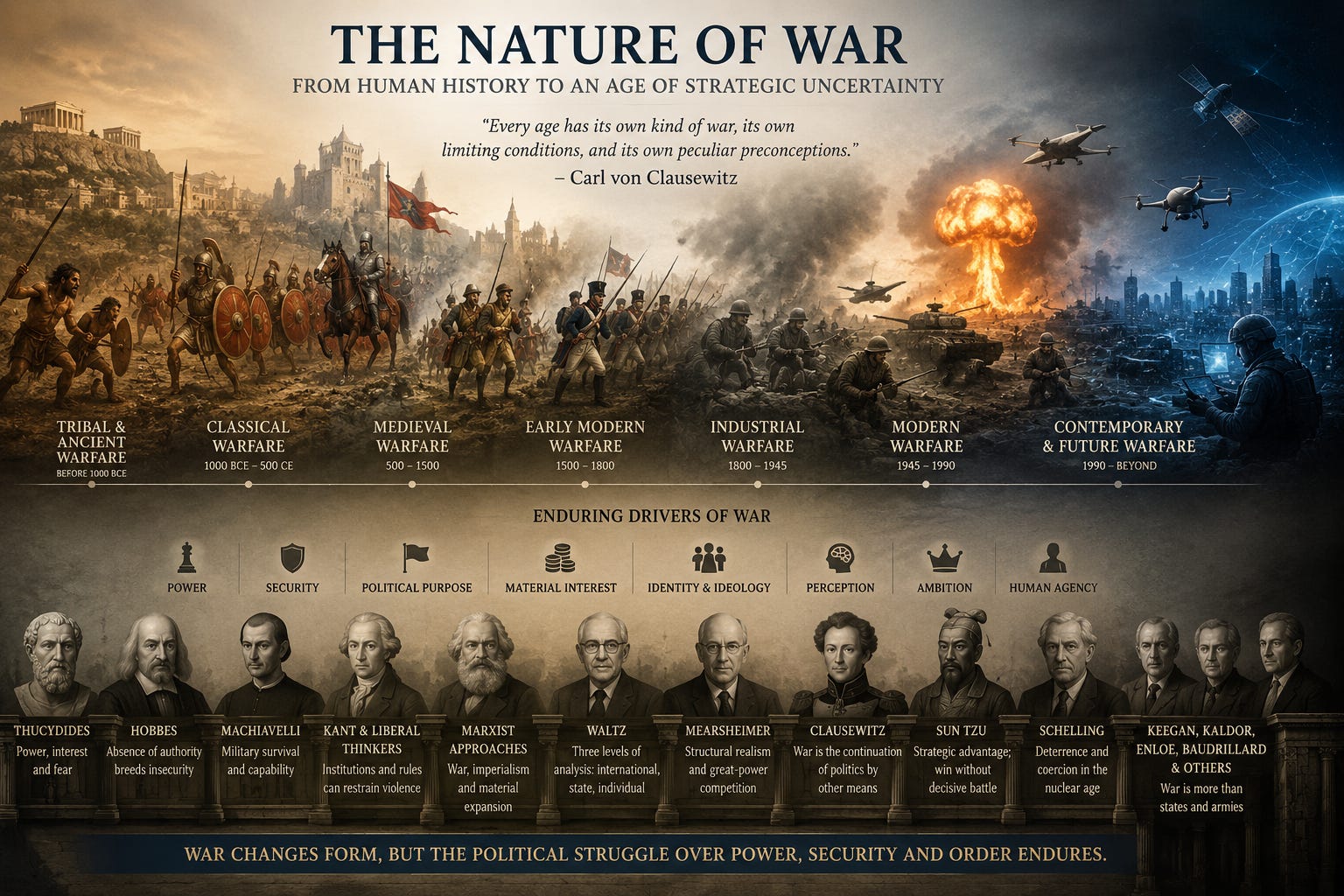
“Every age has its own kind of war, its own limiting conditions, and its own peculiar preconceptions.”
— Carl von Clausewitz
Executive Summary
War is one of the oldest and most persistent forms of organized human interaction, yet it has never remained static. Human societies have fought through tribal structures, ancient kingdoms, city-states, empires, feudal systems, sovereign states, ideological blocs and increasingly complex networks of state and non-state actors, while the instruments of violence have developed from spears, bows, swords and fortified cities to industrial armies, nuclear weapons, drones, cyber operations and autonomous systems. The historical record therefore presents an apparent contradiction: the character of war changes continuously, while many of the forces that generate it remain remarkably persistent.
This analysis, divided in two parts, approaches war as both a historical phenomenon and an intellectual problem. Rather than treating the major International Relations theories such as realism, liberalism, constructivism or any other school of thought, as a complete explanation, it places the major theories and theorists of war within the historical development of organized violence. That said, Thucydides has connected war with power, interest and fear. Hobbes has identified the absence of overarching authority as the source of uncertainty and insecurity. Machiavelli, on his behalf, has connected military survival with military capabilities, while Kant and later liberal thinkers have examined the political conditions and institutions as the main tools to restrain violence. Marxist approaches have exposed the connection between war, imperial ambition and material expansion, while Waltz has organized the explanations in three levels: international, state, and individual. Mearsheimer has pushed structural realism toward a more competitive understanding of great-power behavior, while Clausewitz has placed politics at the epicenter of war. Sun Tzu has emphasized on strategic advantage and the possibility of defeating the enemy without any decisive battle. Schelling has explained deterrence and coercion in the nuclear age, while thinkers like Keegan, Kaldor, Enloe and Baudrillard have challenged the theories which diminish warfare to simple relations between organized and rational states and their armed forces.
The central argument is that war is a complicated phenomenon with no single cause and no single historical form. War emerges from combinations of power, fear, insecurity, political purpose, material interest, identity, ideology, perception, ambition and human choice. International institutions and rules have the ability to restrain these forces from colliding with each other while technology can transform the means through which they operate. Inventions like railways, the telegraph, gunpowder, mass conscription, aircraft, nuclear weapons, digital networks and autonomous systems have changed significantly what armed forces could do and the ways societies experience war. However, none of the aforementioned has removed the political struggle over interests, security, order and which offers war, organized violence, its meaning.
This distinction between the nature and character of war is increasingly important. The contemporary battlefield extends from the traditional domains land, sea, air, to the new like cyberspace, the information environment and outer space, while hybrid methods allow actors to pursue strategic objectives in the ambiguous space between peace and open armed conflict. Artificial intelligence, autonomous systems and inexpensive unmanned platforms are altering operational calculations, yet the fundamental strategic question remains familiar: what political objective is force intended to achieve, against whom, at what cost, and under which conditions can violence produce a sustainable political result?
Consequently, understanding war requires historical perspective as much as contemporary strategic analysis. Every age develops its own technologies, institutions and doctrines, but the enduring interaction between political purpose, fear, power, perception and human agency explains why war continues to survive the political systems created to restrain it.