

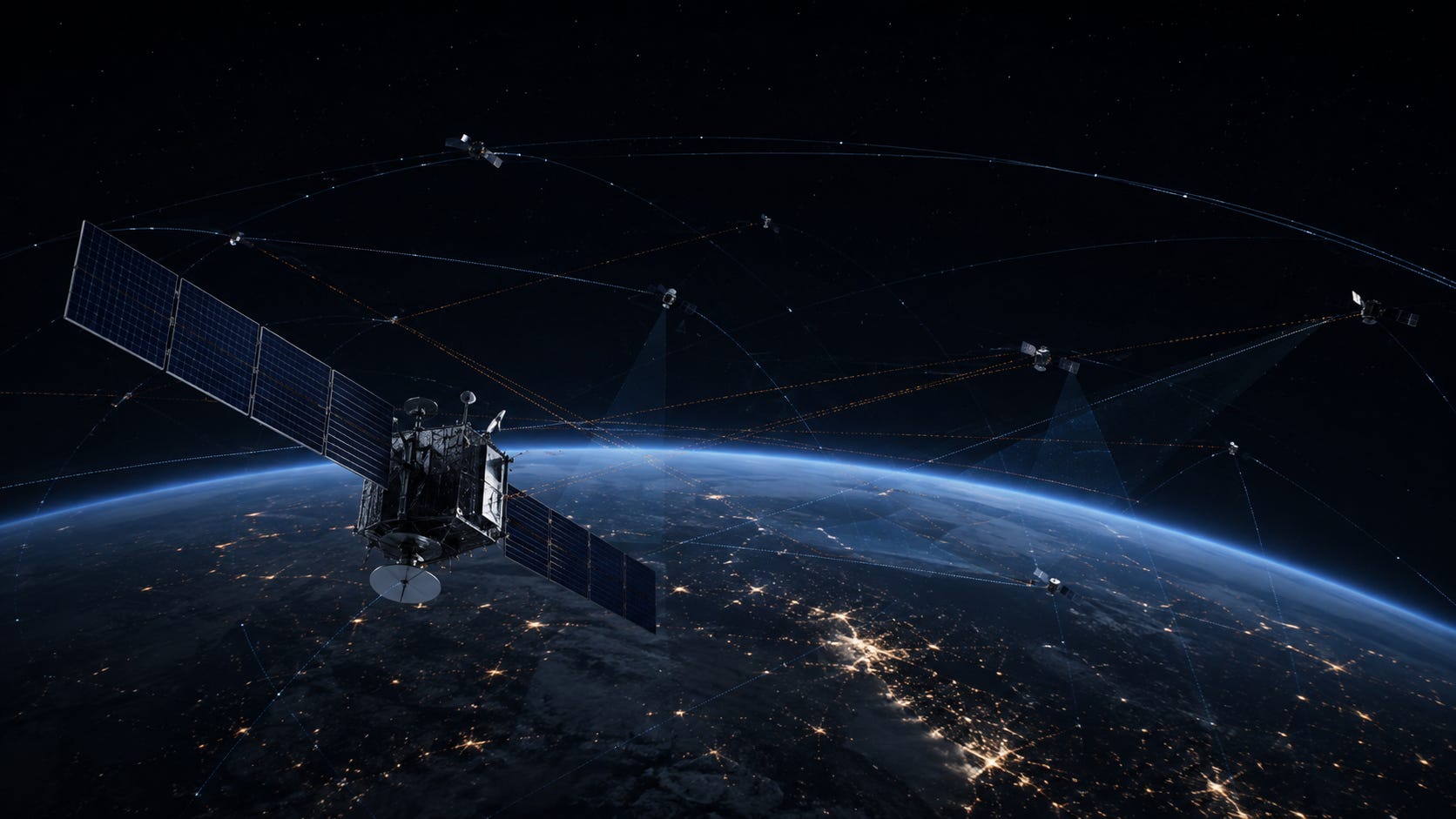
Cover illustration created for GeoSec Insights.
EXECUTIVE SUMMARY
The militarization of space is already an operational reality; the recent change is the depth of military and civilian dependence on orbital systems.
The most likely attacks are not debris-producing missiles but jamming, spoofing, cyber intrusion, laser dazzling or coercive proximity operations.
Through 2030, persistent non-kinetic interference is highly likely, while a limited disabling attack in a major-power crisis is a plausible high-impact scenario.
Commercial systems are now part of the battlespace, increasing resilience while exposing private providers, civilian users and critical infrastructure to military risk.
The appropriate response is resilience combined with restraint: hardened ground systems, alternative positioning and timing, commercial crisis arrangements and clearer limits on dangerous conduct.
Strategic Context
In the early hours of 24 February 2022, one of the first attacks associated with Russia’s full-scale invasion of Ukraine did not take place on land. Approximately one hour before Russian forces crossed the border, a cyberattack struck the KA-SAT satellite network operated by Viasat. Communications were disrupted in Ukraine, but the effects did not remain inside the war zone. Users in several European states also lost service.[1]
No satellite was blown apart, there was no explosion to photograph and no debris cloud spreading across the sky. Yet a space-enabled communications system was attacked at the precise moment when military operations began.
That episode offers a more realistic picture of conflict in space than the images usually associated with the subject. The first sign of a space war may not be a missile rising toward orbit but a navigation receiver that suddenly reports the wrong position, a military unit that loses connectivity, a satellite camera that is temporarily blinded, or a ground station whose software has been compromised. The effect would be felt on Earth even if the attack itself remained invisible.
The militarization of space is therefore not a future scenario but an established condition of modern power. What has changed is the depth of military dependence on orbital systems, the number of actors capable of interfering with them, and the willingness of governments to describe space openly as a domain in which superiority must be achieved and defended. The central danger is not simply that weapons may be placed in orbit. It is that the civilian and military systems operating there have become so closely connected that a limited attack could create consequences far beyond its intended target.