

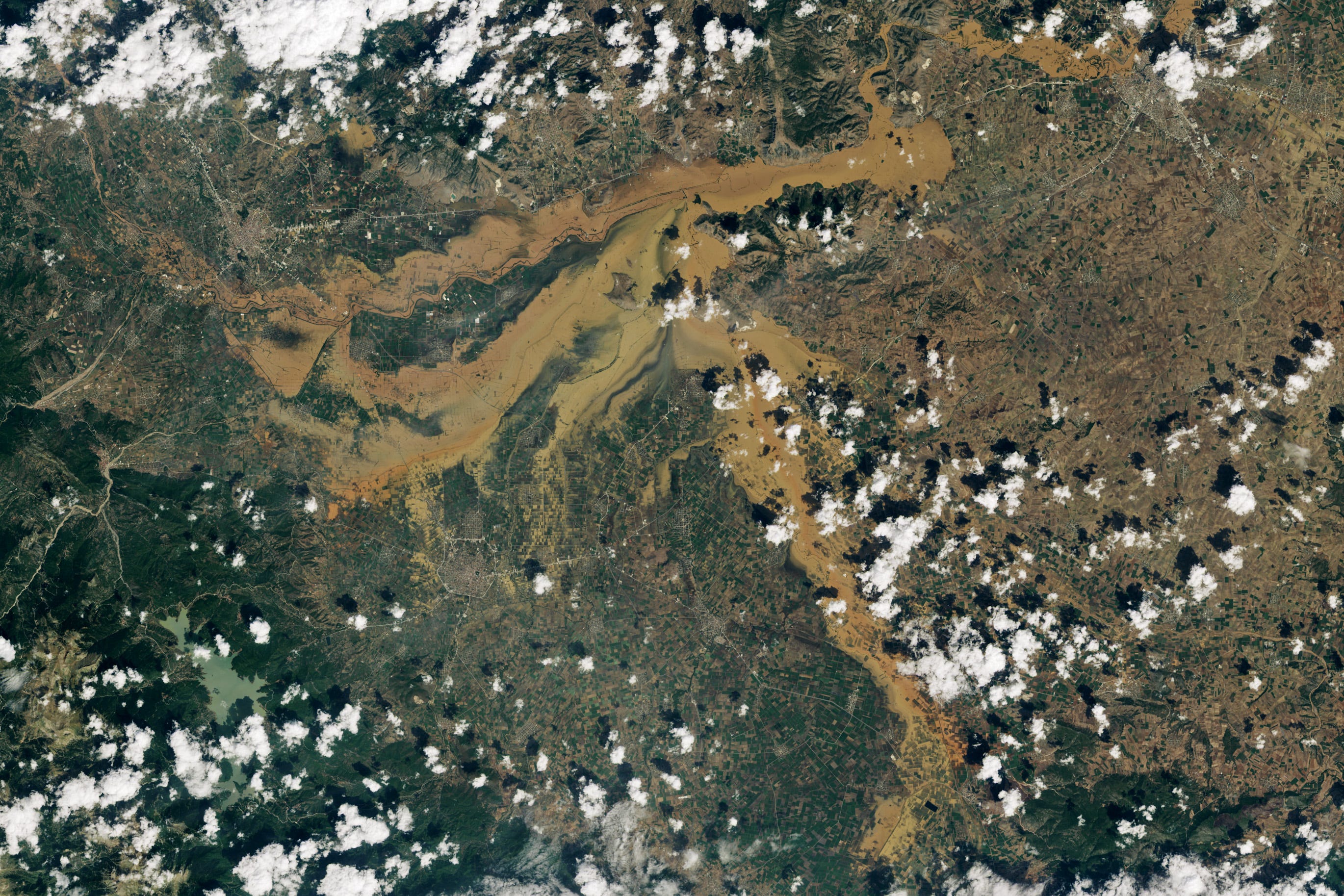
Photo: NASA Earth Observatory image by Lauren Dauphin, using Landsat data from the U.S. Geological Survey.
Executive Summary
Climate change is becoming one of the central risk multipliers of the international system because it increasingly interacts with the pressures that already shape instability: war, food insecurity, weak governance, public-health vulnerability, maritime disruption, debt stress, urban fragility, and contested borders. The subject of “climate refugees” should therefore be approached with precision. The phrase captures a real and growing human vulnerability, but it remains legally incomplete because people displaced by climate change or disasters are not automatically recognized as refugees under the 1951 Refugee Convention unless they also meet the existing legal criteria related to persecution.
The main argument of this report is that climate change will not replace war as the main driver of forced displacement in the near term. Conflict and violence remain the dominant drivers of many of the world’s largest displacement crises, including Sudan, Ukraine, Syria, Afghanistan, Myanmar, Yemen, the Democratic Republic of the Congo, and parts of the Sahel. However, climate change increasingly makes these crises harder to manage because it weakens food systems, damages infrastructure, increases water stress, raises disease risks, disrupts livelihoods, and places additional pressure on host communities that already absorb refugees and internally displaced people.
The year 2026 is especially important because a potentially very strong El Niño is developing at a time when global displacement and humanitarian needs are already high. NOAA’s June 2026 ENSO advisory confirmed that El Niño conditions are present and expected to strengthen into the Northern Hemisphere winter of 2026–27, with a 63 percent chance of a very strong El Niño during November 2026–January 2027 (NOAA Climate Prediction Center, 2026). The precise language matters. This report does not use “super El Niño” as an official scientific category. The more accurate formulation is a potentially very strong El Niño event that may produce significant regional effects in a warmer global climate system.
The geopolitical importance of climate mobility is also becoming more visible through early policy experiments. The Economist’s World Ahead 2026 highlighted the Tuvalu–Australia pathway under the Falepili Union treaty, which allows 280 Tuvaluans to migrate annually to Australia and may become an important precedent in the politics of planned climate mobility (The Economist, 2025). This case should not be generalized too broadly because Tuvalu’s situation is specific, small-island, and treaty-based. However, it matters strategically because it moves climate displacement from abstract future concern into a concrete policy arrangement involving sovereignty, mobility, culture, territory, and long-term state survival.
The main conclusion is that climate displacement cannot be managed only through emergency response after disasters occur. Governments and international institutions need earlier warning, stronger adaptation finance, planned mobility pathways, resilient food systems, better legal tools, stronger host-community support, and closer coordination between climate policy, migration governance, humanitarian response, and conflict prevention. The world is entering a period in which climate change will increasingly shape who moves, who stays, who becomes trapped, and which states can maintain legitimacy under repeated shocks.