

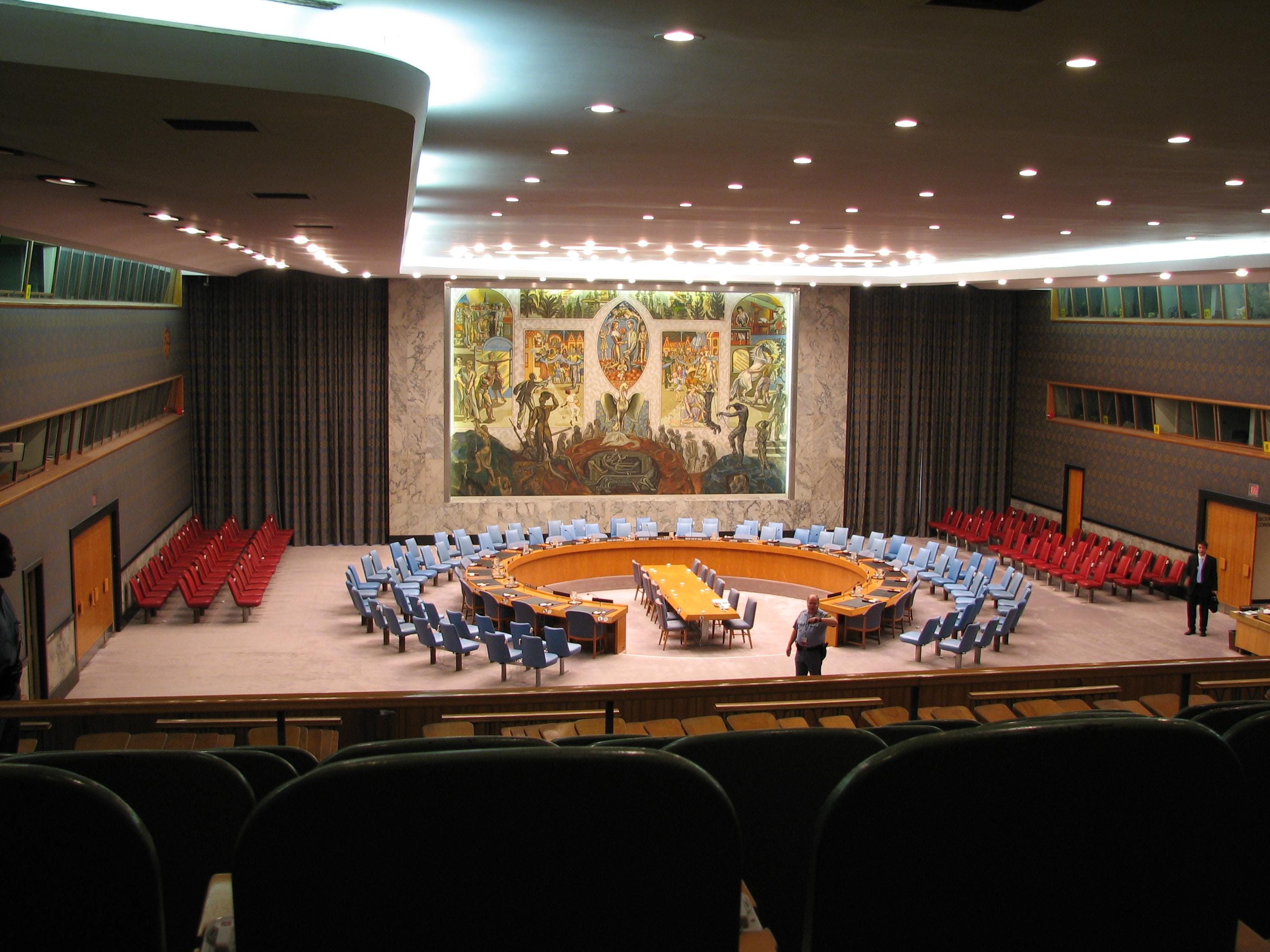
Photo: UN Security Council Chamber /Public Domain
The United Nations Security Council is not weak because it lacks authority. It is vulnerable because its authority increasingly rests on a political structure that no longer reflects the world it is expected to govern. Eight decades after 1945, the Council still carries the legal weight of the postwar order, but it operates in a world shaped by decolonization, demographic change, regional power shifts, strategic competition, and rising demands for representation. The question is therefore not whether the Council still matters because it clearly does. The deeper question is whether it can remain legitimate without reform.
Executive Summary
The United Nations Security Council (UN/SC) remains today the most authoritative institution in the international system for decisions regarding peace, war, sanctions, peacekeeping mandates, and the legal authorization of collective security action. Its decisions still carry a unique legal weight because the Council is the only UN body empowered to adopt binding measures under the UN Charter, including sanctions and the authorization of force. For that reason, the debate over Security Council reform is not a technical discussion about institutional design, but a strategic debate about the future legitimacy of global security governance.
However, the UN/SC was designed in 1945 to preserve great-power participation inside a collective security framework after the failure of its predecessor, the League of Nations (LoN). This design offered permanent seats and veto power to the United States, the Soviet Union, later represented by the Russian Federation, the United Kingdom, France, and China. At the time, this reflected the power distribution that emerged from the World War II. Eight decades later, the UN/SC still carries the authority of the post-1945 order while operating inside a far more complex, multipolar, and regionally fragmented world.
In today’s geopolitical landscape, the distance between legal authority and political legitimacy is widening. Since 1945, the UN itself has expanded from 51 founding members to 193 member states, while decolonization, demographic growth, economic redistribution, and regional power shifts have transformed the global balance of power. That said, Africa has no permanent seat despite representing more than a quarter of UN membership. Additionally, Latin America has no permanent seat while the world’s most populous state, India, and a rising economic and military power, remains outside permanent membership. Other important powers like Japan, Germany and Brazil, also remain excluded from permanent representation. At the same time, the Islamic world and much of the Global South see the UN/SC as structurally distant from their political weight and security concerns.
This resulting not the immediate collapse of the UN/SC but the gradual weakening of its practical relevance. In other words, the Council will continue to exist, meet, vote, mandate peace operations, renew sanctions regimes, and serve as the primary diplomatic theatre for global crises, however, its ability to create binding consensus on the highest-stakes conflicts is becoming increasingly constrained by great-power competition, veto politics, geopolitical fragmentation, and the growing frustration of states excluded from permanent representation.
In this regard, formal reform has become a necessity because the UN/SC’s current structure no longer reflects the political, demographic, and regional realities of the twenty-first century. Simultaneously, a formal reform remains highly unlikely because any amendment to the UN Charter requires adoption by two-thirds of the General Assembly (UN/GA) and ratification by two-thirds of UN members, including all five permanent members of the Security Council (United Nations, 1945). This gives each current permanent member an effective veto over reforms that could undermine its own privilege.
Consequently, we should not expect an immediate institutional reform, but a rather a progressive adaptation to 21st century realities and to the evolving power distribution regionally and globally. These adaptions could eventually prevent the UN, and its most crucial body, the UN/SC, from becoming obsolete.
The main judgment of this report is that the UN/SC faces a high-probability risk of legitimacy erosion and a medium-to-high probability risk of functional bypass over the next decade. The Council is not obsolete, but its unreformed structure is increasingly misaligned with the world it is expected to govern. The challenge for member states is therefore to manage a difficult contradiction: serious reform is essential for long-term legitimacy, while incremental practice-based reform is the most realistic path for near-term risk mitigation.