

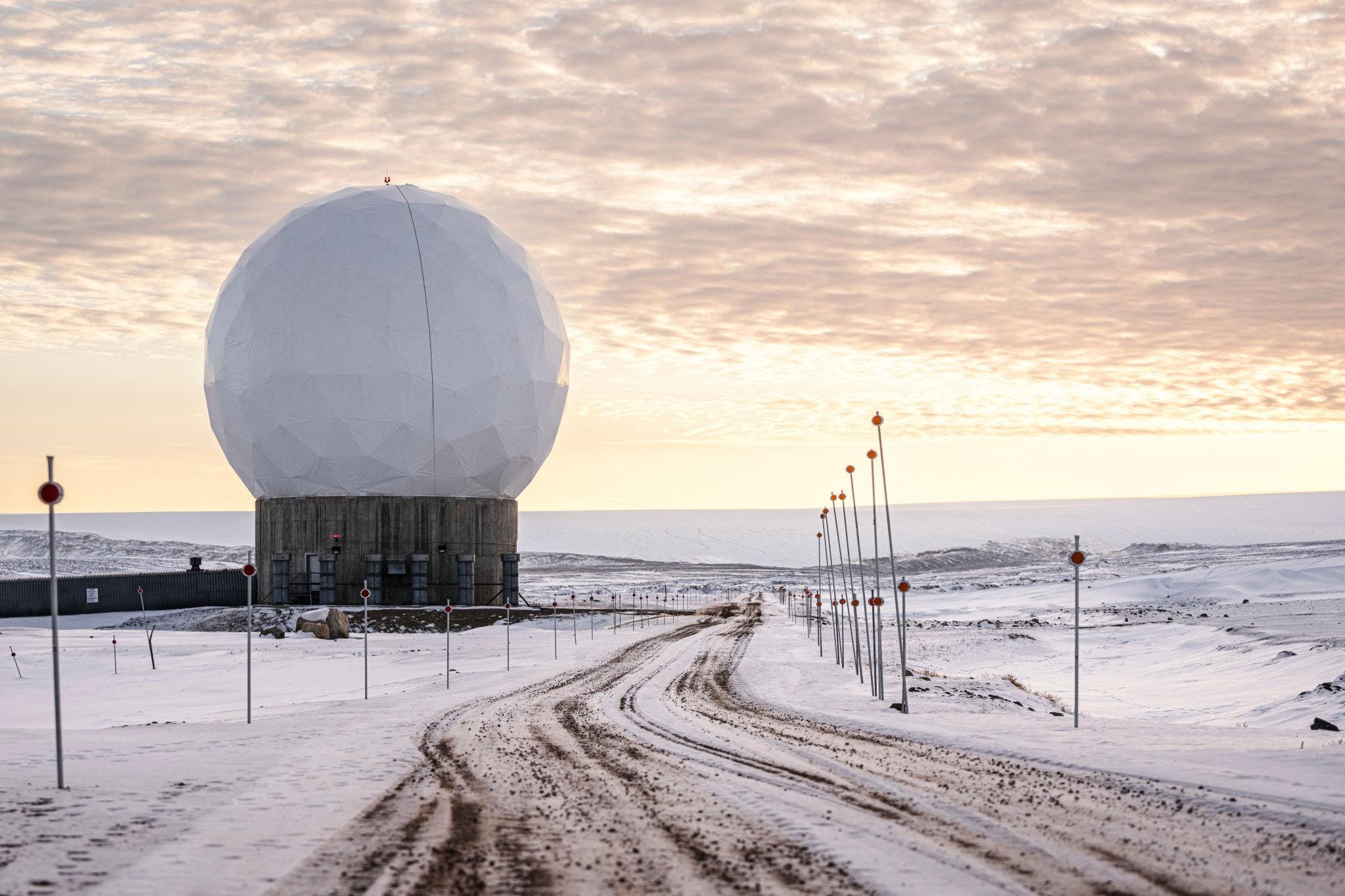
Photo: Radar installation at Pituffik Space Base in northwestern Greenland. Source: U.S. Space Force / Department of Defense, Public Domain
Greenland is no longer a remote Arctic outpost; it is becoming a quiet stress test for NATO itself. As climate change accelerates access, U.S. homeland-defense priorities increasingly shape Arctic decision-making, and European allies struggle to match strategic responsibility with capability, Greenland sits at the intersection of alliance cohesion, deterrence credibility, and great-power competition. This February 2026 risk report examines why the real danger is not an Arctic war, but a gradual erosion of collective defense through unilateralism, gray-zone pressure, and institutional lag. For policymakers, defense planners, and strategic investors, this analysis explains what is already shifting beneath the surface, and what to watch next.
Introduction: Greenland’s Return to Power Politics
Once dismissed as a frozen outpost on the edge of the world, Greenland is suddenly burning hot in the great game of global power. Its ice, its location, and its resources have transformed the island into one of the most strategically sensitive territories in the Arctic system. What was long treated as geopolitical background noise has become a central variable in great-power competition and alliance politics.
Greenland constitutes an Arctic island state belonging to the Kingdom of Denmark while enjoying extensive self-government, including its own parliament and executive authority. Its population, estimated at approximately 56,000 inhabitants in 2020, is concentrated primarily along the western coastline, with around 12,000 residents in Nuuk, the capital. Geographically located in North America and bordering the Arctic Ocean, Greenland is defined by its environment: roughly 81 percent of its surface is permanently covered by ice.
Until recently, the island concerned the international public primarily as a travel destination or for environmental reasons since, due to its geographic position, it serves as an excellent indicator of climate change. The global temperature rise causes ice melting, resulting in a chain of negative environmental impacts across the planet. The deep concern of scientists, NGOs, and global public opinion about the climate is not shared by several governments and companies, as the melting of Arctic ice creates opportunities both in trade and in energy, as we will see below. Due to its location, Greenland is part of the geopolitical system of the Arctic, which has recently attracted the interest of the Great Powers.
For a number of governments and corporations, the retreat of Arctic ice created opportunity rather than alarm. New shipping routes, access to fossil fuels, and the prospect of rare earth extraction reframed the Arctic as a frontier of economic and strategic competition. Greenland, by virtue of its geography, was pulled into this shift whether it sought it or not.
Today, Greenland is no longer merely part of the Arctic system. It is becoming one of its key pressure points. That development has direct consequences for NATO, an alliance that has long benefited from Arctic stability without ever fully governing it.