

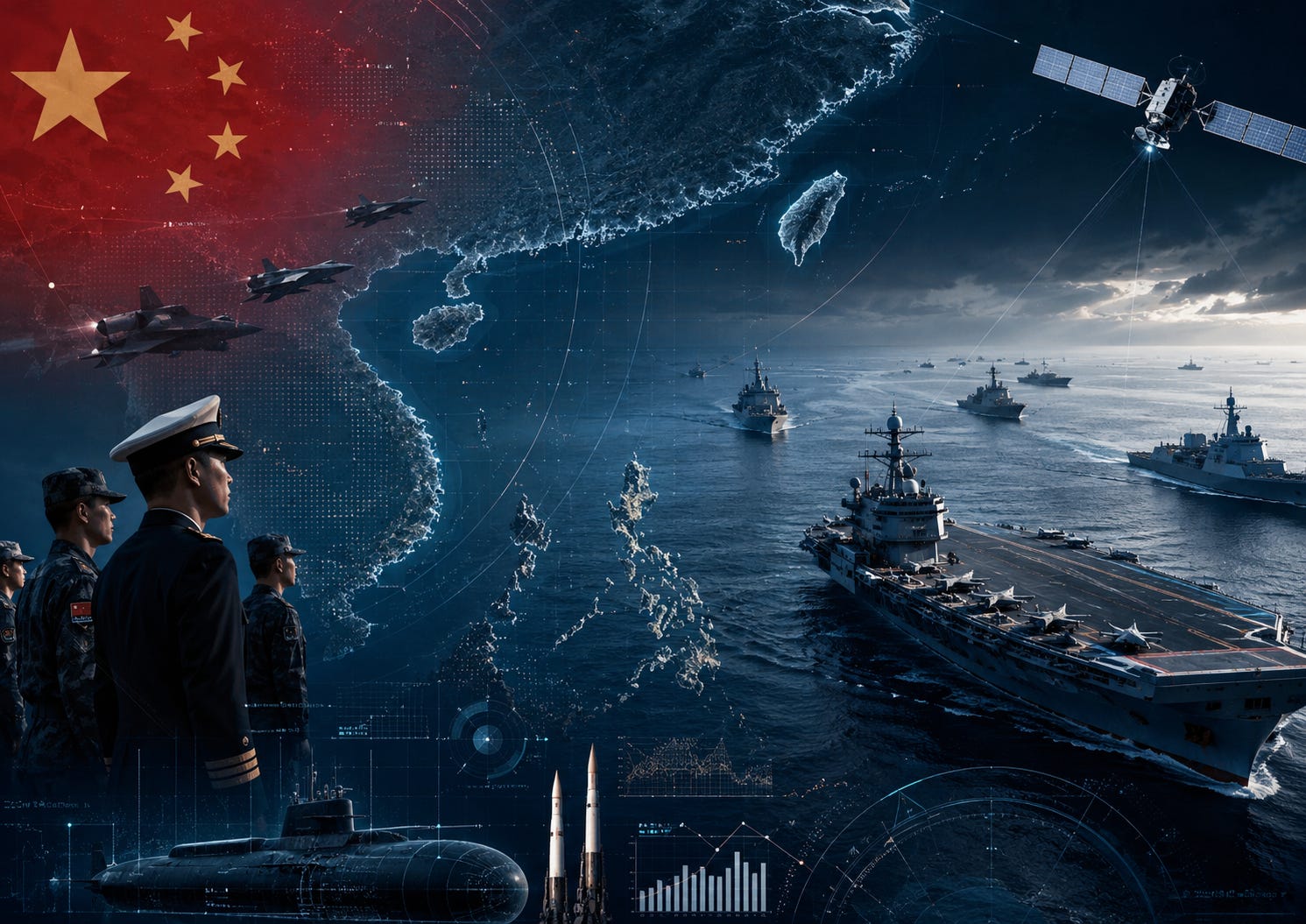
Photo: This is a modern geopolitical image of China’s strategic posture in the Western Pacific, combining naval power, regional geography, military modernization, surveillance technology, and the Taiwan question.
Key Takeaways
The Chinese strategic culture is primarily shaped by historical memory, particularly the Century of Humiliation and the lessons drawn from internal weakness and foreign domination.
National unification, mainly regarding Taiwan, is still the fundamental objective of the Chinese foreign policy.
China’s grand strategy combines the economic and military expansion and regional influence-building under a framework described as active defense.
Confucian hierarchy, Eastern strategic thought, Maoist legacy, and pragmatic adaptation to Western systems all influence modern Chinese strategic behavior.
Beijing seeks not just to rise within the international system, but to restore what it perceives as its historically rightful central position.
PART II. Strategic Doctrine & Contemporary Behavior
The defensive orientation of the country is reflected even in Beijing’s approach to its nuclear weapons (China’s Strategic Defense in the New Era). These are not expected to be used by China for a first strike against the enemy, in contrast to the established nuclear doctrines of the U.S. and the former USSR, and now Russia, which envisaged a first strike. Instead, they are reserved solely for retaliation (a second nuclear strike) (Twomey 2006).
The tension with Taiwan in 1955 led to the development, for the first time, of a nuclear arsenal. The Soviet Union supported this effort, both due to ideological affinity (Twomey 2006). However, the alignment between the two communist regimes did not last, resulting in the withdrawal of Soviet nuclear advisors. This event directly delayed the development of the Chinese nuclear program, with the first nuclear test taking place only in 1964 (Twomey 2006). The build-up of a numerically strong nuclear arsenal was further delayed due to the consequences of the Cultural Revolution, reaching only into the mid-1980s (Twomey 2006).
To this day, China possesses a relatively small nuclear arsenal, always in comparison with those of the U.S. and Russia, while its efforts are focused on modernization rather than expansion. Furthermore, Chinese nuclear strategy, also influenced by Confucianism, rejects the concept of a first nuclear strike, restricting the use of nuclear weapons exclusively to retaliation, as already noted above (Twomey 2006).
At the conventional level, the country’s leadership seeks the development of the armed forces’ capabilities, since their strengthening constitutes the second main pillar of China’s revival, alongside economic growth, ensuring the “Never Again” of the Century of Humiliation (Allison 2018). The foreign powers that defeated China were militarily powerful, especially in terms of their navies. For this reason, Beijing places emphasis on the sea, as it does not wish under any circumstances to repeat the historical mistake of turning its back on the oceans, a decision made in the 15th century under the Ming dynasty, which withdrew the country from maritime affairs (Papasotiriou 2013).
GeoSec Insights is a reader-supported publication. To receive new posts and support my work, consider becoming a free or paid subscriber.
Naturally, the transformation of China from a traditionally land power into a maritime one, correcting the Ming mistake. requires time. Yet the Chinese, due to their culture, can demonstrate particular strategic patience, as we will see further below.
We must also note an important parameter of Chinese strategic culture concerning wartime human losses. Chinese society is tolerant of such losses, in contrast to the West and especially the U.S., so long as Chinese troops fight for the greatness of China (Allison 2018).
Nevertheless, it is clear that the Chinese are not always in a defensive posture, even though their strategic culture is defensive. This paradox is summarized in their expressed strategic doctrine of active defense (China’s Strategic Defense in the New Era): defense at the strategic level, but offense at the operational and tactical levels (Defense Intelligence Agency: China Military Power). Both in times of peace and in times of war, their grand strategy is realist (realpolitik) and therefore flexible (Allison 2018). They faithfully follow Sun Tzu’s advice to be as flexible as water (Koliopoulos 2008).
Indeed, on several occasions during the 20th century they chose to attack first, confirming another significant element of Eastern strategic thought: surprise. Examples include the Korean War in 1950 against the U.S., the 1962 attack on India, the 1969 clashes with the USSR, and the 1979 attack on Vietnam. Surprise attack is a Chinese choice, especially when the country is under pressure, showing indifference even to the size of the opponent (Allison 2018), while applying the doctrine of active defense (Ashraf 2017).
The emphasis that the Chinese place on surprise, deception, and intelligence naturally derives from the tradition of Eastern strategic thought. To show the importance of the above in a single phrase: surprise is considered the key to victory, and deception the key to surprise (Koliopoulos 2008).
It would be a mistake to assume that modern Chinese strategic culture is shaped solely by historical memory. It is a fact that the Chinese armed forces (PLA) systematically study the country’s ancient strategic culture, while not overlooking the fact that it has its limitations in the modern strategic environment (Chiselli 2018). Realistically, and in order to bridge this gap, the PLA does not hesitate to study above all the doctrines of other armed forces as well as their technological achievements, so as to draw conclusions about their methods of operation (Chiselli 2018).
Chinese traditional culture rests upon doctrines and beliefs that continue to permeate its principles to this day. The most important of these is undoubtedly Confucianism, as already noted. Confucianism is not a religion but rather an ethical philosophy, and it served as the country’s ideology during the imperial period (Papassotiriou 2013). According to this doctrine, hierarchy is of crucial importance, as it determines both order and harmony. The Chinese desire that the order governing their social culture be extended to the level of international relations. In other words, they do not seek expansion through conquest, and for this reason military involvement is considered the last resort. A characteristic feature of Chinese culture is that it does not seek to export itself or to impose itself forcibly on other peoples (Twomey 2006).
Furthermore, Confucianism is based on the idea of moral order. In practice, this means that rulers must first and foremost be educated and must govern morally (Papassotiriou 2013). Political hierarchy is identical to social hierarchy and must be harmonious and balanced (Jacques 2012). The model of government and society is based on the family. Within the framework of the Confucian family, the duty of the descendants is to respect the authority of the father, who in turn must protect and care for the members of his family (Jacques 2012). In the Chinese reality, the state is the father, whom the children (the citizens) owe respect and obedience, while the exchange is protection and prosperity. Therefore, the state is a necessary good, as it is the source of order, morality, and meaning (Jacques 2012). Finally, it should be noted that ancestors are of paramount importance within the framework of Confucianism, as they are considered to be permanently present (Jacques 2012).
Confucianism is only one branch of traditional culture. The other branch is Taoism, which is contemporary with Confucianism. It is more introspective and mystical, as it seeks spiritual liberation (Braudel 2007). Buddhism has had a comparatively smaller influence on traditional Chinese culture than Confucianism and Taoism.
The second main pillar of Chinese culture, as we have already noted, is communism. The People’s Republic of China, at its founding in 1949, was supported on three pillars, all under the leadership of Mao Zedong (Papasotiriou 2013). The first concerns the CCP, the second the state, and the third the People’s Liberation Army (Papasotiriou 2013). The gradual emancipation of the CCP from the USSR was completed in 1956 with Nikita Khrushchev’s condemnation of Joseph Stalin (Papasotiriou 2013). Yet Soviet self-criticism affected the CCP and Mao personally, who invited Chinese intellectuals to speak freely about the regime (Papasotiriou 2013).
This move marked the beginning of a process that led to the exile of 700,000 educated Chinese to prisons and labor camps across the country (Papasotiriou 2013). At the same time, the CCP elite distanced itself from the USSR and proclaimed the Great Leap Forward, that is, the radical modernization of the Chinese economy (Papasotiriou 2013). The mobilization of peasants led to a reduction in production, with the result of a sharp increase in deaths from malnutrition and a contraction of the country’s GDP (Papasotiriou 2013).
The solutions proposed by Chen Yun were highly pragmatic and were eventually accepted by Mao (Papasotiriou 2013). The new Chinese economic policy emphasized development through the use of specialized personnel and the provision of material incentives, measures that diverged considerably from what could be called “communist” (Papasotiriou 2013). With this policy, the Chinese economy managed to re-enter a growth trajectory.
Since then, pragmatism has characterized the CCP, whose leader later launched the last domestic political campaign: the Cultural Revolution (1966–1976), which, by the Party’s own admission, inflicted the heaviest losses on the people, the Party, and the state since its founding (Papasotiriou 2013).
The country entered the modern era under the guidance of Deng Xiaoping and Chen Yun, who undertook the task of rapprochement with the West abroad and disengagement from Mao’s Cultural Revolution at home (Papasotiriou 2013). Ultimately, the internal reforms provoked, in 1989, widespread reactions, mainly by students, which led to the events of Tiananmen Square, with losses estimated at 3,000 (Papasotiriou 2013). Despite the internal unrest, the growth of the Chinese economy was impressive, and it continued with undiminished intensity during the first decades of the 21st century, making the country the second-largest economy in the world. In 1997, the handover of Hong Kong by the British authorities to China constituted a milestone, as it satisfied Chinese demands for Western reparations for the damages suffered by the country during the Century of Humiliation (Papasotiriou 2013).
Concluding the reference to China’s political ideology, it should be noted that the CCP is pragmatic, as it has abandoned communist ideology (Feldman 2015). For example, individualism, a hallmark of Western civilization but not of Sinic civilization, has been in full development in recent years, because it is promoted by the Party and its policies that encourage entrepreneurship and consumerism (Feldman 2015). Moreover, the Chinese elites themselves do not appear to be particularly ideologically driven.
Chinese culture displays significant differences compared to its Western counterpart. To understand this difference, we should note that until the late 18th century, that is, relatively recently, China had no conception of diplomatic relations, as it had no established ties with other states: it neither maintained embassies abroad nor permitted foreign embassies on its soil. In fact, it did not even have a Ministry of Foreign Affairs. It is indicative that as late as 1792–1794, Britain unsuccessfully attempted to integrate the country into the European international society of sovereign states as an equal member (Papasotiriou 2013).
The above may appear unusual for Western political thought and culture, but one must not forget that in the Chinese worldview the emperor was the sole ruler on earth, since he was the “Son of Heaven” (Allison 2018). Confucius’s saying that since there are not two suns in the sky, there cannot be two emperors on earth, is indicative (Allison 2018).
Samuel Huntington, in his work The Clash of Civilizations, classifies China under the Confucian civilization, recognizing the significant influence Confucianism has exerted on Chinese culture. In contrast to Western civilization, which primarily promotes individualism, freedom, free markets, democracy, and individual rights, concepts that the Chinese regard with suspicion, as they do anything foreign to them, Chinese culture prioritizes the supremacy of the state over society, and the supremacy of society over the individual (Allison 2018).
Another difference between the two civilizations is found in their perception of time, which is of exceptional importance as it clearly illustrates Beijing’s strategic patience, something that must always be considered (Allison 2018). More specifically, the Chinese, owing to their millennia-long historical trajectory, think in terms of centuries and even millennia, giving priority to securing long-term benefits. The West, by contrast, expects more immediate returns (Allison 2018).
Regarding human rights, Beijing does not reject the fact that they have universal application; however, it incorporates into them “Asian values” in order to justify the different practices of the Chinese authorities, namely, the emphasis on hierarchy and the paternalistic role of the state (Feldman 2015). It would not be an exaggeration to note that China is primarily a civilization which only recently became a nation-state (in the 19th century), and only after being forced to do so by the great powers of the time (Jacques 2012).
We have seen how historical memory significantly influences Chinese culture at the strategic level. But the memories of the Century of Humiliation are not the only ones. For the greater part of its history, China stood at the center of the international system (Twomey 2006). The country’s leading position was so self-evident that it was considered “natural,” both by Chinese society and by the peoples bordering China.
Hierarchy is also of exceptional importance for the Chinese, who perceive their country as superior to all others within the Asian state system (Twomey 2006). It is a fact that Chinese culture and civilization influenced neighboring states such as Taiwan (which Beijing considers Chinese territory), Korea, Japan, and Vietnam (Feldman 2015), while today its radiance is widely diffused even in the West.
For Chinese culture, the country is the center of the world. Indeed, in the Chinese language, the word used for China (Zhongguo) means “Middle Kingdom.” “Middle” here does not refer geographically to a country situated between others, but to one located between Heaven and Earth. This is indicative of the Chinese worldview.
For the Chinese, the rise and dominance of the West is merely a temporary phenomenon, which the current CCP leadership has promised the people will come to an end (Allison 2018). The reader thus understands that in reality, Chinese leadership does not merely aspire to rise to the top of the international system, but to return the country to the position it occupied for centuries and to which it rightfully belongs. Modern China demands respect and recognition from the other powers (Allison 2018).
Conclusion
It is a fact that Chinese culture constitutes a component of Beijing’s soft power, which strengthens the country’s international presence as its economy continues to grow (Nye 2011). Beyond culture, other key components of soft power are political values and foreign policies (Nye 2011), which, however, Beijing does not particularly emphasize on a global scale.
The Chinese may be the only nation in the world so intensely bound to its history. Always faithful to the perception of the superiority of their culture and civilization, they ultimately came into contact with the other great powers — and were defeated by them. This was the infamous Century of Humiliation, the era during which the pendulum of power shifted toward the West.
Yet, imbued with the teachings of Confucianism and Taoism, and carried forward by the triumph of Maoism, the Chinese returned to the forefront of world affairs, developing a peculiar form of nationalism (Braudel 2007). For the West and for the United States they are usurpers of hegemony; for themselves, they are restorers to the rightful position to which they belong. They ardently desire respect and recognition from all.
China’s strategic culture does not explain every political decision made by the country’s leadership, but it undoubtedly constitutes a valuable tool for understanding the international system as it is shaped today by Beijing’s rapid rise. As Napoleon remarked: the dragon appears to have awakened…
I would be interested to hear your thoughts on this issue.
Thank you for reading GeoSec Insights. I research geopolitics, international security, war, and shifts in global power to understand the deeper forces shaping events beyond the daily headlines. If this analysis helped you see the issue more clearly, please consider sharing it with someone who may also find it useful.
Bibliography
Katsoulas, Spyros. 2017. The Concept of Strategic Culture. Athens: Stratigikon.
Koliopoulos, Konstantinos. 2008. Strategic Thought from Antiquity to the Present. Athens: Poiotita.
Papassotiriou, Charalambos. 2013. China: From the Heavenly Empire to the Emerging Superpower of the 21st Century. Athens: Poiotita.
Paschalidis, Grigoris. 1999. Introduction to the Concept of Culture, in Introduction to Greek Culture, Vol. A. Patras: Hellenic Open University Press.
Allison, Graham. 2018. Destined for War: Can America and China Escape Thucydides’s Trap? New York: First Mariner Books.
Ashraf, Junaid. 2017. “String of Pearls and China’s Emerging Strategic Culture.” Strategic Studies 37.
Braudel, Fernand. 2007. Grammatica of Civilizations. Athens: MIET.
Defense Intelligence Agency. 2019. China Military Power: Modernizing a Force to Fight and Win. Washington: DIA Military Power Publications.
Feldman, Noah. 2015. Cool War: The Future of Global Competition. New York: Random House, an imprint of Penguin Random House LLC.
Ghiselli, Andrea. 2018. “Revising China’s Strategic Culture: Contemporary Cherry-Picking of Ancient Strategic Thought.” Cambridge University Press.
Gray, Colin S. 1981. National Style in Strategy: The American Example. Cambridge, MA: MIT Press.
Haglund, David G. 2014. “What Can Strategic Culture Contribute to Our Understanding of Security Policies in the Asia-Pacific Region?” Contemporary Security Policy 35.
Huntington, Samuel. 2017. The Clash of Civilizations and the Remaking of World Order. Athens: Patakis.
Jacques, Martin. 2012. When China Rules the World: The End of the Western World and the Birth of a New Global Order. New York: Penguin Books.
Nye, Joseph S. 2011. The Future of Power. New York: PublicAffairs.
Snyder, Jack L. 1977. The Soviet Strategic Culture: Implications for Limited Nuclear Operation. RAND Corporation.
The State Council Information Office of the People’s Republic of China. 2019. China’s National Defense in the New Era. Beijing: Foreign Languages Press.
Twomey, Christopher P. 2006. Chinese Strategic Cultures: Survey and Critique. SAIC.
Sun Tzu. 2008. The Art of War. Athens: Oxy.
Ying, Fan. 2000. “A Classification of Chinese Culture.” Cross Cultural Management: An International Journal 7(2).