

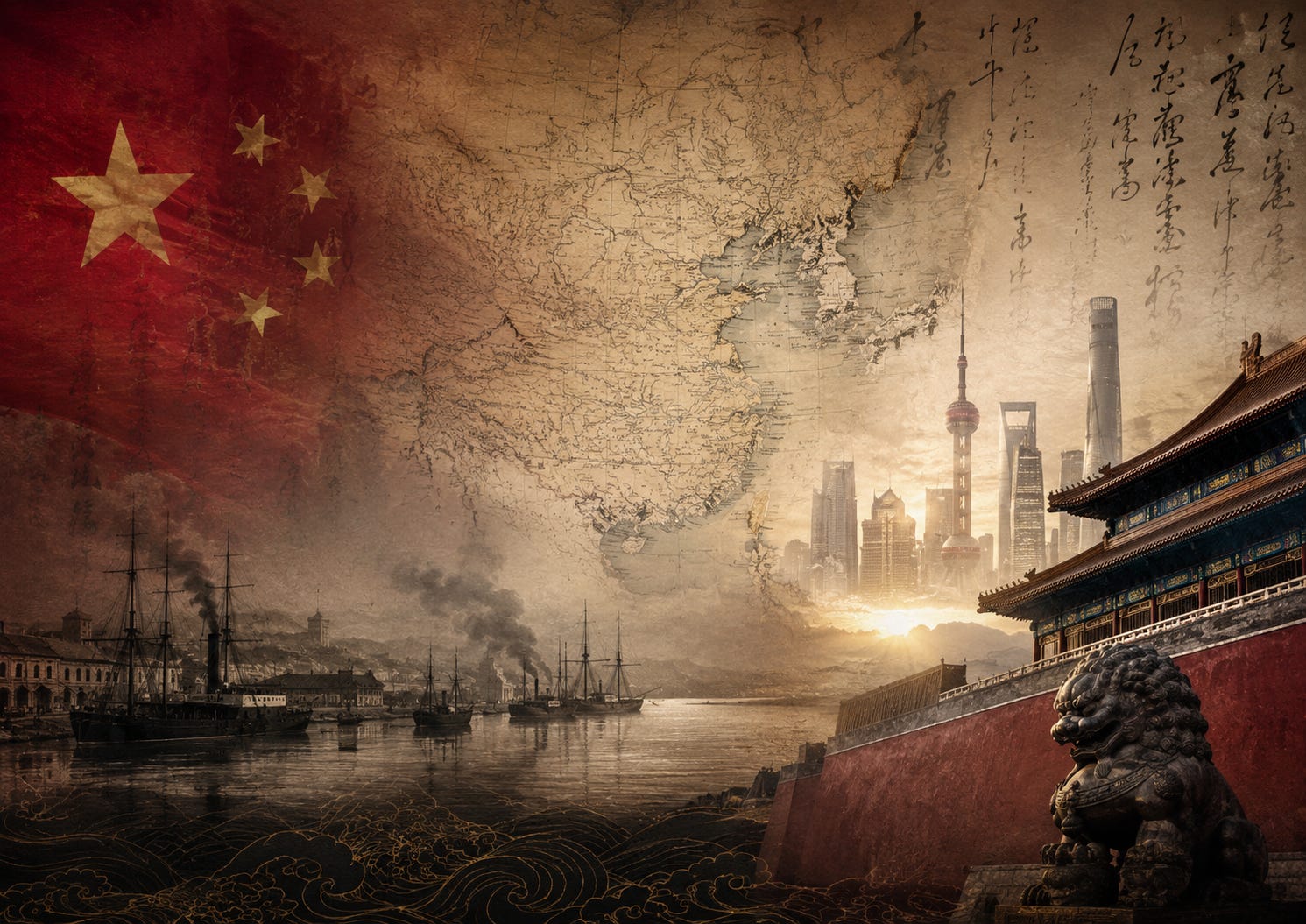
Photo: This is a symbolic visual journey through Chinese historical memory, blending old maps, maritime encounters, imperial architecture, calligraphy, and modern China.
Key Takeaways
The Chinese strategic culture is primarily shaped by historical memory, particularly the Century of Humiliation and the lessons drawn from internal weakness and foreign domination.
National unification, mainly regarding Taiwan, is still the fundamental objective of the Chinese foreign policy.
China’s grand strategy combines the economic and military expansion and regional influence-building under a framework described as active defense.
Confucian hierarchy, Eastern strategic thought, Maoist legacy, and pragmatic adaptation to Western systems all influence modern Chinese strategic behavior.
Beijing seeks not just to rise within the international system, but to restore what it perceives as its historically rightful central position.
PART I. Historical Memory & Cultural Foundations
Issue Overview: China’s Path from Humiliation to Strategic Revival
When the West thinks of China, it often imagines a rising power in purely economic or military terms. But behind the numbers, ships, and missiles lie something far older. A worldview shaped by thousands of years of history, humiliation, and philosophy. To understand China’s next moves, one must first understand its strategic culture, a lens through which Beijing interprets the world, justifies its actions, and defines its destiny.
Introduction
19th, 20th, and 21st Century: China’s Path from Humiliation to Dominance
It is an indisputable fact that the most significant rivalry of the modern era is between the United States (U.S.) and the People’s Republic of China (China), as they are the two most powerful states of the modern international system. The evolution of this rivalry, hegemonic, as termed in the discipline of International Relations, can affect the entire state system in multiple ways. For this reason, various scholars attempt to analyze the behavior of the U.S. and China to extract, as safely as possible, conclusions regarding the form their rivalry will take in the near future.
Obviously, International Relations theory constitutes the basis of analysis, with multiple levels (system, state, individual), as well as the areas upon which it focuses. The purpose of this paper is to concentrate on the field of Chinese strategic culture, as it constitutes an indicator that can help provide a broader understanding of the country’s strategic behavior and the policy decisions made by its leadership. However, caution is needed: strategic culture[1] is a tool for understanding strategic behavior, but it should always be treated as such. As a concept, it can explain every political decision, since actors inevitably possess culture, but it cannot predict future state behaviors. It constitutes only one parameter of Chinese strategy, essentially offering an interpretation of the causes for specific strategic decisions (foreign policy decisions), by no means the only one, since strategy by nature is a continuously evolving process.
More specifically, the strategic objective of Chinese foreign policy is national unification, that is, today, the annexation of Taiwan into the mainland, so that unity is restored after it was disrupted by the victory of Mao’s communists in 1949 and the flight of the nationalists to the island of Taiwan (Papasotiriou 2013). Its rapid economic development presupposes that trade routes and supply lines remain unaffected by any threat, whether originating from state or non-state actors.
In China’s National Defense in the New Era (2019), the Chinese national strategy is recorded. According to it, Beijing explicitly considers the U.S. solely responsible for the intensification of international strategic competition, since its policies undermine China (China’s Strategic Defense in the New Era). The U.S., as the most powerful actor in the East Asian region, possesses the strongest navy in the world and a network of alliances/agreements with states that are Beijing’s rivals in the area. Consequently, China, which fervently desires its economic development to continue unimpeded, seeks to protect its fragile trade routes and supply lines from the American threat, while at the same time replacing the U.S. as the leader of its region by increasing its influence economically, politically, diplomatically, and militarily.
This will be achieved through economic strengthening, in the framework of which the colossal investment program One Belt One Road has been launched, and through the attainment of naval supremacy with the clear reinforcement of the Chinese armed forces in all sectors (Ashraf 2017). Finally, it seeks the reform of the entire International System of states to its own advantage.
The characteristics of Chinese strategic culture, to which we will refer more extensively later, are the following: traditional culture with centuries of history and principal influences from Confucianism, Taoism, and to a lesser extent Buddhism; Eastern strategic thought as depicted in the work of Sun Tzu; and historical memory, since the Han Chinese are a people profoundly tied to their millennia-long history, the origins of which go back to around 2200 BC (Papasotiriou 2013).
Other characteristics of modern Chinese strategic culture are Maoism as political ideology, as well as Western influences that affect the country’s political elites. Another feature is the partial abandonment of isolationism, as the country increasingly concludes economic agreements with other states, and also the partial abandonment of the doctrine of “peaceful rise,” since it now appears to assert sovereignty dynamically in the South China Sea at the expense of its neighbors and the U.S. (Ashraf 2017).
Therefore, Chinese strategic culture is shaped by geopolitical, historical, economic, and religious factors, offering the framework within which the leadership’s strategic ideas and policies are formulated (Gray 1981).
GeoSec Insights is a reader-supported publication. To receive new posts and support my work, consider becoming a free or paid subscriber.
Evidence & Analysis: Foundations of Modern Chinese Strategic Culture
Chinese Strategic Culture
Modern Chinese strategic culture is distinct and unique, both because of the country’s geography and because of its millennia-long history. It is naturally rooted in modern Chinese culture, which is a mixture of three elements: traditional culture, communist ideology, and Western influence (Fan 2000).
Culture constitutes a constantly evolving entity, dependent on geopolitical and technological changes (Twomey 2006). Traditional Chinese culture possesses a history of thousands of years[2], a language, despite its variations during its evolution, and incorporates different religions, philosophies, and schools of thought such as Confucianism, Taoism, and Buddhism (Fan 2000), as we will see below.
Similarly, modern Chinese strategic culture, shaped over the centuries, developed because of the shock of defeat in the Opium Wars and the Century of Humiliation. Contributing to this formation was also the definitive collapse of the imperial system in the 20th century, since the Confucian system proved inadequate for the industrial age (Papasotiriou 2013).
For modern Chinese, their history teaches that any internal weakness or division will ultimately be exploited by foreign powers (Twomey 2006). In particular, the most recent Century of Humiliation was the result of internal division, which facilitated the invasion of foreign powers (British, French, Dutch, Germans, Americans, Soviets, and especially Japanese) (Twomey 2006).
Because of their millennia-long history, the Chinese shape their strategy based on principles drawn from historical events (Allison 2018). A characteristic example is the enormous investment program that will help the country project its power on a global scale, shifting the balance of power in Asia through the unification of Eurasia (Twomey 2006).
This specific investment program, announced by current President Xi Jinping during an official visit to Kazakhstan in 2013, is equivalent to 25 Marshall Plans and is called the Belt and Road Initiative (BRI) (Ashraf 2017), formerly known as One Belt One Road (OBOR), or, in Greek translation, the “New Silk Road”, showing its connection to the historical Chinese trade routes.
Historical memory is omnipresent in modern China. These extremely traumatic memories of the Century of Humiliation lead the leadership of the CCP (Chinese Communist Party) to pursue internal stability imperatively, regardless of cost (for example, with regard to human rights) (Twomey 2006).
The objectives of the Chinese leadership are threefold. First, it seeks the restoration of the country’s grandeur, meaning its return to the dominance it enjoyed before Western intrusion (demand for regional supremacy). Second, it seeks to secure absolute control over the territories of greater China, including Taiwan (demanding from neighboring states that they recognize and respect Chinese superiority). And finally, it desires the revival of its historic sphere of influence, both land and maritime, so that it will be accepted and respected by the other great powers (Allison 2018).
Recovering lost prestige and respect is of paramount importance. As long as the Chinese President promises this, while simultaneously delivering economic growth regardless of environmental cost, the Party retains legitimacy within society (Twomey 2006). Consequently, historical memory contributes to the shaping of Chinese strategic culture in such a way that it relentlessly pursues internal stability and cohesion, meaning it must display no weakness outwardly that could invite foreign powers (as in the events in Hong Kong and the harshness with which demonstrators have been and continue to be treated by the authorities).
Indeed, internal instability combined with exposure to the industrialized West in the first half of the 19th century brought about the end of Chinese dominance. Since then, military confrontations with foreign powers consistently resulted in Chinese defeat, indicatively: in 1839 with the First Opium War; in 1856 with the Second; in 1894 with Japan’s invasion and the conquest of Manchuria; in 1899 with the Boxer Rebellion, against which eight states united and ultimately overthrew the Qing dynasty in 1912; the renewed civil war; and the new Japanese invasion in 1937, which caused the deaths of more than 20 million Chinese (Twomey 2006).
The communist seizure of power in 1949 marked the end of the Century of Humiliation. Precisely these achievements of Mao (leader of the communists) remain to this day the core of the CCP’s legitimacy, as he is credited with saving the country and expelling the foreign powers (Twomey 2006).
Today, Chinese students are taught the feeling of shame associated with the Century of Humiliation and the aforementioned defeats. The lesson drawn from these defeats is simple: Never again, and nothing is ever forgotten (Twomey 2006). Patriotism, a peculiar form of nationalism, is reinforced by the need to avenge the national humiliation suffered by the country. Moreover, it is extremely useful for the CCP, since it derives legitimacy from society, especially at a time when economic growth appears to be slowing (Twomey 2006).
The current CCP leadership seeks the strengthening of the country and the expulsion of the U.S. from its periphery, even as it recognizes that, essentially, it was because of Washington that the much-desired stability and security existed in the region, which allowed for uninterrupted economic prosperity. Geographically, the field of confrontation is located in the South China Sea (Allison 2018).
International relations scholars have long commented on Beijing’s reluctance to replace the U.S. as overseer in areas from which the latter withdraws. This Chinese reluctance may appear surprising, but it is entirely consistent with the country’s strategic culture, which is primarily defensive (Allison 2018).
Of course, this development was influenced by Confucianism as well as the Eastern tradition of strategic thought, summarized masterfully in the work of Sun Tzu, who was himself a follower of Confucianism (Koliopoulos 2008). According to this doctrine, presented in the form of maxims in The Art of War, war is one of the available tools of politics and must be employed rationally (Koliopoulos 2008). Furthermore, offensive operations are considered particularly costly and should therefore be avoided. What is paramount is systematic analysis, knowledge of oneself, of the opponent, and of the battlefield (Koliopoulos 2008).
Supreme success is defined as the enemy’s surrender without battle (Sun Tzu 2008), since for Chinese strategists’ war is primarily psychological and political (Allison 2018). Moreover, the best strategy is to attack the enemy’s strategy itself in order to achieve victory as quickly as possible (Koliopoulos 2008).
I would be interested to hear your thoughts on this issue.
Thank you for reading GeoSec Insights. I research geopolitics, international security, war, and shifts in global power to understand the deeper forces shaping events beyond the daily headlines. If this analysis helped you see the issue more clearly, please consider sharing it with someone who may also find it useful.
Bibliography
Katsoulas, Spyros. 2017. The Concept of Strategic Culture. Athens: Stratigikon.
Koliopoulos, Konstantinos. 2008. Strategic Thought from Antiquity to the Present. Athens: Poiotita.
Papasotiriou, Charalambos. 2013. China: From the Heavenly Empire to the Emerging Superpower of the 21st Century. Athens: Poiotita.
Paschalidis, Grigoris. 1999. Introduction to the Concept of Culture, in Introduction to Greek Culture, Vol. A. Patras: Hellenic Open University Press.
Allison, Graham. 2018. Destined for War: Can America and China Escape Thucydides’s Trap? New York: First Mariner Books.
Ashraf, Junaid. 2017. “String of Pearls and China’s Emerging Strategic Culture.” Strategic Studies 37.
Braudel, Fernand. 2007. Grammatica of Civilizations. Athens: MIET.
Defense Intelligence Agency. 2019. China Military Power: Modernizing a Force to Fight and Win. Washington: DIA Military Power Publications.
Feldman, Noah. 2015. Cool War: The Future of Global Competition. New York: Random House, an imprint of Penguin Random House LLC.
Ghiselli, Andrea. 2018. “Revising China’s Strategic Culture: Contemporary Cherry-Picking of Ancient Strategic Thought.” Cambridge University Press.
Gray, Colin S. 1981. National Style in Strategy: The American Example. Cambridge, MA: MIT Press.
Haglund, David G. 2014. “What Can Strategic Culture Contribute to Our Understanding of Security Policies in the Asia-Pacific Region?” Contemporary Security Policy 35.
Huntington, Samuel. 2017. The Clash of Civilizations and the Remaking of World Order. Athens: Patakis.
Jacques, Martin. 2012. When China Rules the World: The End of the Western World and the Birth of a New Global Order. New York: Penguin Books.
Nye, Joseph S. 2011. The Future of Power. New York: PublicAffairs.
Snyder, Jack L. 1977. The Soviet Strategic Culture: Implications for Limited Nuclear Operation. RAND Corporation.
The State Council Information Office of the People’s Republic of China. 2019. China’s National Defense in the New Era. Beijing: Foreign Languages Press.
Twomey, Christopher P. 2006. Chinese Strategic Cultures: Survey and Critique. SAIC.
Sun Tzu. 2008. The Art of War. Athens: Oxy.
Ying, Fan. 2000. “A Classification of Chinese Culture.” Cross Cultural Management: An International Journal 7(2).
[1] Our purpose is to introduce the reader to Chinese strategic culture. For the sake of clarity, since the term itself is not particularly developed in Greece — we will here provide what we consider the most complete definition: strategic culture constitutes a set of beliefs, mentalities, and behavioral patterns of a geographically defined collective entity with a historical experience (Katsoulas 2017). The term was coined in 1977, when Jack Snyder, in a study, attempted to show the different approaches of American and Soviet strategists to limited nuclear war (see Jack L. Snyder, The Soviet Strategic Culture: Implications for Limited Nuclear Operation, RAND, 1977). As the reader may understand, this definition is multidimensional, since there is difficulty even in defining the concept of culture itself, as the latter is a linguistic borrowing (see Grigoris Paschalidis, Introduction to the Concept of Culture, in Introduction to Greek Culture, Vol. A, HOU, 1999). The strategic culture of a state depends on its internal structures, socio-economic organization, political regime, geography, and historical memory (Katsoulas 2017). It does not concern only the conduct of war, as it also arises from technological infrastructure and is based on political ideologies, consequently linking it to the geopolitical position of each state (Haglund 2014). These are only some of the factors influencing the decision-making process in the field of international relations. States in the international system are considered fundamentally rational actors, but it is well known that they do not all act in exactly the same way. This very differentiation is what the theory of strategic culture attempts to explain (Katsoulas 2017). Two further observations regarding strategic culture: First, the concept of culture should not be confused with that of education (paideia), as it is broader and indeed encompasses it (Paschalidis 1999). Second, culture is often confused with the concept of civilization, especially in the Greek language, since as noted it is a linguistic borrowing. It is not the purpose here to analyze the etymology of the two terms, but it suffices to mention that they are essentially complementary, as they both describe the same phenomenon: human creation in a specific era (Paschalidis 1999). Culture refers more to intangible achievements, while civilization refers to material ones (Paschalidis 1999). Finally, it is important to highlight the distinction between strategic culture and strategy so as to avoid confusion. Strategy is understood as the alignment of means and ends under the prism of an actual or potential conflict, and it presupposes the existence of at least one opponent (Koliopoulos 2008). In conclusion, the continued study of strategic culture will further contribute to understanding the role of culture in international relations (Chiselli 2018).
[2] Spoken Chinese differs considerably from region to region; however, the same is not true for the written language, since the use of ideograms rather than an alphabet rendered it uniform throughout the entire country (see Ch. Papassotiriou, China: From the Heavenly Empire to the Emerging Superpower of the 21st Century).
The emphasis on strategic culture is useful because it moves beyond GDP, military spending, and capability metrics. Understanding how Beijing views history, sovereignty, and national rejuvenation may be just as important as measuring its material power.