

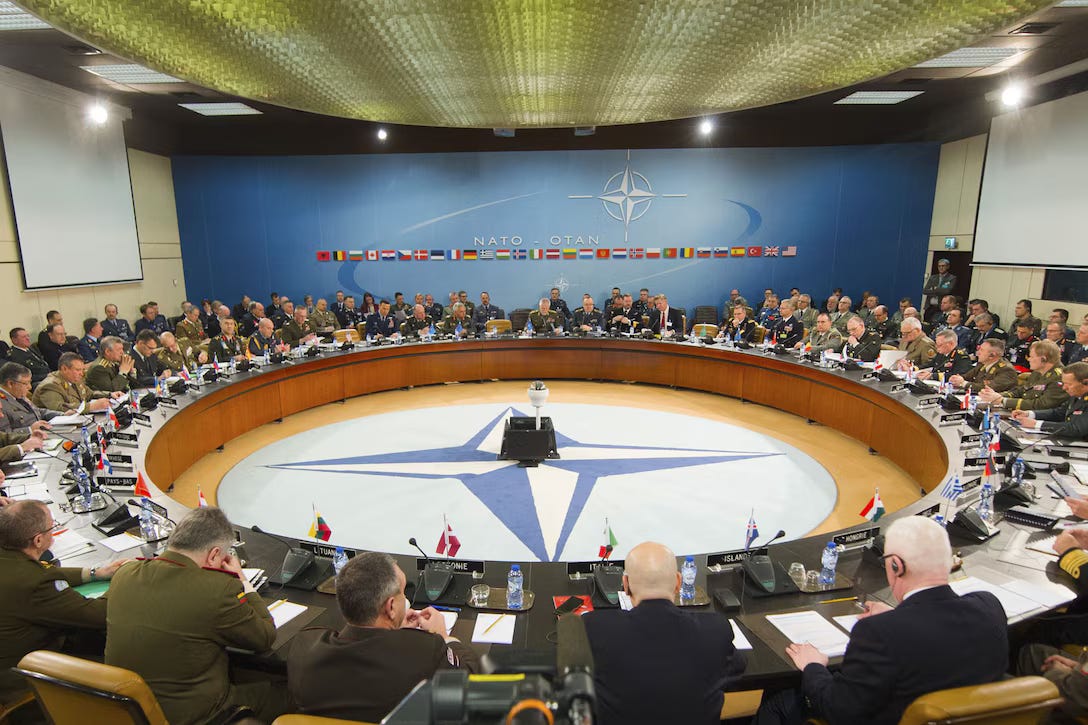
Photo: NATO Military Committee meeting at NATO headquarters in Brussels. Credit DoD photo by Navy Petty Officer 1st Class Dominique A. Pineiro / Public Domain
Key Takeaways
The war in Iran has exposed a serious political split inside the Atlantic alliance regarding the limits of European support for U.S. military action outside NATO’s collective-defense framework, which can potentially damage the alliance itself (NATO 1949).
Several European nations like France, Germany, Spain, Italy, and Poland have each restricted aspects of U.S. military access linked to the conflict. This selective and uneven alliance response has led top U.S. officials to state openly that Washington will rethink its commitment to NATO.
Recent reporting indicates that U.S. officials have discussed punitive options against allies viewed as uncooperative, including symbolic measures against Spain and a reassessment of U.S. diplomatic support for certain British interests. NATO officials have also clarified that the founding treaty has no mechanism for suspending a member state, which makes some of these options legally difficult but politically significant.
The most important consequence is political since trust among the allies has weakened, while Washington is more willing to judge allies by their defense spending and their strategic usefulness, access, and political alignment in crisis.
The U.S. can readjust its commitment to NATO and even create an “alliance of the willing” and the strategic useful to its core interests in a more transactional terms, relying more on flexible coalitions rather than automatic alliance solidarity (NATO 2025).
Introduction
The war against Iran has opened a new and serious fault line in transatlantic relations. The main issue is not whether NATO still exists as the central military alliance in the Euro-Atlantic space but whether Washington and key European capitals still understand alliance solidarity in the same way. Now, the answer appears to be no as NATO is facing its most severe crisis since it was founded in 1949.
Several European governments have made clear that they do not consider NATO membership an automatic obligation to facilitate a U.S.-led war outside the treaty’s collective-defense framework. That distinction is central since NATO was created to defend allied territory against external attack, not to function as a blank check for every military operation launched by one member beyond the North Atlantic area. Article 5 remains tied to collective defense, and Article 6 defines the treaty’s scope (NATO 1949; NATO 2025). Consequently, the Iran war falls outside that default logic. What has changed is that the core European allies are no longer treating this as a technical legal point but instead, they are enforcing it politically and operationally.
That is why the restrictions imposed by those allies matter. More specifically, reports suggest that Spain closed its airspace to U.S. military aircraft involved in attacks on Iran and had already refused the use of jointly operated bases for those operations. Italy denied U.S. aircraft access to Sigonella for Middle East operations without prior authorization. France also maintained restrictions on U.S. military flights and related support tied to the conflict. Germany even though allowed the use of Ramstein Air Base from the U.S. forces; it has repeatedly denied its participation in the war by rejecting calls to send its warships in the Strait of Hormuz. Additionally, Poland has rejected the informal U.S. request to send its Patriot air defense system to the Middle East. Polish officials, including the Minister of Defense, stated that the Patriot systems are crucial for protecting polish air space and the Eastern flag of NATO.
Together these decisions alongside the denial of the U.K. to enter the war in Iran indicate that Europe’s strategic priority is different from the American and the assumption that the U.S. forces have automatic access across allied territory in no longer valid. In this strategic environment, NATO is still there but it is becoming a conditional alliance in practice, a very different political climate from the one that defined earlier phases of the transatlantic relationship.
This conditional logic became clearer after many reports suggested that an internal Pentagon email outlined possible measures against NATO allies that Washington believes failed to support U.S. operations in the Iran war. The reported options included measures against Spain and a possible reassessment of U.S. diplomatic support for British sovereignty over the Falkland Islands. The key point is not that NATO can easily suspend a member state; the treaty does not provide a simple mechanism for that. The real point is political indicating that parts of the U.S. administration are now thinking about alliance discipline in punitive terms. This means that NATO membership may remain formally equal, while U.S. treatment of allies becomes increasingly unequal in practice.
The consequences for U.S.-Europe relations are already visible
To begin with, trust among allies have been damaged because several European states appear to believe that they were expected to absorb the military, political, and economic risks of a U.S.-Israeli war without meaningful prior consultation. That matters because alliances do not function only through treaty text but also through process, especially consultation before escalation. When that process weakens, support becomes conditional. In other words, for the European allies solidarity cannot be demanded especially since Washington took unilateral action without their fully support in a war that many Europeans consider reckless and strategic mistake.
Additionally, the war in Iran has reinforced European concerns about the increasingly transactional character of U.S. leadership. The clearest sign came on March 31, when Defense Secretary Pete Hegseth declined to clearly reaffirm America’s commitment to NATO’s collective-defense principle and said the matter was ultimately up to President Donald Trump. Even if this was intended as leverage, the message was damaging because it blurred the line between disagreement over the ongoing war in Iran and the credibility of America’s broader security guarantee to Europe. Since these issues are linked, NATO begins to look less like a strategic community and more like a conditional bargain: support Washington when asked or face the consequences later. To make matters worse, U.S. Secretary of State Marco Rubio stated that Washington should re-examine its security relations NATO after the war in Iran.
The American statements are particularly dangerous specifically for European states that are closest to Russia. Europe and Russia know that the value of NATO rests above all on the credibility of U.S. power. If Washington begins to imply that collective defense itself is open to political bargaining, then deterrence weakens. In this context, even if the immediate dispute is about Iran, the strategic audience includes Russia as well. That is why careless ambiguity on Article 5 has effects far beyond the Middle East (NATO 2025).
Also, the economic consequences of the war are pushing Europe toward greater caution. Recent reports suggest that the E.U. was considering reviving parts of its 2022 emergency energy toolkit because of the risk of prolonged market disruption linked to the war. This matters for transatlantic relations because it increases the domestic political cost, in Europe, of alignment with U.S. strategy. Even where direct dependence on Middle Eastern energy is lower than in previous decades, price shocks, shipping disruption, and market anxiety still hit European economies quickly. The longer that pressure continues, the harder it becomes for European governments to justify support for an open-ended conflict that they did not choose.
The result is a deeper shift in the political psychology of the alliance. Europe still depends on the U.S. for deterrence, logistics, intelligence, and high-end military capability. Nonetheless, it is increasingly unwilling to underwrite U.S. strategic decisions outside Europe without consultation, legal cover, and some sense of political control. This tension is not new, but the Iran war has exposed it more clearly than before.
Washington’s next moves
The U.S. is unlikely to totally abandon NATO even though President Trump has stated that he is considering of removing the U.S. form this “paper tiger” alliance. According to the Article 13 of NATO’s Treaty, a member state can withdraw one year after giving notice of denunciation (NATO 1949). The main obstacle however is the U.S. domestic law were the 2023-2024 FY2024 NDAA states the U.S. President cannot suspend, terminate, denounce or withdraw the U.S. from NATO unless the President has the consent of 2/3 of the Senate or an Act of Congress. In other words, the U.S. President cannot unilaterally withdraw Washington from NATO. But still the President has more room to pull the U.S. out of NATO’s integrated military structures, like France in 1966 and Greece in 1974, which is expected to have catastrophic result for the alliance’s credibility.
Let’s not forget that NATO is still one of the most efficient frameworks through which Washington projects military power in Europe and anchors deterrence against Russia. However, the U.S. might reshape the relationship with is European partners in unprecedent ways that make it harder, narrower, and more explicitly interest based. So, what we might expect next if not a total U.S. withdrawal from the alliance?
The first likely shift is toward a more demanding definition of allied reliability. European allies will increasingly be judged not only by whether they meet spending targets, but by whether they provide tangible support in a crisis: access to bases, overflight rights, logistical flexibility, and political backing when Washington sees a major strategic interest at stake.
The second shift will likely be toward more bilateral and subregional arrangements. If the Iran war has shown that alliance-wide access cannot be assumed, then Washington will seek more dependable channels with those allies that remain willing. That means stronger emphasis on countries that provide stable operational infrastructure, fewer assumptions about consensus, and a greater preference for concrete commitments over general declarations. In other words, NATO may remain the formal umbrella, but the operational core may become more selective or an “alliance withing the alliance”.
A third shift may be toward informal tiering inside NATO. This should not be presented as a formal NATO structure. There is no confirmed public document creating three official categories of allies. However, the reported U.S. discussions point toward a practical ranking of allies based on usefulness and cooperation. In this logic, the most valuable allies are those that spend more, provide access, allow overflight and basing, support U.S. operations, and align with Washington’s priorities beyond Europe. Allies that refuse access or political support may remain inside NATO, but they could face reduced trust, reduced influence, symbolic pressure, or even U.S. troop redeployments away from their territory. That is the real meaning of the reported “tiered” approach: not the legal division of NATO, but the political differentiation of allies. That said, Washington is likely to push harder on the idea that alliance solidarity must be reciprocal across theaters. This does not mean every ally will be forced to support every American involvement elsewhere, but it does mean the U.S. may increasingly link support for Europe’s security to broader expectations of European alignment. That would mark a serious change from the older transatlantic model, which often allowed a gap between U.S. military leadership and European political hesitation.
Europe’s Response
For Europe, this creates a difficult strategic reality. Many European governments want greater strategic autonomy, but autonomy requires capability. If Europe wants more freedom to say no to Washington in crises outside the NATO treaty framework, it will eventually need to carry more of the burden for security inside Europe. Otherwise, it risks falling into an unsustainable middle position: politically more distant from Washington, but militarily still dependent on it.
Spain is the clearest example of this dilemma. Madrid has tried to defend its position as a legal and political choice but not as an anti-NATO move. In this regard, the Spanish Prime Minister Pedro Sánchez has downplayed the dispute with Washington and emphasized that Spain remains committed to cooperation within the limits of international law. However, the reported Pentagon email suggesting possible punitive measures against Spain shows how easily European refusal can be interpreted in Washington as disloyalty rather than strategic disagreement. This is important because Spain’s position may encourage other European governments to insist on clearer legal limits before supporting future U.S.-led operations outside Europe. At the same time, it may also expose them to stronger American pressure if Washington decides to link NATO solidarity with broader political alignment.
Germany represents the other side of Europe’s response. Berlin is not simply talking about autonomy; it is trying to build the military weight that autonomy requires. On April 22, 2026, Germany unveiled a new military strategy and reaffirmed the goal of expanding the Bundeswehr to 260,000 active personnel, with a broader force target of 460,000 including 200,000 reservists. Defense Minister Boris Pistorius also repeated Germany’s ambition to become Europe’s strongest conventional military force. This matters for NATO because Germany’s military development is no longer only a national modernization project. It is becoming part of Europe’s answer to a less predictable U.S. security guarantee.
This does not mean Europe is ready to replace the U.S. because it is not. Europe still depends heavily on U.S. intelligence, logistics, airlift, missile defense, nuclear deterrence, command-and-control, and high-end military capabilities. But the direction is changing. The new NATO spending commitment adopted at The Hague in 2025, which calls for allies to reach 5% of GDP annually by 2035, including 3.5% for core defense and 1.5% for broader defense- and security-related spending, shows that European defense planning is moving into a harder phase. The political argument is now being matched, slowly and unevenly, by a capability debate.
That is why the future of NATO after the Iran war is more likely to defined by gradual hardening. The alliance will survive, but with less trust, less automatic solidarity, and more explicit bargaining. The rhetoric may still be sometimes harsh but in practice it may increasingly revolve around access, leverage, burden-sharing, and strategic usefulness.
Conclusion
Consequently, the Iran war is not expected destroy the Atlantic alliance, but it has accelerated its political transformation. Washington will not walk away from Europe, but it may decide that it can no longer treat all European allies in the same way. Europe on the other hand has realized that they are no longer prepared to equate alliance membership with automatic support for American wars and thus they need to take care their own defense. That mutual recalibration is now underway.
The future of NATO, therefore, will depend less on public declarations than on whether Washington and Europe can rebuild a working balance between leadership and consent. If the U.S. tries to remake the alliance through pressure alone, it will deepen European hedging. If Europe demands autonomy without building the military capacity to support it, its room for independent action will remain limited. The alliance will endure, but the post-Iran-war version of it is likely to be narrower, tougher, and more transactional than the one that came before.
References
NATO. 1949. The North Atlantic Treaty. Washington, DC, April 4, 1949.
NATO. 2025. The Hague Summit Declaration. June 25, 2025.
NATO. 2025a. “Collective Defense and Article 5.” Last updated November 12, 2025.
Reuters. 2026a. “Europe Pushes Back on Some U.S. Military Operations as Concerns over Iran War Mount.” March 31, 2026.
Reuters. 2026b. “Pentagon Declines to Reaffirm NATO’s Collective Defense, Says Up to Trump.” March 31, 2026.
Reuters. 2026c. “EU May Revive 2022 Energy Crisis Measures in Response to Iran War.” March 31, 2026.
United States. National Defense Authorization Act for Fiscal Year 2024. Public Law 118-31. 137 Stat. 136. Enacted December 22, 2023.