


Photo: National Institutes of Health (NIH), public domain
Scientific power does not collapse overnight, but once its foundations begin to weaken, the strategic consequences can last for decades
Key Takeaways
Scientific research is a crucial but rather underexamined domain of the Great Power competition with long-term implications.
The American scientific dominance has been declining because of closing openness and political interference in research institutions.
China is on a state-driven research strategy which links science, industrial policy, and talent development.
Historical precedents suggest that scientific leadership shifts over time and usually precedes wider geopolitical change.
If the current trends continue, scientific research in global level can move from the West to a multipolar of Beijing driven context, reducing Washington’s influence over talent and innovation.
Issue Overview
Great Power competition is usually assessed through hard and soft power indicators such as military capabilities, economic scale, technological deployment, and political influence. At the same time, far less attention is paid to scientific research itself, even though it underpins all of these domains. For most of the 20th century, the United States was the world’s dominant scientific power. As the world’s science powerhouse, American universities attracted global talent, federal agencies funded long-term basic research, and an open academic culture produced breakthroughs ranging from the internet to modern biotechnology.
However, that position is now under strain. A growing body of evidence suggests that the U.S. research ecosystem is weakening because of internal policy choices, while China is expanding its scientific capacity through sustained investment and strategic coordination. This shift is gradual rather than sudden, but its implications are structural. Scientific leadership shapes who control knowledge flows, sets technical standards, and hosts future innovation clusters.
This policy brief examines the erosion of America’s scientific edge, China’s parallel rise, and the historical and strategic meaning of this transition, as from laboratories to lecture halls, the balance of global brainpower is shifting and the competition between great powers may take a different turn. This is undoubtedly a crucial indication for the future of global affairs. The historical paradigm is clear, even though history does not repeat itself: before World War I, the shift of power between the British Empire and the rising German state could already be seen in scientific research, as German institutions had begun to surpass the world-famous British ones.
Analysis. The Erosion of U.S. Scientific Dominance
Ross Andersen, in the article Every Scientific Empire Comes to an End[1], warns that American dominance in science and technology is entering a period of decline, fundamentally driven by self-inflicted policy decisions (Andersen 2025). He draws comparisons with Nazi Germany and the Soviet Union, arguing that political and ideological interference, budgetary pressure, institutional disruption, and immigration barriers can cause damage even to the most advanced research systems. Andersen suggests that these developments are pushing top scientists out of the country and weakening the backbone of scientific research. With more science shifting toward short-term, privately funded projects, the U.S. risks losing a generation of open, long-range inquiry, and with it, the edge that’s kept America ahead.
Some of these dynamics are already visible. Federal support remains a central pillar of the American research system, especially in higher education. In 2023, the federal government funded 55 percent of academic R&D expenditures, while 63 percent of academic R&D was devoted to basic research rather than near-market development (NCSES 2025a). This matters because universities and publicly supported research environments still provide much of the institutional space for long-range inquiry that is less likely to be sustained by commercial logic alone. At the same time, the broader U.S. R&D system is increasingly dominated by the private sector. Total U.S. R&D reached $937 billion in 2023, and a large share of that activity was concentrated in business-led research and especially experimental development rather than basic science (NCSES 2026; NCSES 2025b). The issue, therefore, is not that private capital has no role in scientific innovation. It is that private investment does not replace the public and academic base on which foundational research has historically depended (NCSES 2025a; NCSES 2026).
The international talent dimension is equally important. U.S. scientific leadership has relied for decades on the ability to attract foreign students, researchers, and faculty, particularly at the graduate level. That dependence remains substantial. In 2023, foreign-born workers accounted for 22 percent of the U.S. STEM workforce, and the United States still hosted the largest number of internationally mobile students in the world, even though its global share has declined since 2017 (NSB 2026). More importantly, the latest enrollment signals point to growing pressure on that pipeline. Open Doors 2025 reported that the United States hosted 1,177,766 international students in the 2024/25 academic year, but it also recorded a 7 percent drop in new international enrollments and a 3 percent decline in international graduate enrollment. The Fall 2025 Snapshot then showed a further 1 percent decline in total international enrollment, a 12 percent drop in graduate enrollment, and a 17 percent decline in new international student enrollment (IIE 2025a; IIE 2025b). For a research system that depends heavily on internationally mobile graduate talent, these are not marginal shifts. They point to a weakening inflow at exactly the stage most closely linked to the future research workforce.
Visa policy has become part of that problem. In March 2026, NAFSA reported that F-1 visa issuance during May through August 2025 was 36 percent lower than in the same period a year earlier (NAFSA 2026). That figure should be treated carefully, since visa issuance does not translate automatically into final enrollment totals. Still, the broader signal is difficult to ignore. When the United States becomes more restrictive, less predictable, or more administratively burdensome for foreign students and scholars, it weakens one of the key advantages that long sustained its scientific leadership. In a more competitive global environment, scientific prestige is no longer enough by itself. It must be reinforced by policy coherence and institutional predictability (NAFSA 2026; NSB 2026).
Last, Washington intervention in prestige American institutions regarding their governance, redirection of their scientific research topics and their ideological realignment, will further erode stability (Andersen 2025). The actual power of the American scientific system is based historically on a combination of federal support, university autonomy, openness to global talent, and a decentralized research culture capable of sustaining inquiry across fields without constant political realignment. Once that balance begins to weaken, the damage is rarely immediate, but it is cumulative. The deeper risk for the United States is not simply fewer discoveries in the short term. It is the erosion of the institutional foundations that made American scientific dominance possible in the first place (Andersen 2025).
China’s Rising Scientific Capacity. Shifting Patterns of Scientific Collaboration
At the same time, China is moving in the opposite direction. Its rise is not limited to industrial output. It is increasingly visible in science itself. Research on global chemical space shows that China has driven much of its expansion since 2013, while the U.S. position has stagnated in several areas. Chinese universities have also strengthened their global standing. In the Times Higher Education World University Rankings 2026, Tsinghua University ranked 12th and Peking University 13th, confirming that elite Chinese institutions are now central actors in the global research landscape (Bermúdez-Montaña et al. 2025; Times Higher Education 2025).
The same pattern is now visible in scientific collaboration. China is not simply publishing more. It is also becoming more influential inside international research networks. Recent studies show that Chinese scholars have sharply reduced the leadership gap with the United States in collaborative scientific teams, and some projections suggest parity in bilateral leadership roles by 2027–2028 (Wu, Esposito, and Evans 2025). Meanwhile, U.S.–China scientific collaboration is no longer moving on the path of convergence that defined earlier decades. Since around 2018–2019, the two sides have started to diverge, with collaboration shrinking and knowledge flows gradually realigning (Kitajima and Okamura 2025). This points to something deeper than a temporary fluctuation. China is consolidating both its domestic scientific base and its international influence, while the United States risks losing ground in one of the most important arenas of long-term competition.
The History Parallels. Germany Before World War I
Historical precedent highlights the significance of these trends. At the turn of the 20th century, Imperial Germany became the global leader of science as it dominated in fields like physical chemistry, theoretical physics, and Nobel‑winning research. German institutions attracted top global talent until political upheaval and Nazi interference dismantled that system, forcing scientists like Einstein, von Neumann, Fermi to emigrate to the U.S. This transfer of scientific capital boosted the Americans’ rise as the world’s top scientific power.
Nowadays is obvious that the U.S. is facing a different political context but a comparable dynamic as self-imposed restrictions risk driving scientific capital abroad. China today has positioned itself to attract that scientific capital just as Washington did almost 100 years ago.
Structural Trends and Quantitative Signals
Long-term analyses reinforce the possibility of a systemic shift. Academic M. Yuasa suggested that centers of scientific excellence shift every 80–100 years, moving historically from Italy to Britain, France, Germany, and eventually the U.S. This pattern suggests that a natural cycle now shifting toward China which reflects a structural cycle and not a sudden failure.
At the same time, macro-level studies warn that scientific disruption, truly breakthrough innovation, is slowing globally, even in high-output systems. An analysis of millions of papers and patents shows a persistent decline in “disruptive” innovation, raising concerns about scientific vitality in general, even in the U.S (Park, Leahey & Funk 2021). This suggests that institutional resilience is more important than ever before. In the context where breakthroughs are more difficult to generate, systems that sustain the attraction of top global talent gain significant strategic advantage.
Erosion at the Base: U.S. Education and the Research Pipeline
The weakening of U.S. scientific capacity does not begin at the level of elite laboratories or federal research agencies. It starts much earlier, in the education pipeline itself. Recent results from the National Assessment of Educational Progress show that American students are reaching the end of secondary education with weaker core skills than in previous years. In 2024, average twelfth-grade scores in both mathematics and reading fell by three points compared with 2019, and the average scores in both subjects were the lowest ever recorded for those assessments. Only 24 percent of twelfth graders performed at or above NAEP Proficient in mathematics, while 37 percent did so in reading (NAEP 2024). These outcomes matter well beyond K–12 education because they shape the entry quality into higher education especially in STEM. There, the weak preparation in mathematics continues to narrow the pool of students able to persist in demanding programs. Thus, the major issue is not merely access to college, but the academic readiness required to move through it successfully.
International data reinforces this concern, though they also require precision. In PISA 2022, the United States scored 465 in mathematics, below the OECD average of 472, while scoring 504 in reading and 499 in science, both above OECD averages. Even so, U.S. performance in mathematics remained well behind the strongest systems, particularly in East Asia and several European cases, and was lower than its own 2018 level (OECD 2023). The broader strategic issue is that the United States still possesses world-class universities and research institutions, but its domestic talent pipeline is under growing strain. That weakness increases the importance of foreign-born talent at precisely the moment when the country’s STEM system remains deeply dependent on it: according to the National Science Board, foreign-born workers accounted for 22 percent of the U.S. STEM workforce in 2023, and earlier NSF reporting showed they made up 43 percent of doctorate-level scientists and engineers. At the same time, STEM persistence remains uneven. As of 2021, only 55 percent of students who entered postsecondary education with a declared STEM major had completed a STEM credential, while 29 percent had left college without any degree. The result is a structural problem rather than a temporary fluctuation: weaker preparation at the school level constrains the production of homegrown researchers, while continued dependence on internationally mobile talent leaves the system more exposed to policy shocks, visa uncertainty, and geopolitical competition over highly skilled labor.
Policy Options
In this context, policy makers face several policy options:
Stabilization and potential expansion of federal funding for basic research insulated from short-term political cycles.
Make America attractive again to global scientific talent by easing visa restrictions and reducing surveillance-driven deterrence.
Protection of institutional autonomy which includes both institutions and research facilities/agencies.
Rebalancing collaboration controls to manage security risks without eliminating scientific exchange.
Other Recommendations
Scientific research should be treated as strategic asset, not as discretionary spending.
National Security enforcement should be separated from broad academic oversight.
Prioritization of long-term research capacity.
Tracking scientific indicators as defense and economic metrics.
Targeted reinvestment in pre-college education (especially on fields like STEM) should become a top federal educational priority.
Conclusion. Toward a Multipolar Scientific Order?
In conclusion, if these trends persist in the future, global science will probably shift from the American dominance toward a more multipolar system in which China will have a central role. This could mark a structural shift as scientific leadership changes slowly, but once momentum is lost, it is difficult to recover.
America’s rise as the world’s leading scientific power that was based on a specific model: sustained federal investment in basic research, institutional autonomy for universities, and an unusually open system for attracting global talent. For much of the postwar period, this model worked remarkably well, and the U.S. unquestionably dominated high-impact research output, hosted the majority of top-ranked universities, and absorbed scientific talent displaced by political instability elsewhere.
However, these foundations are now weakening. Federal research funding as a share of GDP has declined steadily since its Cold War peak, and real growth in basic research budgets has failed to keep pace with system-wide expansion. In this regard, American institutions still produce world-class research, but their relative position is shifting as other institutions, notably Chinese, are rising fast in respected global rankings and publication volume. At the same time, immigration restrictions have reduced the U.S. attractiveness to global talent especially regarding early-career scientists.
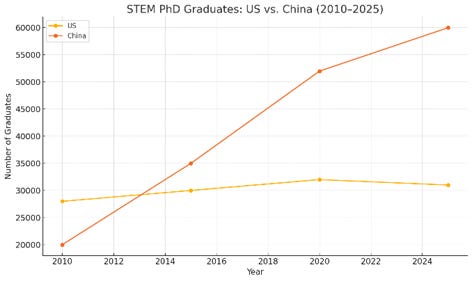
China on the other hand is committed to long-term, state-backed investments in engineering and science. Thus, China is linking fundamental research with applied development under a broader industrial strategy. Nowadays, Chinese institutions graduate more STEM PhDs annually than the American institutions while China is leading globally in total scientific publications with increasingly citation impact. Also, the return of Chinese-trained scientists has accelerated, reversing decades of one-way talent flow.
Scientific leadership cannot be translated into geopolitical dominance overnight. However, in time it can significantly reshape industrial competitiveness, military capability and normative influence over global standards and knowledge production. If history follows its near-cyclical rhythms, the U.S. may already be past the apex of its scientific dominance. China’s ascent, by contrast, is still unfolding, driven less by momentary advantage than by sustained policy choice.
The outcome is not predetermined but absent deliberate efforts to restore funding stability, talent openness, and institutional autonomy, the balance of global scientific power is likely to continue shifting. The consequences of that shift will be felt well beyond laboratories and institutions.
References
Andersen, Ross. “Every Scientific Empire Comes to an End: America’s Run as the Premier Techno-Superpower May Be Over.” The Atlantic, July 31, 2025.
Bermúdez-Montaña, Marisol, et al. “China’s Rise in the Chemical Space and the Decline of US Influence.” ChemRxiv, January 27, 2025.
Institute of International Education (IIE). 2025a. Open Doors 2025 Report on International Educational Exchange. New York: IIE.
Institute of International Education (IIE). 2025b. Fall 2025 Snapshot on International Student Enrollment: Key Findings. New York: IIE, November 2025.
Kitajima, Kensei, and Keisuke Okamura. “The Altering Landscape of US–China Science Collaboration: From Convergence to Divergence.” Humanities and Social Sciences Communications 12 (2025).
NAFSA: Association of International Educators. 2026. “NAFSA Responds to Decline in F-1 Visa Issuance in Summer 2025.” March 2026.
National Assessment of Educational Progress (NAEP). 2024. Declines in 12th-Grade Mathematics and Reading Continue. National Center for Education Statistics, U.S. Department of Education.
National Center for Science and Engineering Statistics (NCSES). 2025a. “Funding Sources of Academic R&D.” National Science Board, Science and Engineering Indicators 2026. Alexandria, VA: National Science Foundation.
National Center for Science and Engineering Statistics (NCSES). 2025b. National Patterns of R&D Resources, 2023–24: Data Update. Alexandria, VA: National Science Foundation.
National Center for Science and Engineering Statistics (NCSES). 2026. “U.S. R&D Totaled $937 Billion in 2023.” National Science Foundation, February 27, 2026.
National Science Board (NSB). 2026. The State of U.S. Science and Engineering 2026. Alexandria, VA: National Science Foundation.
Organisation for Economic Co-operation and Development (OECD). 2023. PISA 2022 Results: The State of Learning and Equity in Education. Paris: OECD Publishing.
Park, Michael, Erin Leahey, and Russell Funk. “The Decline of Disruptive Science and Technology.” Nature 613 (2023): 138–144.
Times Higher Education. 2025. World University Rankings 2026. London: Times Higher Education.
Wu, Renli, Christopher Esposito, and James A. Evans. “Shifting Power Asymmetries in Scientific Teams Reveal China’s Rising Leadership in Global Science.” Proceedings of the National Academy of Sciences 122, no. 43 (2025).
[1] https://www.theatlantic.com/science/archive/2025/07/science-empire-america-decline/683711/