

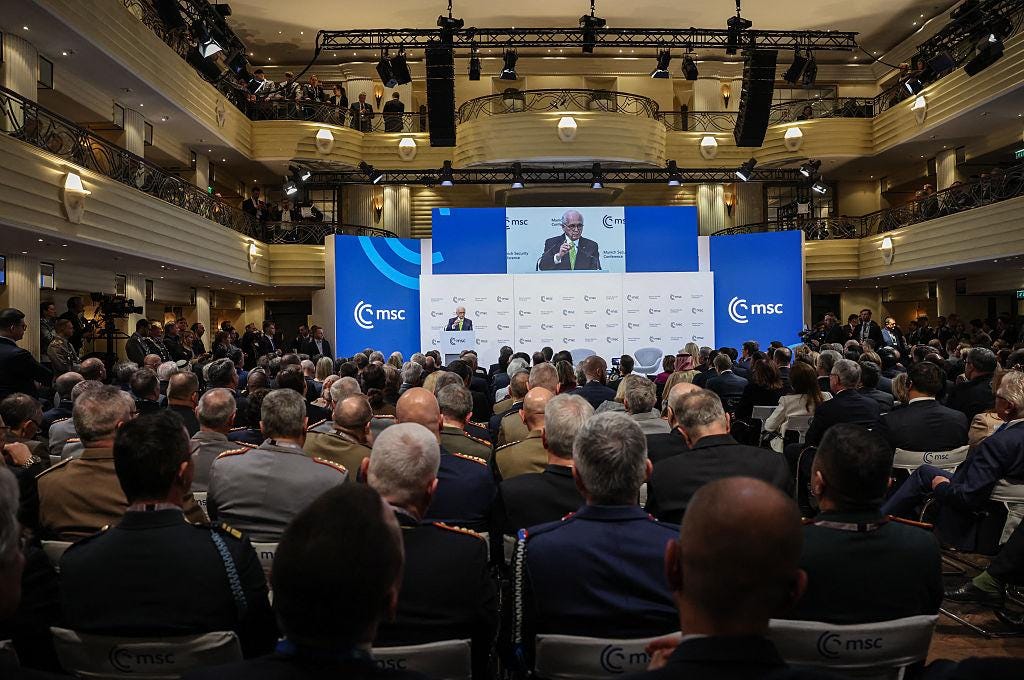
Photo: Munich Security Conference 2026/ Public domain
The war unfolding around Iran is not only a regional escalation; it is occurring at a moment when the foundations of the post-1945 international order are already under strain. The international system built on multilateral institutions, democratic alignment and open trade has been challenged by the raise of powers that favor disruption over reform. As the Munich Security Report 2026 suggests, global affairs are entering an era of wrecking ball politics, where demolition is the first choice. In this context, the Iran war underscores not only a regional instability but mostly the broader transition towards a more fragmented international system where power prevails over rules.
Key Takeaways
The post 1945 world order is undergoing active dismantling which is driven by political forces which favor disruption than reform. This period is characterized as wrecking ball politics, which is described in the Munich Security Report 2026, where demolition and rupture have replaced renovation and incremental adjustment.
The U.S. as the fundamental architect and guarantor of the post-war international order, is now shifting away from multilateralism, open trade and liberal democratic norms. This recalibration is deep as it questions the foundational logic that international institutions, rules, and alliances enhance rather than constrain national power.
Due to this strategic uncertainty, Europe and the Indo-Pacific states are forced in strategic adjusting through defense acceleration, hedging behavior, and new trade alignments.
Global trade fragmentation is increasing; however, liberal economic cooperation has not yet collapsed. Instead, it has been re-networked outside traditional U.S. leadership structures, often through regional or multilateral frameworks anchored in WTO law even as enforcement mechanisms weaken.
The emerging system favors leverage over law. However, without material backing the rules are eroding. Thus, the defining question for 2026 is whether rule-invested actors can convert commitment into capability before erosion becomes normalization.
Issue Overview
The Munich Security Report of 2026 argues that the international system is currently under destruction. This argument highlights the current structural shift is about how political authority is exercised both internationally and domestically. In this context, political actors are increasingly promoting demolition instead of reform which is considered progressively insufficient.
That said, across the Western world, institutional reform has lost its political credibility. Survey data from the Munich Security Index indicates that in the G7 states, only small minorities believe that current government policies will eventually leave the next generation in better position than today. At the same time, the majority of the surveyed expect significant decline. This loss of faith reflects skepticism that democratic systems can deliver meaningful course correction.
The current political situation has produced leaders who are in favor of destruction as a necessity rather than risk. Furthermore, institutional constraints are portrayed as bureaucratic stagnation while multilateral commitments are described as sovereignty dilution. International rules are reframed as optional instruments rather than binding frameworks. Thus, the most important development is that this governing logic has extended to the international order itself.
For approximately 80 years, the postwar system rested on three interlocking assumptions:
1. Multilateral institutions and international law secure stability.
2. Open trade and economic interdependence support prosperity and reduce conflict.
3. Democratic solidarity strengthens collective security.
Munich 2026 claims that these pillars of the postwar international order are not facing episodic disagreements but structural strain. The current transition concerns contestation over the framework itself.
Evidence & Analysis
Multilateralism and International Law. From Constraint to Optionality
The report refers to a clear shift regarding Washington’s posture towards international institutions. Withdrawals from key organizations and agreements, significant reduction of funding, and intense skepticism regarding global governance structures marks a redefinition of national interest. The U.S. National Security Strategy 2025 emphasizes the primacy of nations while it criticizes the sovereignty-sapping international organizations.
Also important is the normative shift as previous U.S. administrations justified deviations from the International Law via legal reasoning. However, the current U.S. administration has been direct as international norms and rules are not inherently binding in case they conflict with the express American strategic priorities. The risk is a potential normalization of rule-optional behavior. Once great powers detach rhetorical commitment from legal constraint, medium or even smaller powers reassess their own incentives to comply. This does not immediately collapse the system, but it will weaken predictability, which is the cornerstone of order.
Open Trade. Fragmentation Without Systemic Breakdown
Trade policies have become an instrument of leverage-based bargaining rather than a domain of predictable liberalization. The report underlines the imposition of broad tariffs and increasing reliance on economic coercion to secure bilateral concessions. At the same time, Beijing continues market-distorting practices and strategic control over key supply chains chokepoints.
The system is therefore pressured from both ends, yet fragmentation does not equal collapse. The data suggests that a surge in new and revived trade negotiations outside direct US leadership as governments are doubling down on trade agreements anchored in WTO principles even as enforcement mechanisms weaken.
This is a critical nuance as the liberal trade architecture has been redistributed across regional and plurilateral networks. WTO principles still anchor many agreements even as dispute settlement mechanisms are significantly weakened.
The implication is structural diversification rather than systemic implosion. Liberal economic order persists, but leadership is decentralized. Fragmentation increases complexity and reduces uniformity, yet it also reduces systemic dependency on a single hegemon.
Democratic Solidarity. The West as Geography, Not Norm
Public opinion data in NATO member states indicate that majorities perceive the West as less united than a decade ago. This perception reflects an ideological divergence. Rhetorical friction between the U.S. and the European allies has sharpened. European governments have expressed concern about disregarding established rules and partnerships.
At the same time, softer rhetoric toward authoritarian leaders alters alliance psychology. The cohesion of the transatlantic relationship historically rested on shared normative framing. When that relationship becomes contested, alignment shifts from identity-based alignment to interest-based calculation. It does not mean that NATO dissolves under such circumstances, however, its cooperation basis becomes transactional. This distinction is important as identity creates automatic alignment while transactional alignment requires continuous renegotiation.
Europe. Acceleration Through Uncertainty
The Europeans are facing a dual dynamic as the ongoing Russian military pressure and the fluctuating of the American strategic signaling. Especially, Washington’s approach is perceived as oscillating between reassurance, conditionality, and coercion.
This combination has resulted in accelerating defense spending commitments and renewed emphasis on capability building which Europe obviously lacks. NATO’s agreement on higher spending targets (5% of GDP) highlights that adaptation is under pressure. Yet capability gap between the U.S. and Europeans remain significant especially in high-end military assets and strategic enablers.
In this strategic environment, the European leaders are not necessarily seeking strategic independence for ideological reasons, but they are trying to adjust to the new realities. Strategic autonomy, once aspirational, now appears as risk mitigation. This shift is gradual but real. Capability accumulation takes time while political will, withing the EU, is still uneven. Nonetheless, the trajectory is moving toward partial decoupling of security dependence.
Indo-Pacific. Hedging as Strategy
Regarding the Indo-Pacific region, the strategic uncertainty leads to hedging rather than that alignment. Regional actors have significantly increased defense budgets while they deepen security cooperation while they maintain a pragmatic approach to China as far as the economic ties are concerned.
In contrast to Europe, institutional fallback mechanisms are limited while the region also lacks the presence of a NATO-like guaranteed structure. This lack of collective defense mechanism boosts strategic ambiguity.
The regional pattern is layered balancing:
Strengthening bilateral defense cooperation.
Avoid full strategic alignment.
Preserve economic flexibility.
Development and Humanitarian Strain
Even before current disruptions, the world was off track on all 17 Sustainable Development Goals. Funding retrenchment deepens structural gaps. Reform conversations focus on efficiency and survival rather than expansion. Humanitarian architecture operates under financial compression. The long-term consequence is increased vulnerability in low- and middle-income states. While not immediately destabilizing at a systemic level, accumulated fragility can produce second-order geopolitical effects over time.
Risk Perception. Psychological Decentering of the United States
The Munich Security Index highlights a significant shift as in most of the surveyed states, the perceived risk related to the U.S. has increased. Moreover, less than 50% of the responders claim that Washington’s leadership is necessary for solving major global challenges like financial stability, conflict resolution and climate change. In other words, the U.S. remains powerful and important global actor however, its perception as indispensable is declining which indicates a broader strategic shift.
Policy Options
The report underscores the pressure and the responses which are already underway. That said, several options are available for states that still prefer a ruled-based international order.
Option 1. Secure Crucial International Institutions through Coalitions
As we have noticed, the international consensus is significantly declining, thus smaller coalitions can preserve international cooperation in areas like trade and security. These forms of international cooperation can be deepened among like-minded actors. This development can preserve operability but not replace universalism.
Option 2. Invest in Material Capability
Normative commitments are insufficient without actual capability. Defense modernization, technological competitiveness, and supply-chain resilience are foundational to preserving leverage within a power-first environment. Institutions require backing power.
Option 3. Reform to Restore Credibility
Public skepticism toward democratic governance is a driver of demolition politics. The address of institutional performance, governance inefficiency, economic stagnation, and inequality, is fundamental in international order preservation because external stability rests on internal legitimacy.
Option 4. Diversify Strategic Partnerships
States can reduce their overdependence on specific actors by widening their economic and diplomatic relations. This can reduce their vulnerability to abrupt policy shifts by great powers as diversification is actually risk management.
Recommendations
Shift from reactive to anticipatory strategy. Preparation for volatility/uncertainty rather than assuming restoration of past stability.
Prioritization capability accumulation over rhetorical defense of norms. Norms without enforcement weaken quickly.
Strengthen regional frameworks as buffers. Regional resilience can compensate for global fragmentation.
Link domestic reform to foreign policy credibility. Internal governance performance affects external leverage.
Conclusion
Munich 2026 captures the ongoing structural transition of the international system. The latter is not collapsing but it is shifting from rules-first system toward power-first. This shift is driven by domestic political frustration, recalibrated great-power strategy, and growing skepticism toward institutional efficacy. In this context, fragmentation is increasing, however, global order has not yet been dissolved. Slowly but steadily trade networks are adapting while regional coalitions are forming. Additionally, due to the uncertainty, investments in defense have dramatically raised.
The decisive variable is whether actors committed to rule-based stability convert commitment into capability. If they do, the system evolves into a hybrid structure: less universal, more regional, but still governed by predictable frameworks in key domains. If they do not, leverage will define outcomes more than law. The transition is underway while the question is who adapts first, and who adapts effectively. Munich 2026 does not predict collapse but instead it diagnoses inflection. That distinction matters.
References
https://securityconference.org/en/publications/munich-security-report/2026/
This analysis, if lengthy, is by far the best geopolitical review of current global power and economic situations. It's much than just Munich 2026. It rhymes well with Peter Zeihan's thesis of an evolving international order wherein regions of geographical influence and economic necessity provide stability and predictability. Unless their very wealthy, my grandchildren will be locavores!