

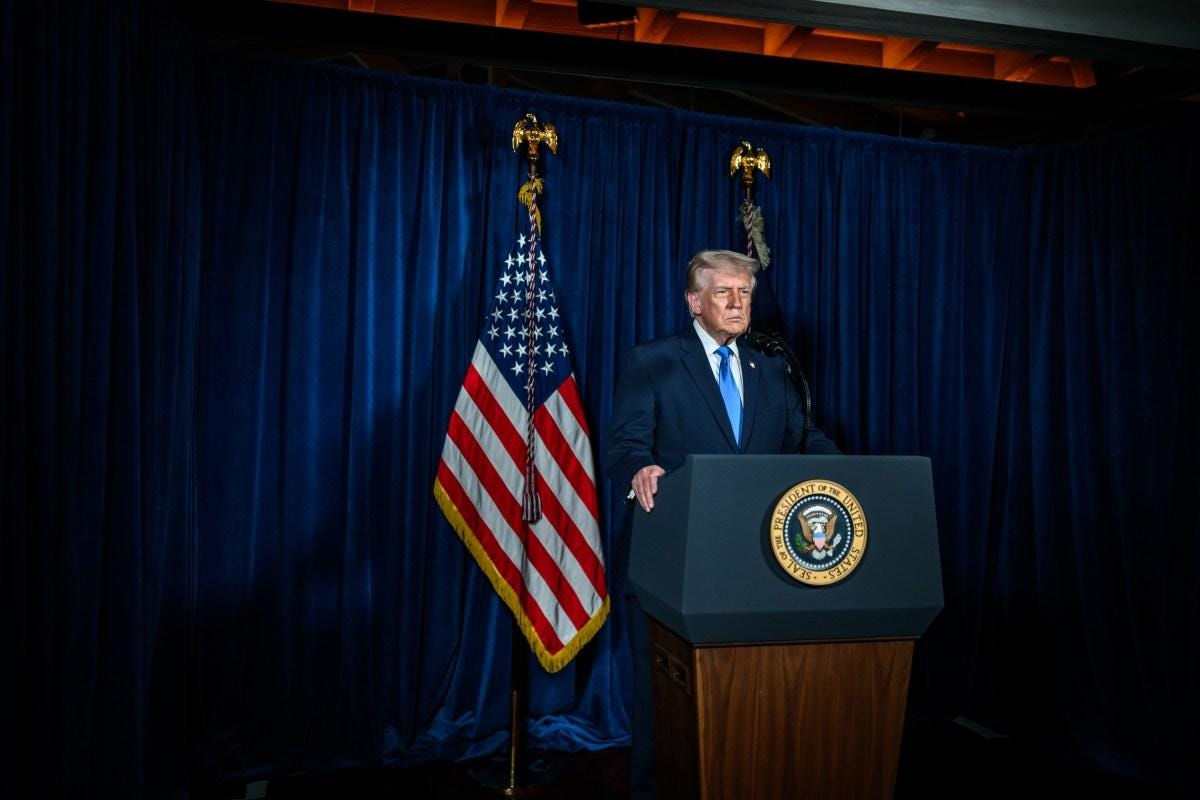
Photo: President Trump / Official White House Photo
I want the North Vietnamese to believe I’ve reached the point where I might do anything to stop the war. We’ll just slip the word to them that ‘for God’s sake, you know Nixon is obsessed about communism... he’s got his hand on the nuclear button and Ho Chi Minh himself will be in for it.
President Nixon
Executive Summary
Donald Trump’s recent rhetoric toward Iran has revived an old strategic debate in a much sharper form than the U.S.-China trade war ever did. His April 7, 2026, warning that “a whole civilization will die tonight” if Iran did not make a deal, was definitely not routine diplomatic language. It was deliberately framed in a maximalist way to underline the fact that the U.S., under his presidency, might be willing to go further than any other leader would openly dare to. This matters as it fits to the logic behind the Madman Theory1 which suggests that a leader can gain leverage by convincing the opponents that he/she might be less predictable and thus more willing to escalate unexpectantly (Reuters 2026a).
In this paper we argue that President Trump’s current rhetoric offers a stronger case for the Madman Theory than the older tariff-war example. The trade war showed a preference for disruption, abrupt pressure, and strategic uncertainty. But the current Iran war moved that style into a far more dangerous setting, where the language of coercion was no longer about tariffs, market pressure, or negotiation tactics, but about civilizational destruction. That shift matters analytically because it shows the same strategic instinct operating at a much higher level of risk (Reuters 2026a; Reuters 2026b).
At the same time, the very rhetoric that may create short-term fear abroad also creates new political costs at home. Trump’s opponents have again turned to the language of presidential incapacity and the Twenty-Fifth Amendment, not because removal is realistically within reach, but because his recent statements have reopened the debate over whether his conduct reflects strategic calculation or dangerous unfitness for office. Reuters reported on April 10 that Representative Jamie Raskin plans to reintroduce legislation for a presidential-capacity commission, while a separate Reuters explainer noted that some Democrats are again discussing whether Trump is fit to discharge the duties of office. Yet the constitutional threshold remains extremely high, and Section 4 of the Twenty-Fifth Amendment has never been used to remove a president involuntarily (Reuters 2026c; Reuters 2026d; Congress.gov 2026).
The central conclusion is straightforward. President Trump’s recent rhetoric does resemble the Madman Theory. It may still generate tactical leverage by creating fear and compressing the opponent’s decision-making space. However, the constant use of this strategy bears significant costs, which we have witnessed so far, as it damages credibility, strengthens domestic opposition, unsettle close allies and finally makes even harder to recognize deliberate coercion from impulsive escalation. In this regard, what starts as a strategic unpredictability can become a strategic overextension.