
NATO member states finally agreed, in the recent 2025 Summit, to a serious increase in defense spending as they committed to spending 5% of their GDP by 2035. This agreement signals a significant shift in the Alliance’s posture which could reshape global arms markets, defense supply chains, and transatlantic economic relations. While the move is framed as a collective investment in shared security, the question looms large: Who will benefit from this surge in military spending?
What the 5% Commitment Means
The new pledge breaks down as 3.5% of GDP is dedicated to core military defense which includes personnel, weapons systems, ammunition, and operations. The rest 1.5% of GDP will be directed to cyber defense, infrastructure, critical resilience, and related technologies. This agreement builds on the 2% GDP minimum agreed in 2014, which many member states have not met yet. Full compliance with the 5% target is expected by 2035, with a review slated for 2029.
This development came with the pressure of the President Trump, who states afterwards that the agreement is a great victory for American workers and defense manufacturers. Why? Because a significant portion of this new spending will probably flow straight into the American defense industry.
NATO’s Current Defense Spending: A Full Breakdown
As of mid‑2025, NATO’s average defense spending hovers around 2.61% of GDP. While this represents progress since the 2014 Summit, it still leaves a steep climb to the 5% target. More specifically, the 32 NATO members currently rank:
Country
Defense Spending (% of GDP, 2024)
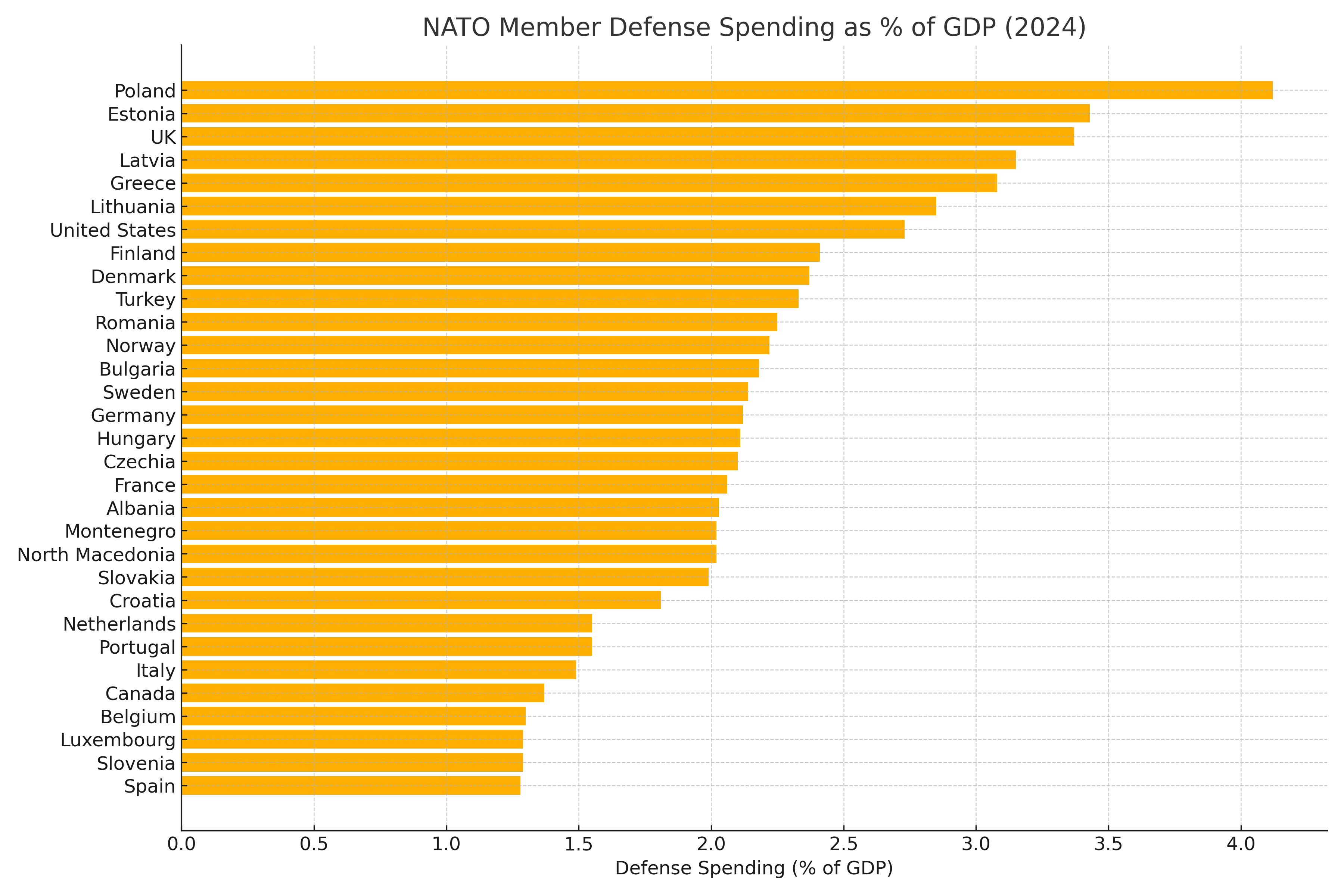
Source: NATO, SIPRI, and national ministries of defense data.
The Leaders
According to the available data, Poland is the spending champion of NATO as it spends over 4.1% of GDP, because its proximity to Russian. Additionally, Poland has invested heavily on American military equipment. Estonia, Latvia, and Greece all exceed 3%, driven by strategic geography and longstanding military commitments. The UK, with 3.37%, has committed to reaching the full 5% by 2030, backed by a recent boost in procurement budgets.