

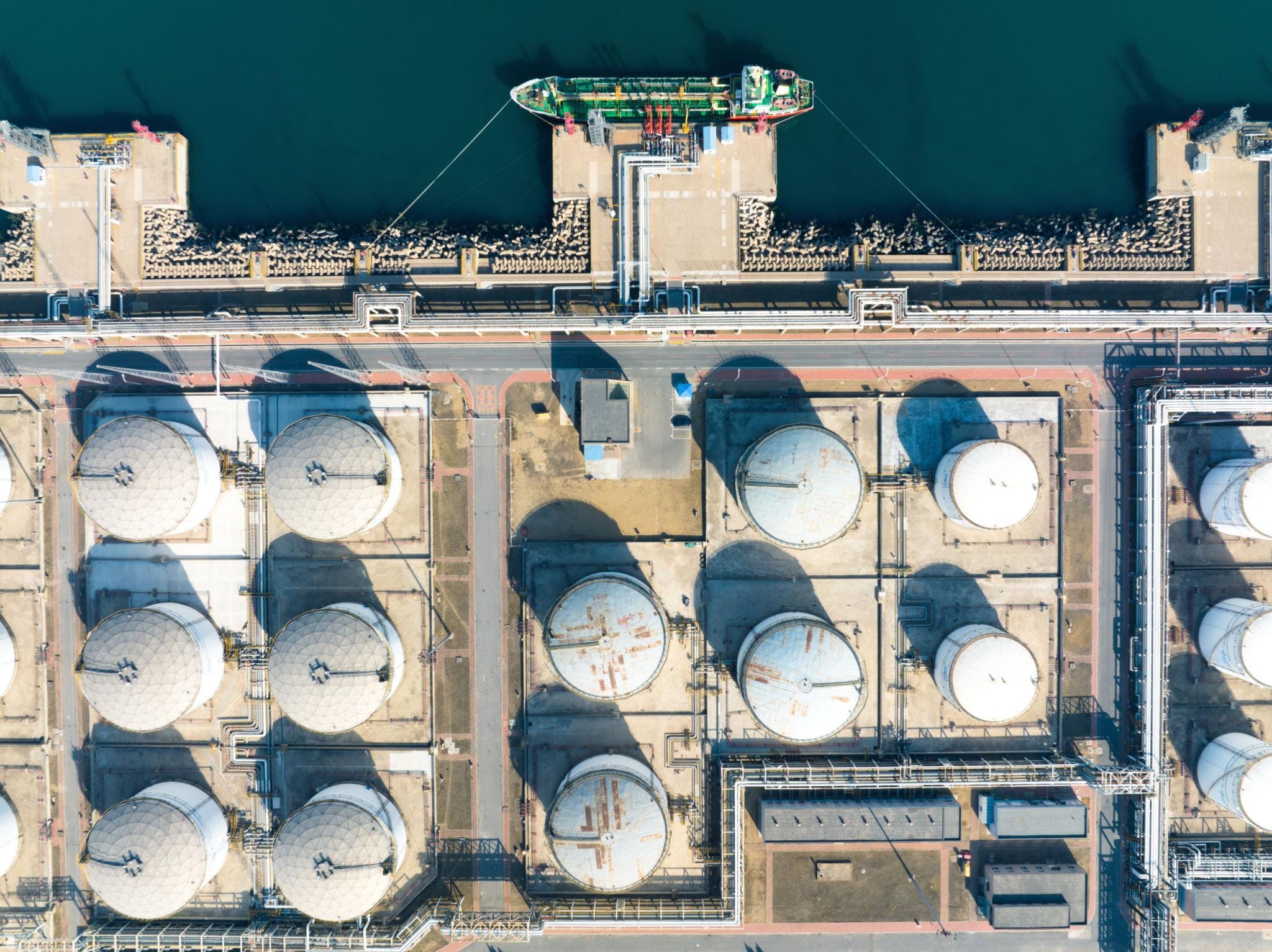
Photo: Aerial view of an LNG terminal with storage tanks and a docked LNG carrier/ Open Source
Europe did not only replaced Russian gas oil with LNG but it actually rewired its whole energy security architecture. Thus, what has emerged since 2022 is not just autonomy but rather a new system of managed interdependence shaped by long term infrastructure commitments, maritime chokepoints and the global markets. LNG has stabilized Europe in crisis but it has introduced new strategic exposures like the dependence on sea routes, Washington’s export capacity and the regulatory execution speed within Europe.
The real question regarding European security is no longer supply sufficiency but whether this LNG based system strengthens resilience or forces Europe into a new set of geopolitical constraints.
Energy security is not only about supply volumes, but about power, structure and control. The abrupt reduction of Russian flows exposed the extent to which European energy security relied on single-direction pipeline systems and demonstrated how infrastructure can function as a geopolitical instrument. Europe’s response was immediate: diversification of suppliers, rapid LNG deployment, new terminals, new transmission routes. Systemic disruption was avoided. However, replacing pipeline gas with LNG does not automatically produce autonomy. What has emerged is a new energy geometry shaped by global markets, maritime corridors, multiple exporting states and reconfigured internal transmission systems. The central question is not whether LNG replaced Russian gas but the strategic system Europe has constructed in its place.
Managed interdependence
European energy security underwent a structural shock during 2022–2023. Until then, Russian pipeline gas had accounted for roughly 40% of EU imports. Supply reductions exposed the vulnerability of natural gas pipelines as a single-direction system. LNG operates under a different structural logic.
Pipeline networks are geographically fixed and dependent on bilateral routes. LNG is mobile while its pricing is linked to future markets, between domestic gas costs and international availability and broader supply and demand.
In structural terms, LNG transforms gas from a route-bound commodity into a globally traded energy system. However, LNG flexibility does not eliminate exposure. Key maritime ports such as Suez and Bab el-Mandeb become critical since LNG requires operationally uninterrupted sea transport, or deliveries to Europe can be delayed within days.
Europe moved from reliance on a single dominant supplier to managed interdependence across multiple exporters, including the United States, Qatar, Algeria and intermittently Nigeria. A significant portion of European gas consumption now depends on US liquefaction capacity.
Although exports operate within market logic, they remain embedded in domestic regulatory and political frameworks. Upstream production decisions and export policies therefore influence European supply balance. Energy security is defined by system architecture and exposure management.
LNG: stabilizer or transitional layer
The European Commission’s REPowerEU initiative accelerated LNG infrastructure expansion, including Floating Storage and Regasification Units (FSRUs), to increase import capacity. Storage policy shifted from commercial optimization to strategic buffering.
In the short term, LNG strengthened energy systems security by offering high storage levels, additional import capacity, and diversified supply contracts which boost operational flexibility.
LNG infrastructure requires large-scale capital expenditure and operates over several decades not only in terms of payoff but also of contracts that further influence the long-term role of gas under transition policy regulations. A broader mix of contracts reduces the risk that a disruption from one supplier would trigger immediate shortages. Investment decisions under crisis can determine long-term system configuration, creating inconsistencies between supply security and energy security, the latter of which passes through sustainability in the case of the EU.
LNG acts as a bridge fuel with geopolitical significance and system-level implications for infrastructure alignment, sustainability targets that refer not only to climate but also to resilience, and long-term energy system design. The duration of LNG’s role depends on structural substitution pathways.
European policy implications
Diversification must be embedded in system design. Procurement should avoid overconcentration on any single exporter, because resilience depends on distributed supply rather than substituting one dependency with another.
Infrastructure resilience is equally strategic. LNG terminals, pipelines, and control systems require physical and cyber protection within EU security planning. System reliability depends not only on volumes, but on continuous operability. Maritime access remains a technical prerequisite for LNG supply stability. Secure sea lanes therefore link energy security directly to naval presence and diplomatic capacity.
Contract arrangements must support decarbonization pathways. Since LNG infrastructure operates over decades, flexibility is necessary to avoid locking the system into volumes that may exceed future demand.
Regional hubs can strengthen redistribution capacity beyond LNG. Greece, positioned between LNG and future energy entry points and Southeast European transmission networks, facilitates northbound reallocation during supply stress and enhances cross-border stability.
Even if LNG demand declines over time, the need for flexible cross-border flow remains. Integrating energy hubs into a coordinated EU structure strengthens internal system balance and joint negotiating capacity, ensuring that LNG, while transitional, is used efficiently and consistently across the Union.
EU innovation and structural exit
While LNG remains essential for European security of supply, the EU has developed a policy architecture that aims to fundamentally reduce gas dependence through demand reduction, diversification, and accelerated deployment of low-carbon energy systems. REPowerEU placed storage as a strategic buffer rather than an optimisation tool. Currently, innovation is treated not only as technological breakthroughs but also as implementation at scale: ensuring demand flexibility, electrifying technically viable sectors, expanding renewable power generation, utilising advanced biofuels, and developing hydrogen production and transport infrastructure to substitute natural gas in industry and heavy transport.
The key constraint in the adoption of new energy technologies is implementation that can accelerate uptake. Permitting procedures, grid expansion, hydrogen backbone development, and industrial transformation timelines remain underlying bottlenecks. In several member states, renewable and grid approvals still require years. Hydrogen projects face infrastructure gaps, fragmented frameworks, and delayed decisions, as in the implementation of REDIII (Renewable Energy Directive III). Biofuel scale-up depends on feedstock consistency and enhanced conversion technologies. Without regulatory speed in authorising innovative technologies for market reach, well-planned and coordinated infrastructure, especially across borders, and matched industrial acceptance, natural gas and consequently LNG substitution cannot scale at the necessary pace. Otherwise, LNG remains systemically relevant regardless of strategic objectives.
The EU possesses substantial instruments, including Horizon Europe and industrial frameworks supporting net-zero manufacturing. Still, a translation gap persists between research participation and deployment at industrial scale, not due to patent filing or research output, but due to the shift from intellectual property to physical implementation. Moving from IP to permitting, financing, integration, and industrial deployment involves time lags, bureaucracy, and regulatory requirements. Administrative complexity, fragmented markets, infrastructure constraints, and slow financing approvals delay implementation and slow system transformation.
Bureaucracy thus becomes a geopolitical variable. Slow delivery prolongs reliance on gas and LNG. The constraint to the EU’s energy security is not technological capability, but execution speed, infrastructure alignment, and institutional coordination and effectiveness.
Author Bio
*Dr. Panagiota Pimenidou is a Chemical Engineer with a PhD in hydrogen production from the University of Leeds and extensive academic experience in the UK and Greece. She has held academic posts at Ulster University and the University of Bradford and currently contributes to EU-funded research projects on sustainable fuels and advanced materials. Her research focuses on low-carbon fuels, hydrogen technologies, catalyst development and emissions reductions, with particular emphasis on process evaluation and validation, fuel performance, and the technical challenges associated with transitioning energy systems toward lower-carbon pathways.
Bibliography (indicative)
Bruegel. (2022). A grand bargain to steer through the European Union’s energy crisis (Policy Contribution). Bruegel. https://www.bruegel.org/sites/default/files/2022-09/PC%2014%202022_0.pdf
European Commission. (2022). REPowerEU plan (COM(2022) 230 final). European Commission. https://eur-lex.europa.eu/legal-content/EN/TXT/?uri=CELEX%3A52022DC0230
European Network of Transmission System Operators for Gas (ENTSOG). (2023). Ten-Year Network Development Plan (TYNDP). ENTSOG. https://www.entsog.eu/tyndp
International Energy Agency. (2025). Gas market lessons from the 2022–2023 energy crisis. IEA. https://www.iea.org/reports/gas-market-lessons-from-the-2022-2023-energy-crisis
Yafimava, K., Ason, A., & Fulwood, M. (2025). The EU proposal to ban Russian gas imports: Roadblock more than roadmap (NG 199). Oxford Institute for Energy Studies.
https://www.oxfordenergy.org/wpcms/wp-content/uploads/2025/07/The-EU-Proposal-To-Ban-Russian-Gas-Imports-roadblock-more-than-roadmap-NG-199.pdf
European Parliament & Council of the European Union. (2023). Renewable Energy Directive (EU) 2023/2413 (RED III). Official Journal of the European Union. https://eur-lex.europa.eu/legal-content/EN/TXT/?uri=CELEX:32023L2413
The most important line in this piece: "Bureaucracy becomes a geopolitical variable." Europe has solved the supply problem but not the sovereignty problem. Managed interdependence is a more stable arrangement than single-supplier dependence, but it is not autonomy. The question is whether Europe's institutional architecture can move fast enough to convert energy diversification into genuine strategic capacity, before the next disruption arrives.