

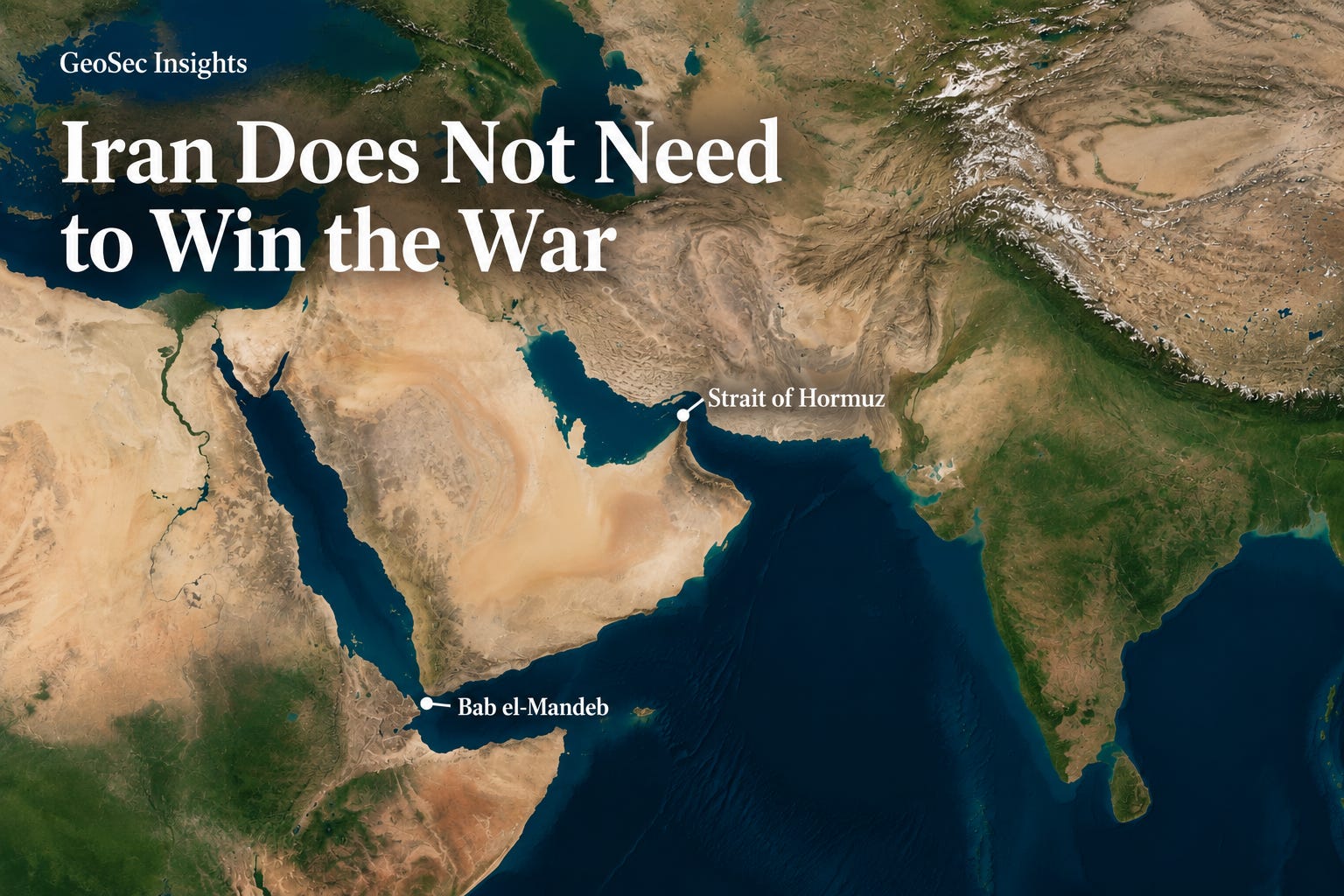
The map of the Middle East with the Strait of Hormuz and the Bab el-Mandeb.
The war against Iran is usually discussed in military terms: missiles intercepted, targets destroyed, ships deployed and territory controlled. However, measuring success this way misses Iran’s most important source of leverage. Tehran does not need to defeat the United States or its regional partners in a conventional war, it cannot. Nor does it need to close the Strait of Hormuz completely. It only needs to keep the movement of energy uncertain, dangerous and expensive enough for the economic consequences to spread far beyond the battlefield.
That pressure is no longer limited to the Persian Gulf. Traffic through Hormuz remains severely constrained, while the Houthi advance and renewed attacks around Bab el-Mandeb have placed another critical maritime chokepoint under pressure. The result is not a perfect Iranian blockade, but a more flexible pattern of disruption involving Iran and aligned armed groups across several points. Adversaries must protect long shipping routes and vulnerable energy infrastructure, while every new attack can translate into higher freight rates, insurance costs and fuel prices.
Iran remains militarily weaker than the forces opposing it. Yet that imbalance is precisely what makes economic disruption so valuable: Tehran does not have to dominate the battlefield if it can make the economic cost of continuing the war increasingly difficult for others to absorb.
Two narrow waterways, one system
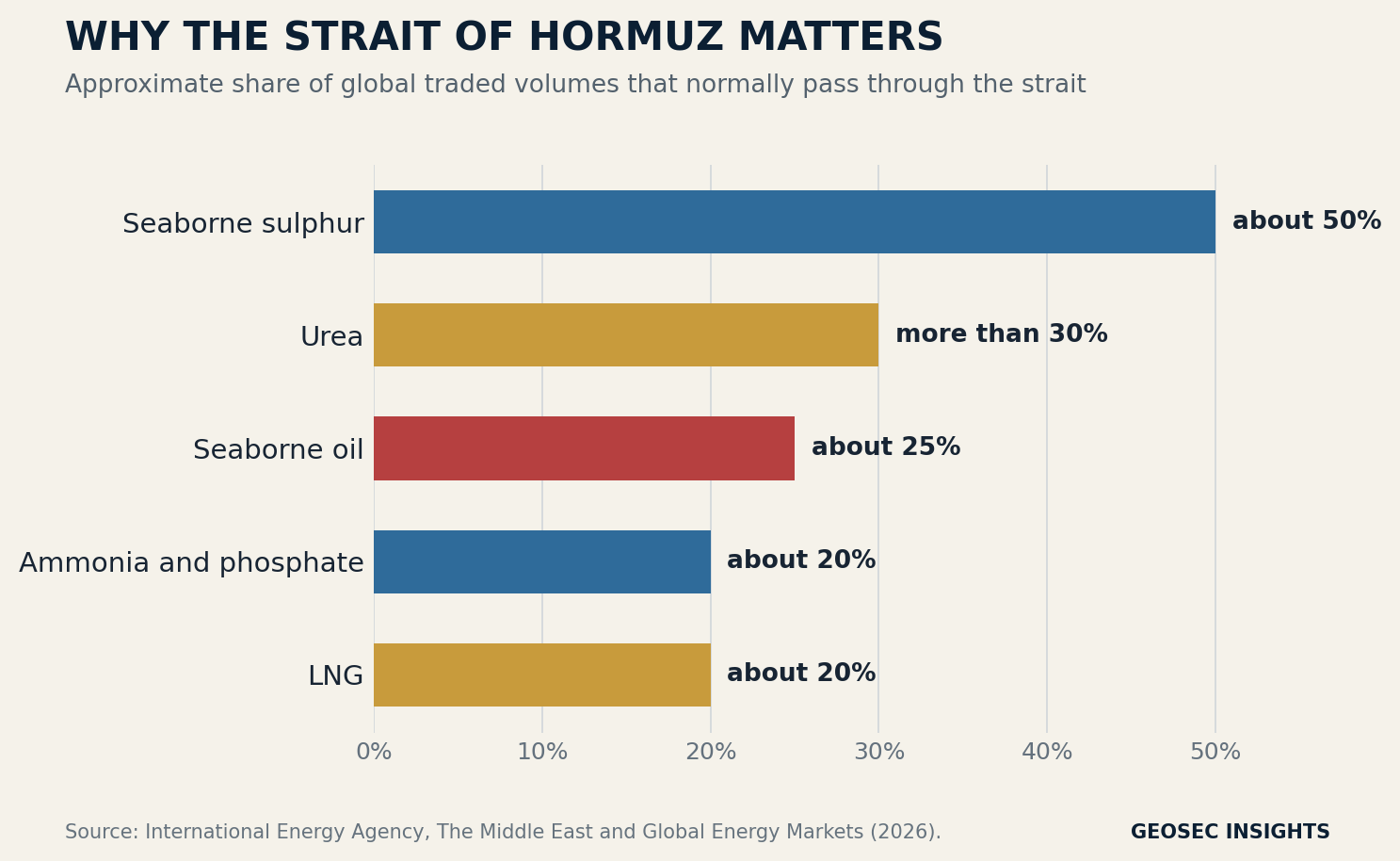
The Strait of Hormuz remains the main maritime route for the energy producers of the Persian Gulf. According to the International Energy Agency (IEA), around 25 percent of global seaborne oil trade and almost one-fifth of global LNG trade passed through it in 2025. Around 80 percent of the oil and oil products moving through the strait were destined for Asia.
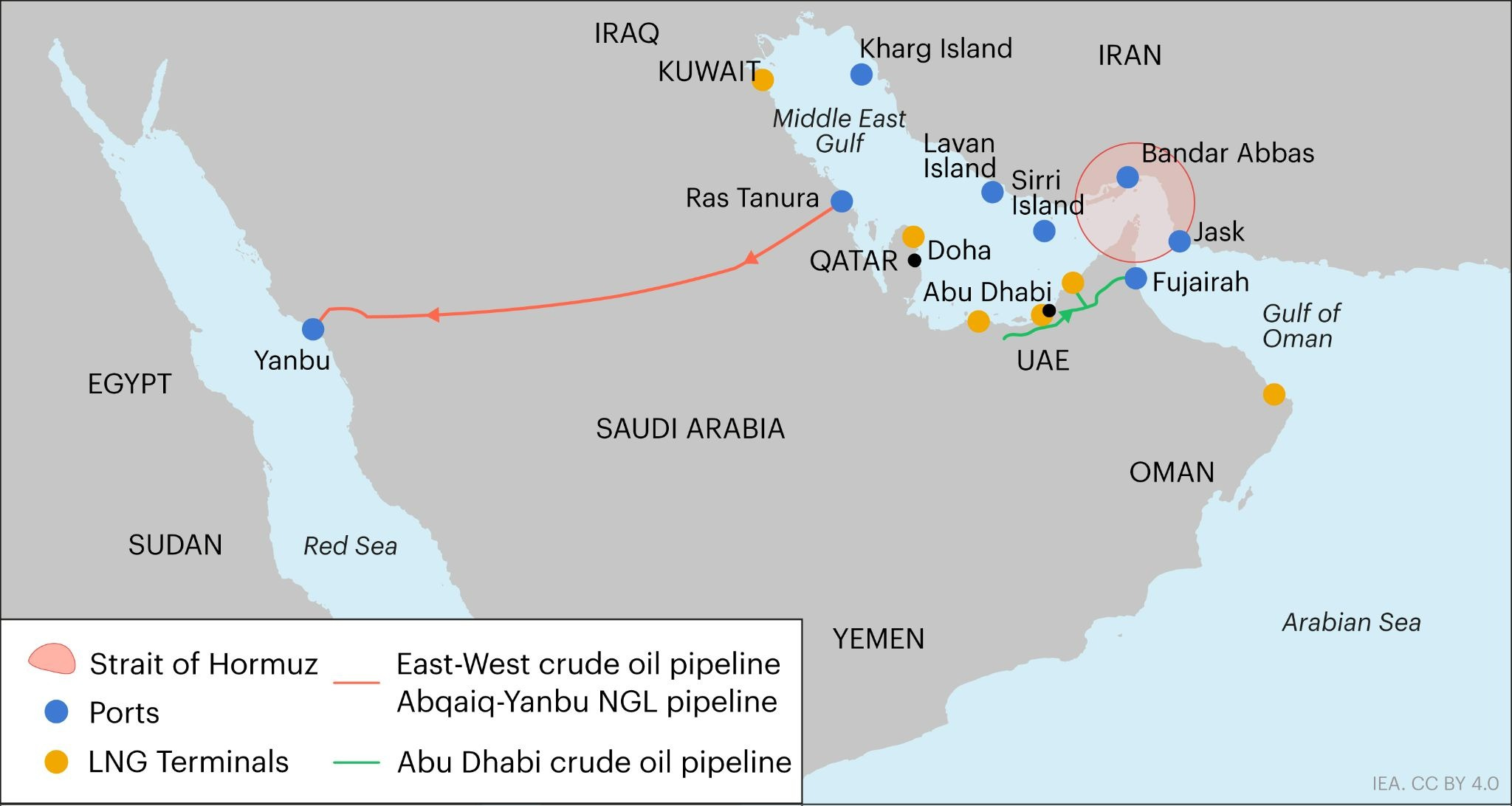
The alternatives are limited. Saudi Arabia and the United Arab Emirates operate pipelines capable of redirecting some crude exports outside Hormuz, but the IEA estimates their available bypass capacity at only 3.5–5.5 million barrels per day. Iran, Iraq, Kuwait, Qatar and Bahrain remain heavily dependent on the strait. LNG is even more vulnerable because there is no equivalent alternative route for the volumes exported from Qatar and the UAE.
Bab el-Mandeb creates a second pressure point. It connects the Indian Ocean and Gulf of Aden with the Red Sea and, through the Suez Canal, the Mediterranean. Avoiding it requires the much longer route around the Cape of Good Hope. With Hormuz already heavily constrained and traffic through Bab el-Mandeb also under pressure, disruption at one chokepoint increasingly affects the strategic importance of the other.
Saudi Arabia demonstrates the problem. Its East–West pipeline can move millions of barrels of oil toward the Red Sea and reduce dependence on Hormuz. Yet three of its pumping stations were recently damaged in a drone attack, forcing the pipeline temporarily offline and disrupting exports through Yanbu. A route designed to provide resilience against one chokepoint has therefore become vulnerable to pressure elsewhere.
Alternative routes for bypassing the Strait of Hormuz remain limited. Saudi Arabia’s principal route terminates at Yanbu on the Red Sea, increasing the importance of secure passage through Bab el-Mandeb. Source: International Energy Agency, 2026, CC BY 4.0.:
Iran does not require complete control
The rhetoric surrounding the closure of the Strait of Hormuz can be misleading. Iran does not need to impose a complete military blockade to create serious economic disruption. Current traffic remains far below normal levels, demonstrating that uncertainty itself can restrict a major maritime chokepoint.
Commercial shipping responds to risk rather than territorial control alone. A missile strike, a damaged tanker or simply uncertainty about the next target can be enough to change shipping decisions. Shipowners must protect their crews, insurers reassess coverage, and energy markets price future disruption before supplies physically disappear. This creates an important asymmetry: the United States and its partners must protect ships, terminals and sea lanes across a wide area, while Iran only needs to demonstrate that attacks remain possible. Naval escorts can reduce the danger, but they cannot eliminate it or quickly restore damaged energy infrastructure.
The Houthis extend this pressure into the Red Sea. Their recent advance along Yemen’s coast has increased the threat around Bab el-Mandeb at the same time that Hormuz remains constrained. However, they should be described as Iran-aligned rather than Iranian-controlled. Tehran provides support and retains influence, but the Houthis have their own leadership, interests and calculations. China’s recent effort to persuade Iran to restrain them illustrates this distinction: Tehran may influence Houthi behaviour without necessarily controlling every decision.
This makes deterrence more complicated. Iran can benefit strategically from Houthi pressure without having to direct or assume responsibility for every attack, while its opponents must respond to threats emerging from more than one theatre.
GeoSec Insights is a reader-supported publication. To receive new posts and support my work, consider becoming a free or paid subscriber.
The economic weapon is already working
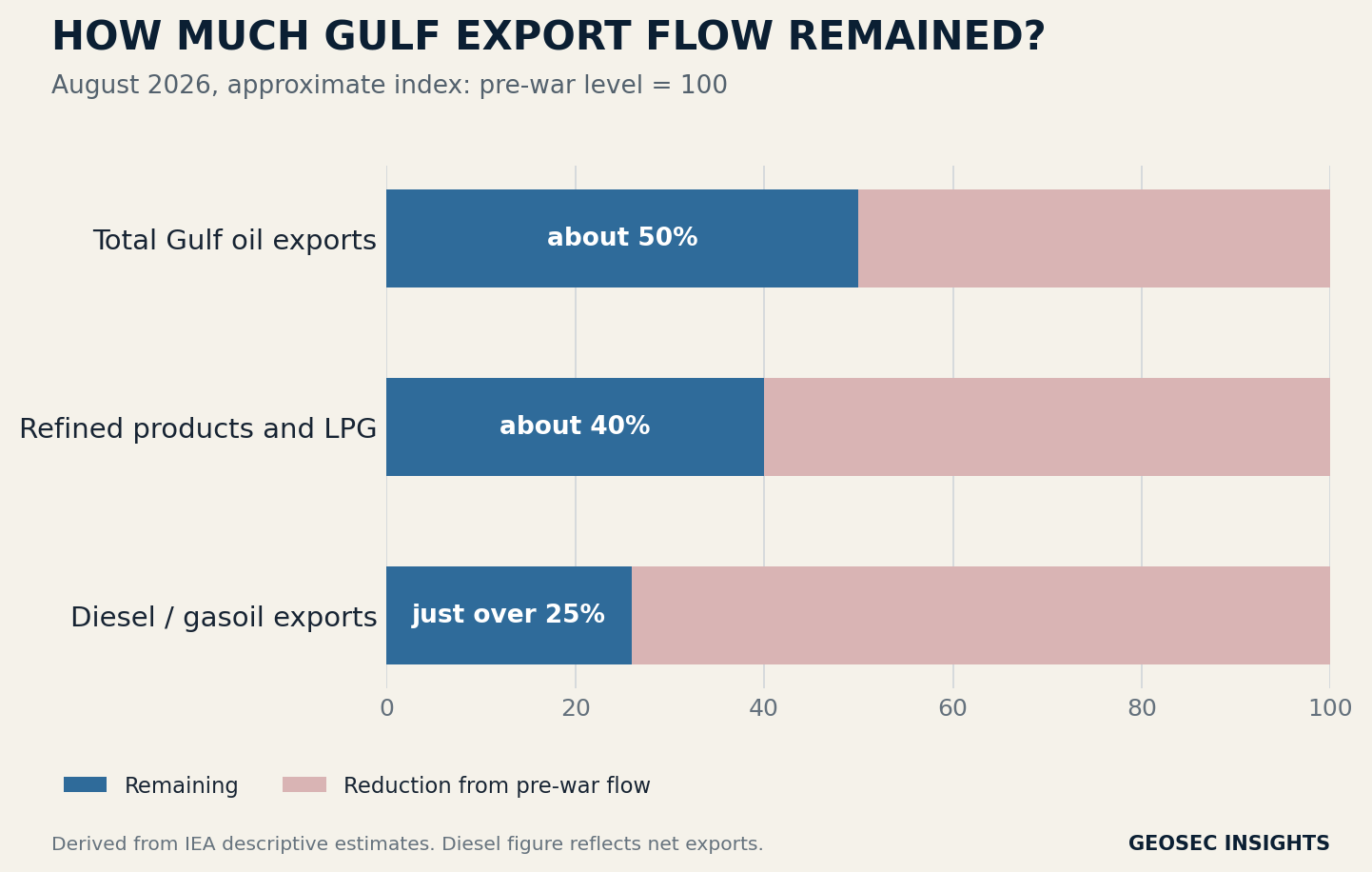
The scale of the disruption shows why battlefield measures alone are inadequate. The IEA’s September 2026 Oil Market Report estimates that more than 10 million barrels per day of Gulf production remained shut in during August. Total Gulf oil exports were running at roughly half their pre-war level, while exports of refined products and liquefied petroleum gas remained almost 60 percent below February levels.
Gulf oil and refined-product exports remained substantially below their pre-war levels in August 2026. Source: GeoSec Insights, based on International Energy Agency estimates.:
The greatest pressure is not limited to crude oil. Diesel and other middle distillates are essential to road transport, agriculture, mining, construction and industry. The IEA reported that US diesel prices moved above the equivalent of $200 per barrel in early September, almost double their pre-war level, with Europe and Asia not far behind. Disruption to Russian refining and exports has made the shortage harder to offset.
Natural gas markets are also exposed. Reduced LNG flows from Qatar and the UAE removed more than 300 million cubic metres per day from the market after 1 March, according to the IEA. Other producers replaced around three-quarters of those losses, but the shock drove Asian and European spot prices well above their 2025 levels. Damage to Qatar’s liquefaction infrastructure may also constrain supply growth beyond the immediate conflict.
The pressure travels further. More than 30 percent of global urea trade and around 20 percent of ammonia and phosphate trade normally move through Hormuz. Disruption therefore raises the cost of fertiliser, which can later feed into food prices. The strait also carries substantial shares of global aluminium and sulphur trade. Sulphuric acid is required in petroleum refining and in processing minerals such as copper, nickel and zinc. What begins as a maritime security crisis can consequently reach farms, factories and critical-mineral supply chains.
Hormuz is not solely an oil chokepoint. Disruption can reach food production, manufacturing and critical-mineral supply chains. Source: GeoSec Insights, based on International Energy Agency data.:
Emergency stocks can buy time, but they cannot provide a permanent answer. In March, the IEA’s 32 member countries agreed to release 400 million barrels—the largest coordinated stock release in the organisation’s history. By September, however, observed global oil inventories had fallen by 507 million barrels since the beginning of the war. Strategic reserves soften a shock; they do not replace stable production, refining and transport.
Asia is exposed, but the political effects are global
Asia remains the most directly exposed region because much of its imported oil and LNG normally passes through Hormuz. The disruption has already pushed Asian LNG prices sharply higher and forced countries such as China and India to seek alternative supplies or temporarily rely more heavily on coal and oil. This gives Asian governments a growing interest in de-escalation, regardless of their different relationships with Washington and Tehran.
The consequences, however, extend far beyond Asia. Europe enters the coming winter with relatively low gas storage and must compete for alternative LNG cargoes, while continued disruption around Hormuz and the Red Sea keeps shipping and energy costs elevated. The United States has greater domestic energy production, but it is hardly insulated: diesel prices have reached record levels, feeding directly into transportation, agriculture and consumer prices.
This is where the economic pressure becomes political. Higher energy costs are contributing to renewed inflation and forcing central banks to reconsider interest rates. If the war continues to raise household and business costs, pressure for a settlement may increasingly emerge in countries that Iran could never hope to defeat militarily.
The strategy still carries serious risks
Economic disruption is leverage, but not victory. Iran cannot control how other states respond, and an attack causing mass casualties or prolonged shortages could still generate a broader coalition against it. China and India want the conflict contained because continued disruption threatens their own energy security, while the Houthis’ expanding role in Yemen adds another source of escalation that Tehran may not fully control.
There is also a longer-term limit. High prices and disrupted Gulf supplies are already pushing buyers toward alternative energy sources, while governments draw down inventories and look for ways to reduce demand. Iran’s leverage is strongest when disruption remains severe but temporary. If the crisis becomes prolonged, producers, governments and companies will adapt, although that adjustment would be expensive, uneven and potentially slow.
Four indicators will show whether the pressure is intensifying or beginning to ease:
Actual export volumes, not simply oil prices. Prices will continue to move with military developments and diplomatic expectations, but the more important measure is how much oil and LNG is actually reaching the market. Saudi Arabia is trying to increase exports through Hormuz using ship-to-ship transfers off Oman, while Gulf LNG flows remain constrained. If physical exports remain well below normal levels, the underlying pressure will persist even when prices temporarily fall.
The condition of the alternative export routes. This is no longer a hypothetical risk. Saudi Arabia’s East-West Pipeline, one of the most important alternatives to Hormuz, has already been hit, reducing flows toward the Red Sea and Yanbu. The question now is how quickly these routes can be restored—and whether they are attacked again. Continued pressure on pipelines, refineries and export terminals would make bypassing Hormuz increasingly difficult.
How far Asian diplomacy goes. China, India, Japan and South Korea have strong incentives to prevent a prolonged energy disruption because Asian markets absorb much of the Gulf’s energy exports. India and China are already becoming more diplomatically involved, while the BRICS summit in New Delhi called for restraint and a negotiated solution. The next indicator will be whether this develops into sustained mediation capable of influencing the belligerents rather than remaining diplomatic pressure from the sidelines.
The behavior of commercial shipping. This may remain the clearest measure of confidence. On September 17, only four commodity vessels crossed Hormuz, compared with a ten-day average of sixteen, while traffic through Bab el-Mandeb also remained below its recent average. Some vessels are sailing with transponders switched off, and freight costs remain exceptionally high. A sustained return of large crude and LNG carriers would suggest that confidence is recovering. Continued avoidance of the chokepoints, even under military protection, would show that deterrence has still not restored normal commercial behavior.
I would be interested to hear your thoughts on this issue.
The real measure of power
Iran does not need to sink an American carrier or win total control of the Gulf. It needs to preserve enough uncertainty across the region’s maritime and energy infrastructure to make governments, companies and consumers calculate the cost of every additional month of war.
That is the uncomfortable lesson of the present crisis. Military superiority can destroy targets and escort tankers, but it cannot instantly restore confidence in a market built around vulnerable geography. As long as Hormuz remains constrained, Bab el-Mandeb remains dangerous or blocked, and alternative pipelines remain threatened or damaged, Iran can impose economic costs far beyond what its conventional military capabilities would suggest. In that sense, Iran does not need to defeat its adversaries militarily. If it can convince governments, companies, insurers, and markets that continuing the conflict will become increasingly expensive, it can achieve a form of strategic success even while remaining conventionally weaker.
Thank you for reading GeoSec Insights. I research geopolitics, international security, war, and shifts in global power to understand the deeper forces shaping events beyond the daily headlines. If this analysis helped you see the issue more clearly, please consider sharing it with someone who may also find it useful.
Sources
International Energy Agency, Oil Market Report – September 2026, 11 September 2026.
International Energy Agency, The Middle East and Global Energy Markets, updated 2026.
U.S. Energy Information Administration, World Oil Transit Chokepoints.
U.S. Defense Intelligence Agency, Iran: Enabling Houthi Attacks Across the Middle East, 2024.
United Nations Security Council, Resolution 2722 (2024), 10 January 2024.
Reuters, 17 September 2026 — Three Saudi East–West Pipeline pumping stations damaged. This is essential now because that incident is a major part of your argument.
Reuters, 17 September 2026 — China presses Iran to restrain the Houthis. Very useful for your distinction between Iranian influence and direct Iranian control.
Reuters, 15 September 2026 — Asian LNG demand and the Middle East supply disruption. Supports the China/India alternative-supply and fuel-switching discussion.
Reuters, 17–18 September 2026 — energy shock and monetary policy. Supports your claim that the energy shock is affecting inflation and central-bank calculations.