

We are living in the era of Great Power competition as the most powerful states of the international system, the U.S. and China, are competing for regional and global dominance. In this regard, Washington’s High Strategy is the direct containment of the Chinese rapid rise, since 2016 and the Pivot to Asia of President’s Obama Administration. Today, President Trump’s Administration has renewed this policy in a more aggressive ways, and we do not mean just the tariffs.
Many analysts argue about the shape of that containment. In this regard, in Foreign Affairs, analysts like Ely Ratner suggest a Pacific Defense Pact, which has the potential to become the next crucial alliance between the U.S., Japan, Australia and the Philippines, which are currently the most loyal American allies in the region. Obviously, the goal of the Alliance would be the military containment of China showing that there are limits in the Chinese military expansion. However, any strategy of containment must be balanced with credible, sustainable measures of de-escalation ensuring that “containment without confrontation” is a functional doctrine for stability in the Indo-Pacific region.
The Backbone of Indo-Pacific Strategy
The U.S. Defense Secretary, Pete Hegseth, spoke at the Shangri-La Dialogue in Singapore, earlier this year arguing that “China isn’t posturing, it’s preparing”. He highlighted the Chinese naval built-up[1], which is impressive, the growing hypersonic missile capabilities, as well as the militarization of the islands in South China Sea. His message, and thus the message from American policymakers, was loud and clear “the threat is real, and it’s imminent” (Hegseth 2025).
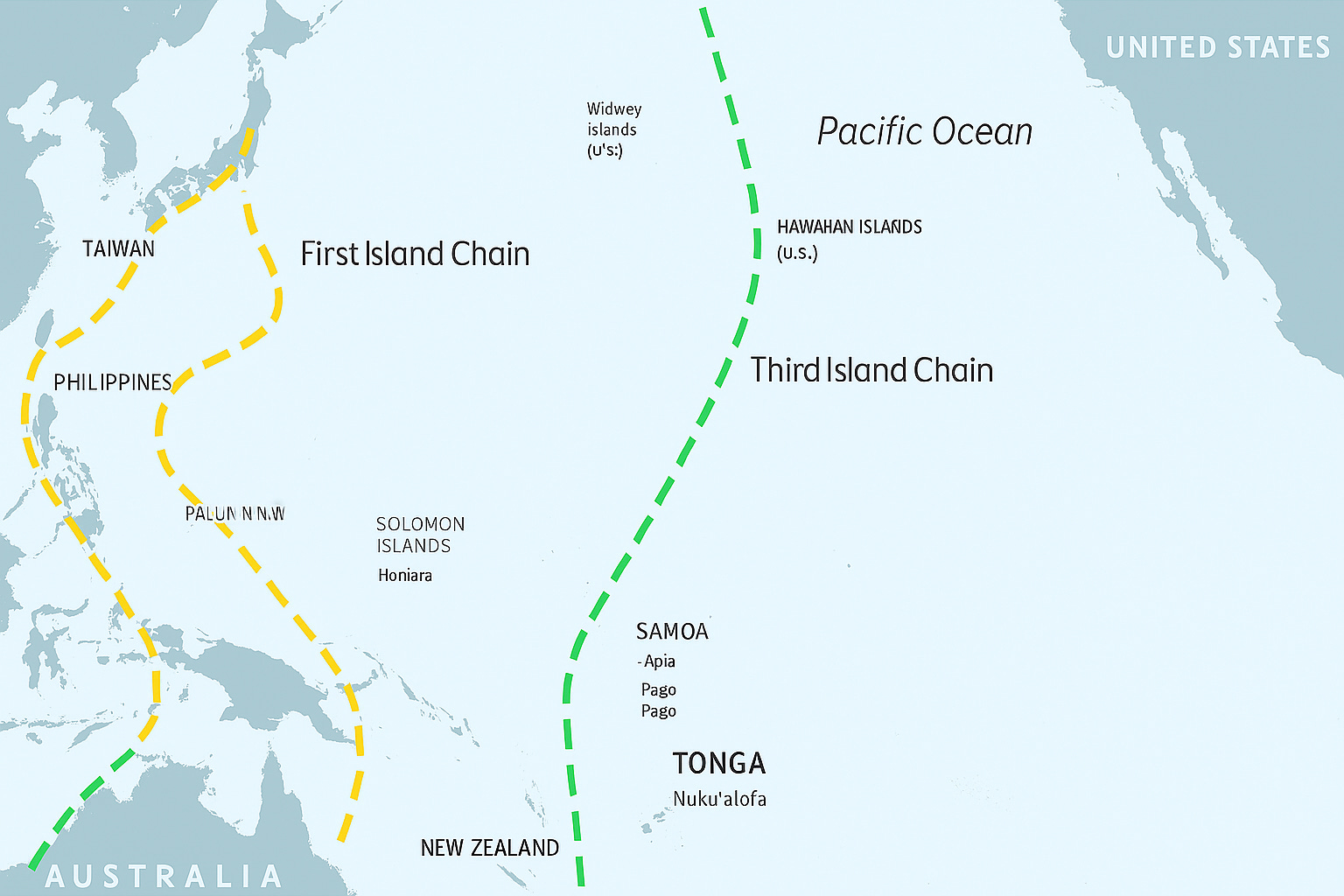
Obviously, Washington is not watching passively the extensive Chinese military buildup of conventional and nuclear forces. America is responding by reinforcing key positions with Patriot missile batteries in Okinawa and Guam, launching a new joint command with Japan in Tokyo, and leading major multinational drills like Cobra Gold in Thailand, which drew military participation from 30 nations (Wall Street Journal 2025). Moreover, Washington’s close allies are increasing their military footprint. In this regard, Tokyo is on track to hit 2% of GDP in defense spending by 2027, while Seoul is already at about 2.8%. Japan is also teaming up with the UK and Italy to co-develop next-gen fighter jets (Financial Times 2025). These developments indicate not just defense upgrades as they are parts of a new U.S. Island chain strategy aimed at locking in control over critical chokepoints and boxing in China’s naval ambitions (CSIS 2025).
The Architecture of Influence: Diplomacy, Alliances, and Strategic Leverage
“What we are witnessing is Washington’s move from the traditional, bilateral alliances towards a real regional security structure, something closer to a Pacific NATO” (Brookings 2025). The U.S. after decades of bilateral agreements, is changing course. Now, we are witnessing the systematic attempt for the creation of a unified defense pact which will bring key partners, like Japan, Australia, and the Philippines, under one coordinated strategy to counter China.
Nonetheless, this contemporary American strategy in the Indo-Pacific is far from uncontested. China, for its part, is monitoring closely the American moves in the region, scrutinizing every alliance, deployment, and shift in posture. Simultaneously, Beijing is actively working to undercut Washington’s momentum by exploiting strategic ambiguity, signaling gaps, and allied fatigue. To sustain credibility, the U.S. must stop being vague by making their red lines explicit, prepare for crises jointly with partners, and institutionalize deeper defense and diplomatic coordination (Carnegie Endowment 2025).
Moreover, U.S. allies bring their own strategic priorities on the table, often diverging from Washington’s focus. South Korea remains primarily preoccupied with threats from the North, wile the Philippines shows hesitancy around direct involvement in Taiwan contingency. These gaps present real barriers to deeper regional integration (CSIS 2025). Although, a shared unease over China’s rise exists, it has yet to crystallize into a unified and durable defense architecture.